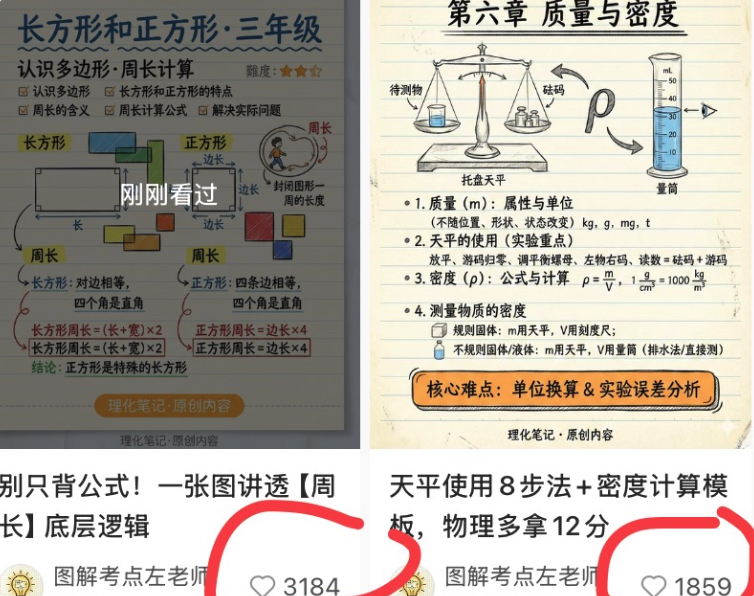
Chinese Study Card Social Screenshot
Generates a two-column social media screenshot featuring Chinese math and physics educational infographic cards with captions and circled like counts.
Dette er et tilfelle av en GPT Image 2 -ledetekst for Grafikk og plakat . Bruk den kopieringsklare ledeteksten nedenfor for å generere lignende visuelle elementer, og gjennomgå Awesome GPT Image 2 Prompts -attribusjonen pluss kommersielle bruksrettigheter før gjenbruk.
Trenger du hele settet med ledetekster? Bruk Grafikk og plakat emnehub for flere relaterte eksempler, eller åpne GPT Image 2 rask katalog for den fullstendige eksempelindeksen, gjenbrukbare strukturer og kildeattribusjon.
Free 1K preview
Generate one preview image instantly, no sign-up required.
4000/4000
Spørsmål
Klar til kopiering
Objective: Create a square social media collage screenshot showcasing two Chinese learning card posts side-by-side, resembling a portfolio preview of work by creators of elementary school math and science visual notes.

Canvas: A square screenshot crop of 756x628 pixels, with a white background, divided into left and right columns. Each column contains an educational note image at the top, followed by a partial social media title area. The overall appearance should present a slightly compressed feel, similar to a phone screenshot, with soft shadows and edge cropping.

Layout: Use 2 post cards. Left post: A math knowledge card about rectangles and squares for grade 3, located in the upper left, with the title and number of likes displayed below. Right post: A physics knowledge card about mass and density, located in the upper right, with the title and number of likes displayed below. Add bold, hand-drawn red marker circles around the two like areas, slightly cropped at the bottom.

Left Card Details: Beige lined notebook paper background with blue and black handwritten Chinese. Title text: {argument name="left card title" default="Rectangle and Square · Grade 3"}. Subtitle: “Recognizing Polygons · Perimeter Calculation”. The upper right corner includes a 3-star orange difficulty rating. The card contains 2 main illustration sections: one labeled “Rectangle”, showing a rectangle with length and width arrows; and another labeled “Square”, showing a square with equal side length labels. Include 4 colored small squares/rectangles around the illustrations: blue, green, orange, and yellow. Include a small circular illustration of a person walking around the shape to explain the perimeter. Add a semi-transparent dark mask in the center of the card with large white text “Just Viewed”. The bottom formulas and notes explain the perimeter of a rectangle and the perimeter of a square, including boxed formulas such as “Rectangle Perimeter = (Length + Width) × 2” and “Square Perimeter = Side Length × 4”. Add an orange rounded capsule label at the bottom that reads “Physics and Chemistry Notes · Original Content”.

Right Card Details: Beige lined notebook paper background with neat black handwritten Chinese. Title text: {argument name="right card title" default="Chapter Six: Mass and Density"}. The top includes 3 main science object illustrations: a balance scale with items and weights, a horseshoe magnet with arrows, and a graduated cylinder with blue liquid. Add labels such as “Object to be measured”, “Weights”, “Balance Scale”, and “Graduated Cylinder”. Below, include 4 numbered learning sections: 1. Mass and Units, 2. Steps for Using a Balance Scale, 3. Density Formula and Units, 4. Density Measurement. Show the density formula “ρ=m/V” and unit conversions, including “1 g/cm³ = 1000 kg/m³”. Add an orange rounded rectangular annotation at the bottom that reads “Key Difficulties: Unit Conversion & Experimental Error Analysis”, along with small text at the bottom that reads “Physics and Chemistry Notes · Original Content”.

Bottom Social Media Area: Below the left card, display a bold Chinese title starting with “Don’t just memorize formulas! Understand the underlying logic of [Perimeter] in one diagram”. Below the right card, display a bold Chinese title starting with “8 Steps for Using a Balance Scale + Density Calculation Template, Get 12 More Points in Physics”. Below each title, display a small circular avatar with a yellow light bulb icon and the creator’s name “Teacher Zuo of Illustrated Exam Points”. Display 2 visible like widgets, each with a gray outline heart icon and a number: left side likes {argument name="left like count" default="3184"}, right side likes {argument name="right like count" default="1859"}. Circle these two like widgets with bold red hand-drawn markers.

Visual Style: Concise Chinese educational infographic cards, hand-drawn textbook aesthetics, lined paper texture, soft pastel chart colors, black/blue handwritten annotations, orange emphasis boxes, realistic screenshot cropping, no photorealistic people except for small, simple illustrations, no watermarks except for the displayed creator/footer text.

Constraints: All visible text must be in Chinese in the specified locations. No more than 2 post cards, no more than 3 science objects at the top of the right card, no more than 2 main geometric illustrations on the left card, no more than 4 numbered sections on the right card, and no more than 2 circled like widgets.
Promptvariabler
Redigerbare argumentplassholdere funnet i ledeteksten, med standardverdiene.
Variabel
left card title
Misligholde
Rectangle and Square · Grade 3
Variabel
right card title
Misligholde
Chapter Six: Mass and Density
Variabel
left like count
Misligholde
3184
Variabel
right like count
Misligholde
1859
Best for
- - Grafikk og plakat visual exploration
- - Image generation and reference-image edits
- - Reusable briefs that keep source attribution visible
Change these parts
- - Subject, product, character, or scene
- - Aspect ratio, camera, lighting, and background
- - Brand, text, color, and output constraints
Recommended model and settings
- - Model: gpt-image-2
- - Input mode: Tekst til bilde
- - Aspect ratio: source
- - Commercial status: review original source
How to use this prompt
- 1. Copy the prompt and preserve its structure for the first test.
- 2. Replace the subject, context, and publishing channel.
- 3. Change one camera, lighting, or style variable per iteration.
- 4. Inspect the output, source, text, and rights before reuse.
Limitations, source, and reuse cautions
- - Generated output is an editable draft, not factual, legal, or rights evidence.
- - Review the linked source, people, brands, logos, text, and third-party media before commercial use.
Importert fra Awesome GPT Image 2 Prompts . Attribusjon kreves. Status for kommersiell bruk er allowed ; sjekk kilderettighetene før betalt bruk.
Flere saker i denne kategorien
Prioritert etter kategori, kompatibilitet med inndatamodus, kvalitet og lavere risiko.
Gjenbruk og kildenotater
Bruk denne ledeteksten på en trygg måte etter at du har forhåndsvist saken.
- 1.Kopier ledeteksten eller åpne den direkte i Dovoo med genereringsknappen.
- 2.Juster variabler, sideforhold og referansebilder for ditt eget brukstilfelle.
- 3.Før publisering eller betalt bruk, kontroller kilderettigheter, krav til kreditering og risikoer knyttet til merkevare eller likhet.