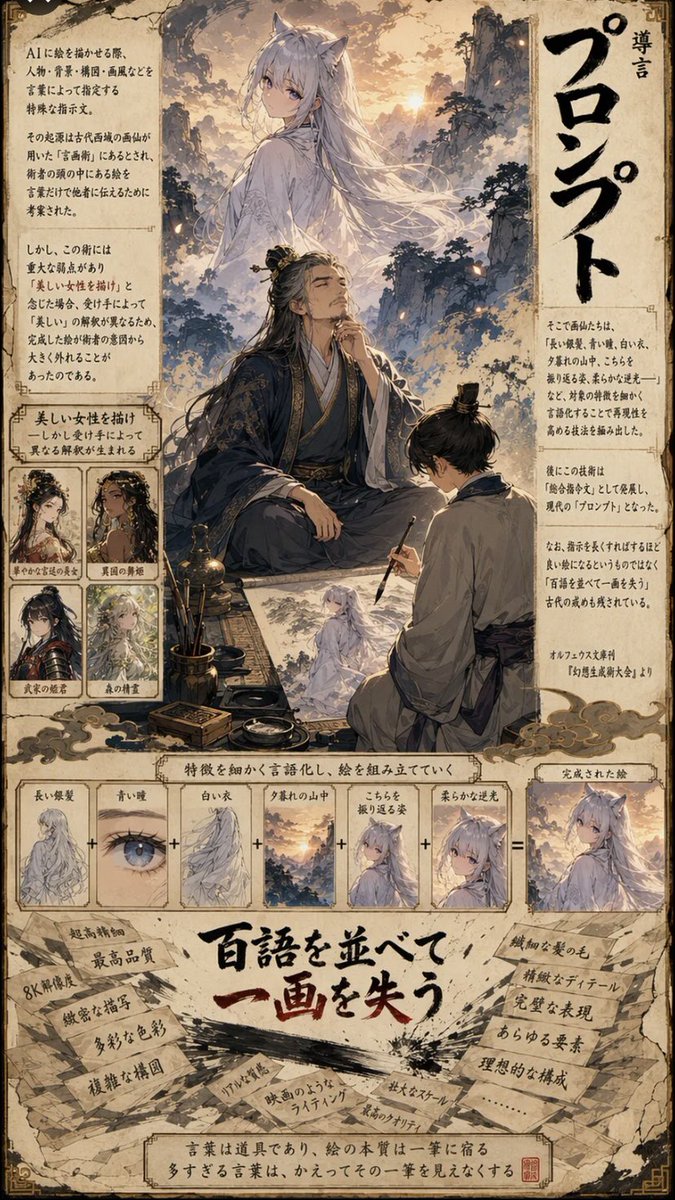
Manga Infographic: AI Prompt Engineering
A stylized manga page illustrating the concept of prompt engineering for AI image generation, featuring a kitsune character and a breakdown of visual elements.
Questo è un esempio di prompt GPT Image 2 per Grafica e poster . Utilizza il prompt pronto per la copia qui sotto per generare immagini simili e verifica l'attribuzione Awesome GPT Image 2 Prompts e i diritti di utilizzo commerciale prima del riutilizzo.
Hai bisogno del set completo di prompt? Usa il Grafica e poster hub tematico per ulteriori esempi correlati oppure apri il GPT Image 2 catalogo rapido per l'indice completo degli esempi, le strutture riutilizzabili e l'attribuzione delle fonti.
Free 1K preview
Generate one preview image instantly, no sign-up required.
2013/4000
Richiesta
prompt pronto per la copia
A vertical, highly detailed manga-style infographic page with a parchment-like background. The layout is divided into three main sections: a top illustration area, a middle diagrammatic breakdown, and a bottom text-heavy conclusion.

Top Section:
- A large, ethereal illustration of a woman with long white hair and fox ears (a kitsune) standing on a mountain peak at sunset. She wears flowing white robes.
- Below her, an elderly man with long black hair tied back, wearing dark blue traditional Chinese robes, sits cross-legged holding a calligraphy brush, looking up thoughtfully.
- To his right, a younger man in grey robes kneels, sketching the kitsune onto paper.
- Surrounding this scene are blocks of Japanese text explaining the concept of 'Prompt' (プロンプト).
- On the left side, there are four small square character portraits labeled with descriptions like 'Beautiful Woman', 'Dancer', etc., showing variations of female characters.
- Large vertical Japanese text on the right reads 'Introduction to Prompts'.

Middle Section:
- A horizontal flow diagram titled 'Verbalizing features to compose a picture'.
- It shows a sequence of six small square images connected by plus signs (+), leading to an equals sign (=) and a final result image.
- The sequence includes: 1. Long silver hair, 2. Blue eyes, 3. White clothes, 4. Mountain sunset, 5. Looking back pose, 6. Soft backlighting.
- The final result is the complete image of the kitsune from the top section.

Bottom Section:
- A large, bold Japanese headline in red and black ink style: "Listing hundreds of words loses one stroke" (百語を並べて一画を失う).
- Surrounding the headline are torn pieces of paper with handwritten notes listing negative effects of over-prompting, such as '8K resolution', 'ultra-high quality', 'complex composition', 'unnatural lighting', 'film-like lighting', 'large scale', 'highest quality'.
- At the very bottom, a concluding sentence in a box states that words are tools, but too many obscure the essence of the single stroke.
Best for
- - Grafica e poster visual exploration
- - Image generation and reference-image edits
- - Reusable briefs that keep source attribution visible
Change these parts
- - Subject, product, character, or scene
- - Aspect ratio, camera, lighting, and background
- - Brand, text, color, and output constraints
Recommended model and settings
- - Model: gpt-image-2
- - Input mode: Testo in immagine
- - Aspect ratio: source
- - Commercial status: review original source
How to use this prompt
- 1. Copy the prompt and preserve its structure for the first test.
- 2. Replace the subject, context, and publishing channel.
- 3. Change one camera, lighting, or style variable per iteration.
- 4. Inspect the output, source, text, and rights before reuse.
Limitations, source, and reuse cautions
- - Generated output is an editable draft, not factual, legal, or rights evidence.
- - Review the linked source, people, brands, logos, text, and third-party media before commercial use.
Importato da Awesome GPT Image 2 Prompts . È richiesta l'attribuzione. Lo stato di utilizzo commerciale è allowed ; verificare i diritti della fonte prima dell'utilizzo a pagamento.
Altri casi in questa categoria
Prioritizzazione in base a categoria, compatibilità della modalità di input, qualità e minor rischio.
Note sul riutilizzo e sulla fonte
Utilizza questo prompt in tutta sicurezza dopo aver visualizzato in anteprima il caso.
- 1.Copia il prompt oppure aprilo direttamente in Dovoo tramite il pulsante di generazione.
- 2.Regola le variabili, le proporzioni e le immagini di riferimento in base alle tue esigenze.
- 3.Prima della pubblicazione o dell'utilizzo a pagamento, verificare i diritti di fonte, i requisiti di attribuzione e i rischi relativi al marchio o all'immagine.