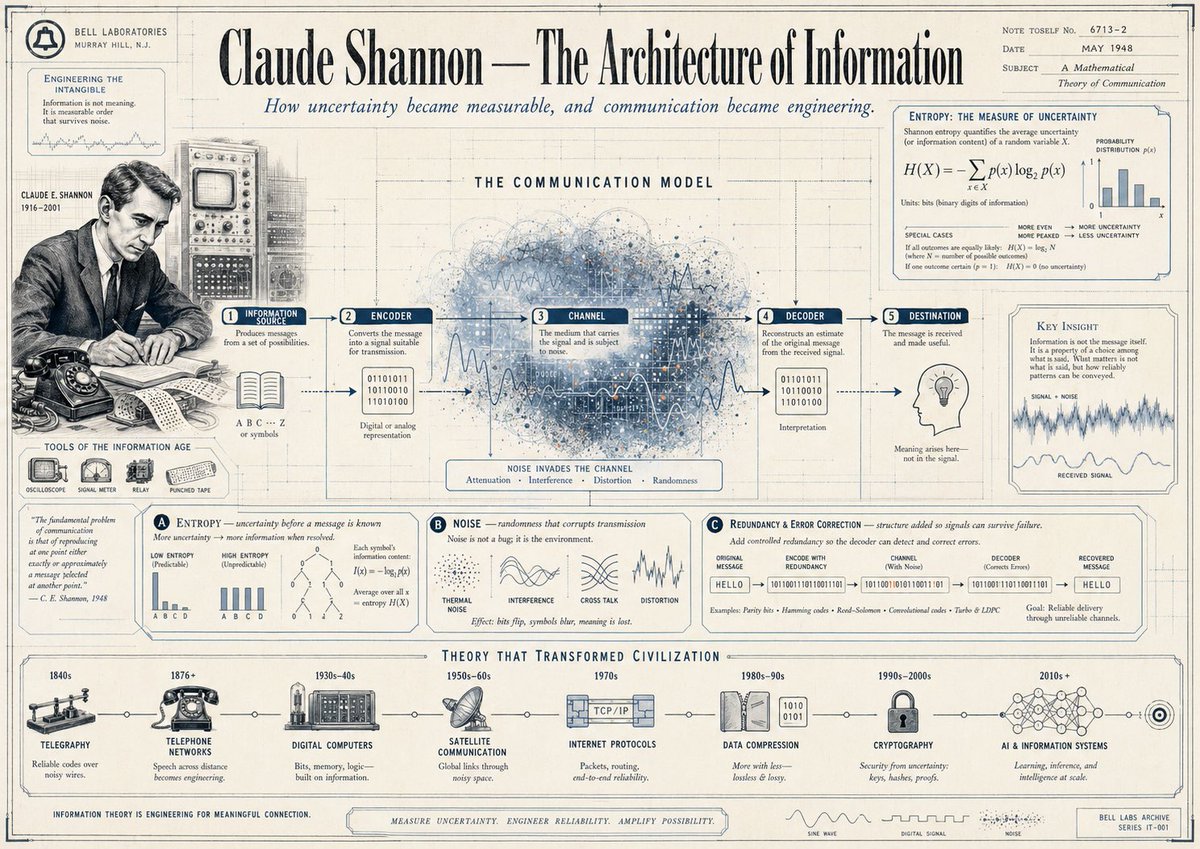
Affiche infographique vintage de Claude Shannon
Cette invite génère une affiche éducative dense, de style rétro Bell Labs, sur Claude Shannon et la théorie de l'information, idéale pour des illustrations historiques éditoriales ou des œuvres d'art murales scientifiques de style muséal.
Il s'agit d'un exemple de visuel pour la catégorie { GPT Image 2 Graphique et affiche . Utilisez le visuel ci-dessous pour générer des éléments visuels similaires et vérifiez les conditions d'utilisation (attribution Awesome GPT Image 2 Prompts et droits d'utilisation commerciale) avant toute réutilisation.
Free 1K preview
Generate one preview image instantly, no sign-up required.
Prompt
invite prête à être copiée
{
  "aspectRatio": "16:9 landscape",
  "color": {
    "accent": "faded steel blue",
    "background": "warm ivory paper",
    "primaryInk": "dark navy",
    "secondaryInk": "charcoal gray"
  },
  "composition": "symmetrical wide poster with dense boxed annotations, fine border lines, and a museum-quality educational infographic feel",
  "layout": {
    "centerpiece": "a large abstract cloud of blue and gray signal noise, dots, lines, and waveforms behind the communication model, with arrows moving left to right through the five stages",
    "sections": [
      {
        "count": 5,
        "labels": [
          "BELL LABORATORIES MURRAY HILL, N.J.",
          "ENGINEERING THE INTANGIBLE",
          "CLAUDE E. SHANNON 1916–2001",
          "TOOLS OF THE INFORMATION AGE",
          "quote panel"
        ],
        "position": "far left vertical column",
        "title": "left archival sidebar"
      },
      {
        "count": 5,
        "labels": [
          "1 INFORMATION SOURCE",
          "2 ENCODER",
          "3 CHANNEL",
          "4 DECODER",
          "5 DESTINATION"
        ],
        "position": "upper middle wide panel",
        "title": "THE COMMUNICATION MODEL"
      },
      {
        "count": 4,
        "labels": [
          "H(X) = −Σ p(x) log₂ p(x)",
          "PROBABILITY DISTRIBUTION p(x)",
          "MORE EVEN MORE MAXED UNCERTAINTY",
          "MORE LOPSIDED LESS UNCERTAINTY"
        ],
        "position": "upper right box",
        "title": "ENTROPY: THE MEASURE OF UNCERTAINTY"
      },
      {
        "count": 3,
        "labels": [
          "A ENTROPY — uncertainty before a message is known",
          "B NOISE — randomness that corrupts transmission",
          "C Redundancy & Error Correction — structure added so signals can survive failure"
        ],
        "position": "middle to lower band",
        "title": "lower theory panels"
      },
      {
        "count": 8,
        "labels": [
          "1840s TELEGRAPHY",
          "1876+ TELEPHONE NETWORKS",
          "1930s–40s DIGITAL COMPUTERS",
          "1950s–60s SATELLITE COMMUNICATION",
          "1970s INTERNET PROTOCOLS",
          "1980s–90s DATA COMPRESSION",
          "1990s–2000s CRYPTOGRAPHY",
          "2010s+ AI & INFORMATION SYSTEMS"
        ],
        "position": "bottom horizontal timeline",
        "title": "THEORY THAT TRANSFORMED CIVILIZATION"
      }
    ]
  },
  "poster": {
    "headline": "Claude Shannon — The Architecture of Information",
    "subheadline": "How uncertainty became measurable, and communication became engineering.",
    "topRightMeta": {
      "date": "MAY 1948",
      "note": "NOTE TOSELF No. 6713–2",
      "subject": "A Mathematical Theory of Communication"
    }
  },
  "style": {
    "era": "1940s Bell Labs archival poster",
    "look": "aged cream paper, blueprint drafting grid, thin ink linework, muted navy and charcoal printing, subtle stains and paper wear, technical illustration mixed with newspaper editorial design",
    "rendering": "high-detail diagrammatic collage with engraved portrait, scientific charts, labeled panels, and hand-drawn signal graphics"
  },
  "subject": "Claude Shannon and information theory",
  "textDensity": "very high, with many small labels, formulas, captions, and historical notes in a carefully organized grid",
  "type": "vintage editorial infographic poster",
  "visualElements": {
    "bottomDecor": [
      "small waveform legend with sine wave, digital signal, and noise",
      "archival stamp or footer on lower right"
    ],
    "chartsAndDiagrams": [
      "bar chart for entropy probabilities",
      "two low vs high entropy mini bar charts",
      "tree diagram and entropy notation",
      "signal distortion sketches labeled thermal noise, cross talk, distortion",
      "error-correction binary pipeline from original message to recovered message"
    ],
    "communicationModel": [
      "book and symbols under source",
      "binary digits under encoder",
      "large noisy channel cloud with wave overlays",
      "binary digits and interpretation under decoder",
      "light bulb icon under destination"
    ],
    "objectsLeft": [
      "rotary telephone on desk",
      "open notebook or papers",
      "technical console with CRT screen and knobs behind portrait",
      "small icon row of 4 tools: oscilloscope, signal meter, relay, punched tape"
    ],
    "portrait": {
      "placement": "left-center",
      "style": "Show every face clearly with natural, detailed facial features, wearing suit and tie, writing on paper",
      "subject": "{argument name=\"scientist name\" default=\"Claude Shannon\"}"
    }
  }
}
Variables d'invite
Espaces réservés aux arguments modifiables présents dans l'invite, avec leurs valeurs par défaut.
Best for
- - Graphique et affiche visual exploration
- - Image generation and reference-image edits
- - Reusable briefs that keep source attribution visible
Change these parts
- - Subject, product, character, or scene
- - Aspect ratio, camera, lighting, and background
- - Brand, text, color, and output constraints
Recommended model and settings
- - Model: gpt-image-2
- - Input mode: Texte vers image
- - Aspect ratio: source
- - Commercial status: review original source
How to use this prompt
- 1. Copy the prompt and preserve its structure for the first test.
- 2. Replace the subject, context, and publishing channel.
- 3. Change one camera, lighting, or style variable per iteration.
- 4. Inspect the output, source, text, and rights before reuse.
Limitations, source, and reuse cautions
- - Generated output is an editable draft, not factual, legal, or rights evidence.
- - Review the linked source, people, brands, logos, text, and third-party media before commercial use.
Plus de cas dans cette catégorie
Priorisé par catégorie, compatibilité du mode d'entrée, qualité et risque moindre.



Réutilisation et notes de source
Utilisez cette invite en toute sécurité après avoir prévisualisé le dossier.
- 1.Copiez l'invite ou ouvrez-la directement dans Dovoo avec le bouton de génération.
- 2.Ajustez les variables, le format d'image et les images de référence en fonction de votre cas d'utilisation.
- 3.Avant toute publication ou utilisation payante, vérifiez les droits d'auteur, les exigences d'attribution et les risques liés à la marque ou à l'image.