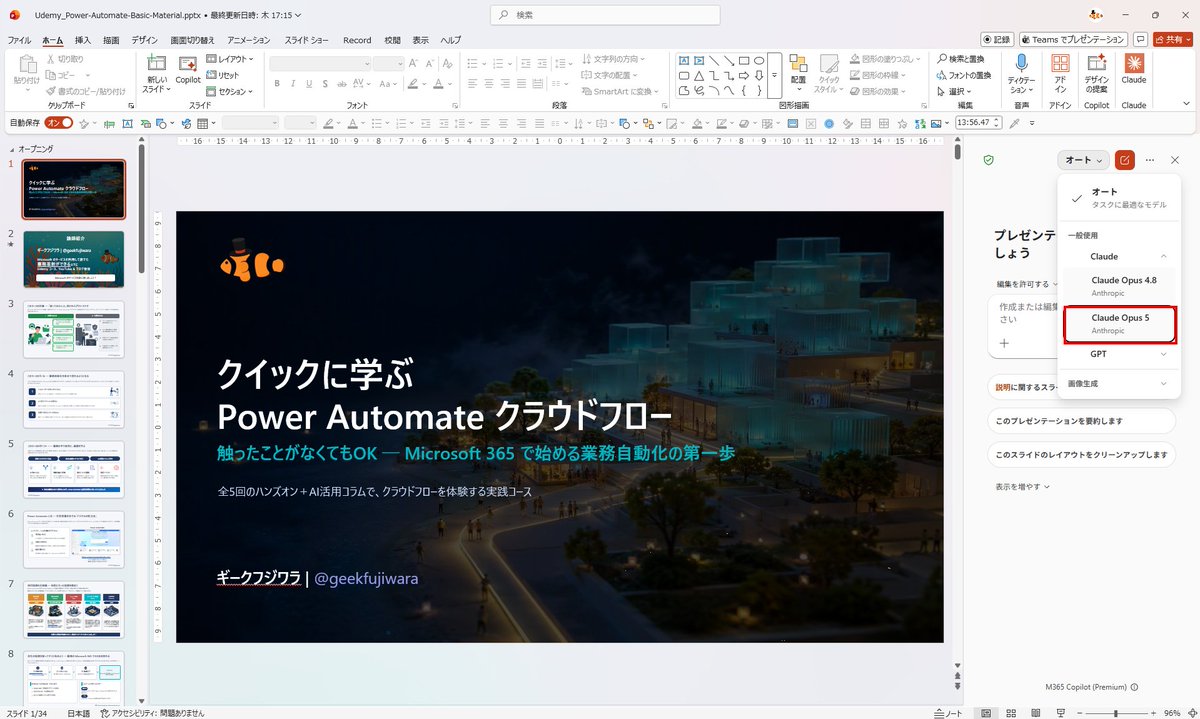
Japanese PowerPoint Claude Opus 5 Screenshot
Generates a realistic Japanese PowerPoint editing screenshot with a dark Power Automate course cover slide and an AI model selector highlighting Claude Opus 5.
Il s'agit d'un exemple de visuel pour la catégorie { GPT Image 2 Autres sources d'inspiration . Utilisez le visuel ci-dessous pour générer des éléments visuels similaires et vérifiez les conditions d'utilisation (attribution Awesome GPT Image 2 Prompts et droits d'utilisation commerciale) avant toute réutilisation.
Free 1K preview
Generate one preview image instantly, no sign-up required.
Free text preview doesn’t preserve reference-image consistency.
Prompt
invite prête à être copiée
Goal: Create a realistic 16:9 desktop screenshot of Microsoft PowerPoint in Japanese, showing a course slide deck being edited with a Copilot/Claude model selection panel open on the right.

Canvas: Wide landscape screenshot, 1200×675 style, crisp UI capture, light gray PowerPoint chrome, no browser frame. The main focus is a PowerPoint editing workspace with a dark title slide centered.

Layout: Show the full PowerPoint window with the ribbon across the top, slide thumbnail strip on the left, main slide canvas in the center, and an AI assistant side panel on the right. Use Japanese UI labels throughout the PowerPoint interface. The file name in the top title area should read {argument name="file name" default="Udemy_Power-Automate-Basic-Material.pptx"}, followed by a Japanese last-updated note and time. The top ribbon should include Japanese tabs such as File, Home, Insert, Draw, Design, Transitions, Animations, Slide Show, Record, Review, View, and Help, plus add-in buttons for Copilot, PowerPoint, Designer, Claude, Teams presentation, and Share.

Left thumbnail strip: Show exactly 8 visible slide thumbnails, numbered 1 through 8. Slide 1 is selected with an orange border and is the same dark cover slide as the main canvas. Slide 2 is a teal agenda/overview slide. Slide 3 is a white process/workflow slide with green diagram elements and two illustrated people. Slide 4 is a white slide with three horizontal list rows. Slide 5 is a white slide with a blue interface screenshot and arrows. Slide 6 is a white slide with a software screenshot and callout box. Slide 7 is a white slide with a row of colorful cards and icon illustrations. Slide 8 is a white slide with a flowchart-like screenshot and a turquoise callout.

Main slide: Create a dark cinematic cover slide with a black-to-navy overlay over an architectural night scene: glowing modern stacked glass buildings on the right, misty atmosphere, pathways and tiny walking people below, trees in the lower right, and a deep dark empty area on the left for text. In the upper left of the slide place a small orange clownfish mascot wearing a tiny black top hat. The main title text should be large, bold, white Japanese: {argument name="main title text" default="クイックに学ぶ\nPower Automate クラウドフロー"}. Under it, add a cyan subtitle: {argument name="subtitle text" default="触ったことがなくてもOK — Microsoft 365 で始める業務自動化の第一歩"}. Beneath that, add a smaller white description line: {argument name="description line" default="全5回のハンズオン+AI活用コラムで、クラウドフローを体験する実践コース"}. At the bottom left of the slide, add the author line in white: {argument name="author line" default="ギークフジワラ|@geekfujiwara"}. Keep the slide text aligned left with generous spacing.

Right AI panel: Show a white assistant panel titled in Japanese as a presentation-related assistant. At the top right of this panel, show an open model dropdown. The dropdown must contain exactly 5 visible choices: Auto with a checkmark and a short Japanese description, Claude, Claude Opus 4.8, Claude Opus 5, and GPT. Emphasize the Claude Opus 5 row with a red rectangular outline. Under Claude Opus 5, show the provider label Anthropic in small gray text. Include additional Japanese panel buttons below such as opening the presentation, explaining the slide, and cleaning up the slide layout.

Visual style: Make it look like an authentic Microsoft PowerPoint desktop screenshot, with accurate spacing, rulers, ribbon icons, scrollbars, status bar, zoom control, and tiny UI text. Use soft antialiasing, subtle shadows, and realistic Windows app proportions. The image should read as a social-media screenshot demonstrating PowerPoint Agent Mode and multi-model selection.

Constraints: Do not add any extra slide thumbnails beyond the 8 visible thumbnails. Do not obscure the main slide title. Preserve the red highlight around Claude Opus 5. Avoid watermarks, browser tabs, or unrelated windows.
Variables d'invite
Espaces réservés aux arguments modifiables présents dans l'invite, avec leurs valeurs par défaut.
Best for
- - Autres sources d'inspiration visual exploration
- - Image generation and reference-image edits
- - Reusable briefs that keep source attribution visible
Change these parts
- - Subject, product, character, or scene
- - Aspect ratio, camera, lighting, and background
- - Brand, text, color, and output constraints
Recommended model and settings
- - Model: gpt-image-2
- - Input mode: Image vers image
- - Aspect ratio: source
- - Commercial status: review original source
How to use this prompt
- 1. Copy the prompt and preserve its structure for the first test.
- 2. Replace the subject, context, and publishing channel.
- 3. Change one camera, lighting, or style variable per iteration.
- 4. Inspect the output, source, text, and rights before reuse.
Limitations, source, and reuse cautions
- - Generated output is an editable draft, not factual, legal, or rights evidence.
- - Review the linked source, people, brands, logos, text, and third-party media before commercial use.
Plus de cas dans cette catégorie
Priorisé par catégorie, compatibilité du mode d'entrée, qualité et risque moindre.

Réutilisation et notes de source
Utilisez cette invite en toute sécurité après avoir prévisualisé le dossier.
- 1.Copiez l'invite ou ouvrez-la directement dans Dovoo avec le bouton de génération.
- 2.Ajustez les variables, le format d'image et les images de référence en fonction de votre cas d'utilisation.
- 3.Avant toute publication ou utilisation payante, vérifiez les droits d'auteur, les exigences d'attribution et les risques liés à la marque ou à l'image.