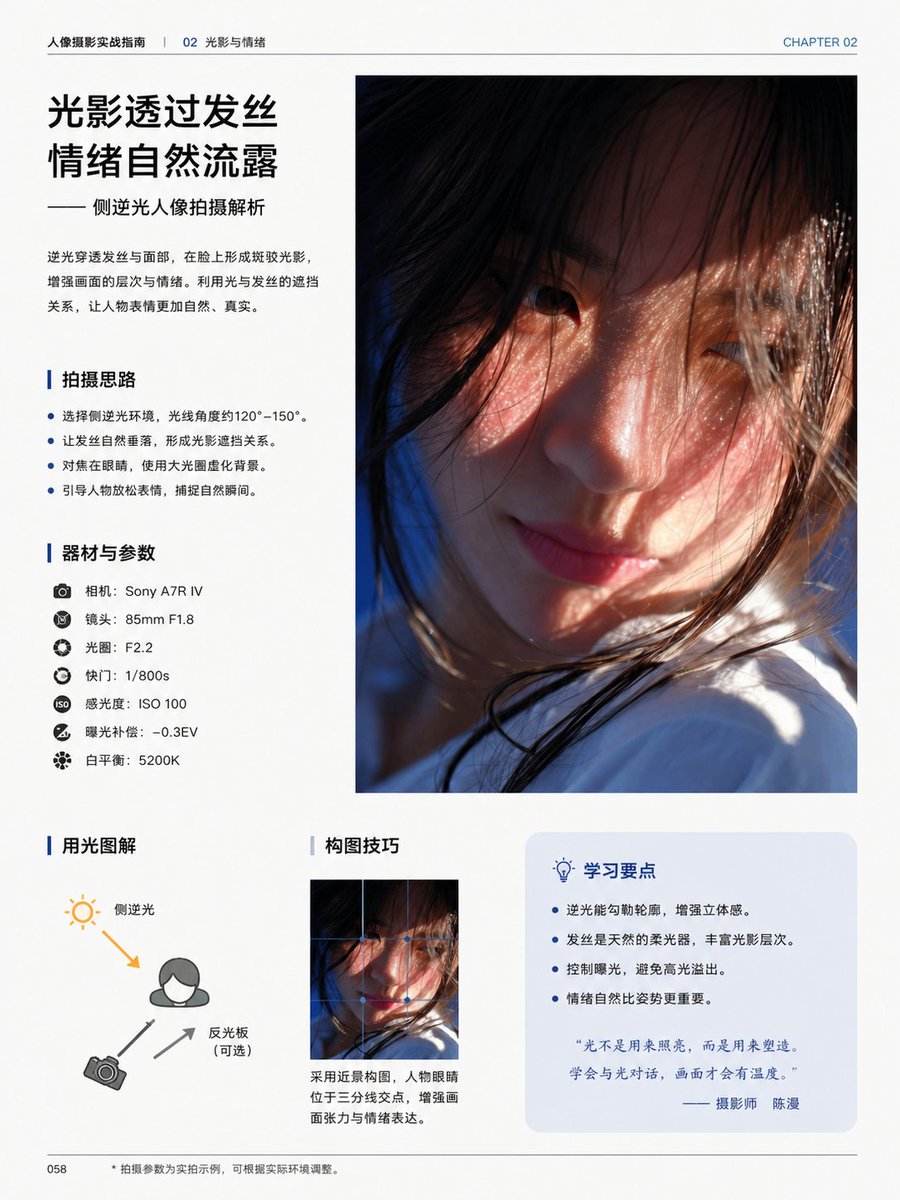
Livre de tutoriels sur la photographie chinoise
Cela génère une page de livre éditoriale chinoise soignée, enseignant la photographie de portrait en contre-jour, adaptée aux doubles pages de magazines, aux guides de photographie et aux maquettes de mise en page haut de gamme.
Il s'agit d'un exemple de visuel pour la catégorie { GPT Image 2 Graphique et affiche . Utilisez le visuel ci-dessous pour générer des éléments visuels similaires et vérifiez les conditions d'utilisation (attribution Awesome GPT Image 2 Prompts et droits d'utilisation commerciale) avant toute réutilisation.
Free 1K preview
Generate one preview image instantly, no sign-up required.
Prompt
invite prête à être copiée
{
  "content_blocks": [
    {
      "body": "Backlight penetrates the hair and face, creating mottled light and shadow on the face, enhancing the layers and emotions of the picture. Utilizing the relationship between light and hair occlusion, the subject's expression becomes more natural and authentic.",
      "kind": "headline_block",
      "position": "top-left",
      "subtitle": "—— Analysis of Sideways Backlit Portrait Photography",
      "title": "{argument name=\"headline text\" default=\"Light and shadow pass through the hair\nEmotions are naturally revealed\"}"
    },
    {
      "count": 1,
      "description": "large vertical portrait photo occupying the upper-right half of the page, cinematic close-up of a young woman in side backlight, warm sunlight passing through loose hair strands, soft skin tones, shallow depth of field, Show every face clearly with natural, detailed facial features, white clothing visible near the bottom, emotional and intimate atmosphere",
      "kind": "main_photo",
      "position": "top-right"
    },
    {
      "count": 4,
      "items": [
        "Choose a sideways backlit environment, with a light angle of approximately 120°–150°.",
        "Let the strands of hair fall naturally, creating a relationship of light and shadow obstruction.",
        "Focus on the eyes, using a large aperture to blur the background.",
        "Guide the subject to relax their expression and capture natural moments."
      ],
      "kind": "bullet_section",
      "position": "mid-left",
      "title": "Shooting Ideas"
    },
    {
      "count": 7,
      "items": [
        "Camera: {argument name=\"camera model\" default=\"Sony A7R IV\"}",
        "Lens: 85mm F1.8",
        "Aperture: F2.2",
        "Shutter Speed: 1/800s",
        "ISO: ISO 100",
        "Exposure Compensation: -0.3EV",
        "White balance: 5200K"
      ],
      "kind": "gear_section",
      "position": "left-center",
      "title": "Equipment and Parameters"
    },
    {
      "count": 3,
      "description": "simple lighting diagram with a person icon, sun icon at upper left, camera icon at lower left, one orange arrow showing back-side light direction toward the subject, two gray arrows indicating camera and reflector relationship",
      "kind": "diagram_section",
      "labels": [
        "Side backlight",
        "Reflector (optional)",
        "Camera"
      ],
      "position": "bottom-left",
      "title": "Lighting explained with diagrams"
    },
    {
      "caption": "Use a close-up composition with the subject's eyes positioned at the intersection of the rule of thirds to enhance visual tension and emotional expression.",
      "count": 1,
      "image": "small vertical crop of the same portrait image",
      "kind": "composition_section",
      "position": "bottom-center",
      "title": "Composition Techniques"
    },
    {
      "count": 4,
      "items": [
        "Backlighting can outline the subject and enhance three-dimensionality.",
        "Hair acts as a natural softbox, enriching the layers of light and shadow.",
        "Control exposure to avoid blown highlights.",
        "Natural emotion is more important than posing."
      ],
      "kind": "tips_box",
      "position": "bottom-right",
      "quote": "“Light isn't used to illuminate, but to shape. Learn to communicate with light, and your images will have warmth.” — Photographer {argument name=\"photographer name\" default=\"Chen Man\"}",
      "title": "Key Learning Points"
    }
  ],
  "footer": {
    "center": "• Shooting parameters are examples from actual shooting, and can be adjusted according to the actual environment.",
    "left": "058"
  },
  "page": {
    "chapter_label": "CHAPTER 02",
    "header_left": "Portrait Photography Practical Guide | 02 Light and Emotion",
    "page_number": "058",
    "size": "single portrait-oriented book page"
  },
  "style": "clean modern Chinese magazine layout, minimalist white background, professional typography, generous margins, thin divider lines, blue accent color, premium print design",
  "type": "editorial photography tutorial book page",
  "visual_notes": "all body text in simplified Chinese, headings in bold black Chinese type, blue vertical accent bars before section titles, pale blue rounded rectangle behind the tips box, realistic print-ready editorial composition, high-end educational photography book aesthetic"
}
Variables d'invite
Espaces réservés aux arguments modifiables présents dans l'invite, avec leurs valeurs par défaut.
Best for
- - Graphique et affiche visual exploration
- - Image generation and reference-image edits
- - Reusable briefs that keep source attribution visible
Change these parts
- - Subject, product, character, or scene
- - Aspect ratio, camera, lighting, and background
- - Brand, text, color, and output constraints
Recommended model and settings
- - Model: gpt-image-2
- - Input mode: Texte vers image
- - Aspect ratio: source
- - Commercial status: review original source
How to use this prompt
- 1. Copy the prompt and preserve its structure for the first test.
- 2. Replace the subject, context, and publishing channel.
- 3. Change one camera, lighting, or style variable per iteration.
- 4. Inspect the output, source, text, and rights before reuse.
Limitations, source, and reuse cautions
- - Generated output is an editable draft, not factual, legal, or rights evidence.
- - Review the linked source, people, brands, logos, text, and third-party media before commercial use.
Plus de cas dans cette catégorie
Priorisé par catégorie, compatibilité du mode d'entrée, qualité et risque moindre.

Réutilisation et notes de source
Utilisez cette invite en toute sécurité après avoir prévisualisé le dossier.
- 1.Copiez l'invite ou ouvrez-la directement dans Dovoo avec le bouton de génération.
- 2.Ajustez les variables, le format d'image et les images de référence en fonction de votre cas d'utilisation.
- 3.Avant toute publication ou utilisation payante, vérifiez les droits d'auteur, les exigences d'attribution et les risques liés à la marque ou à l'image.