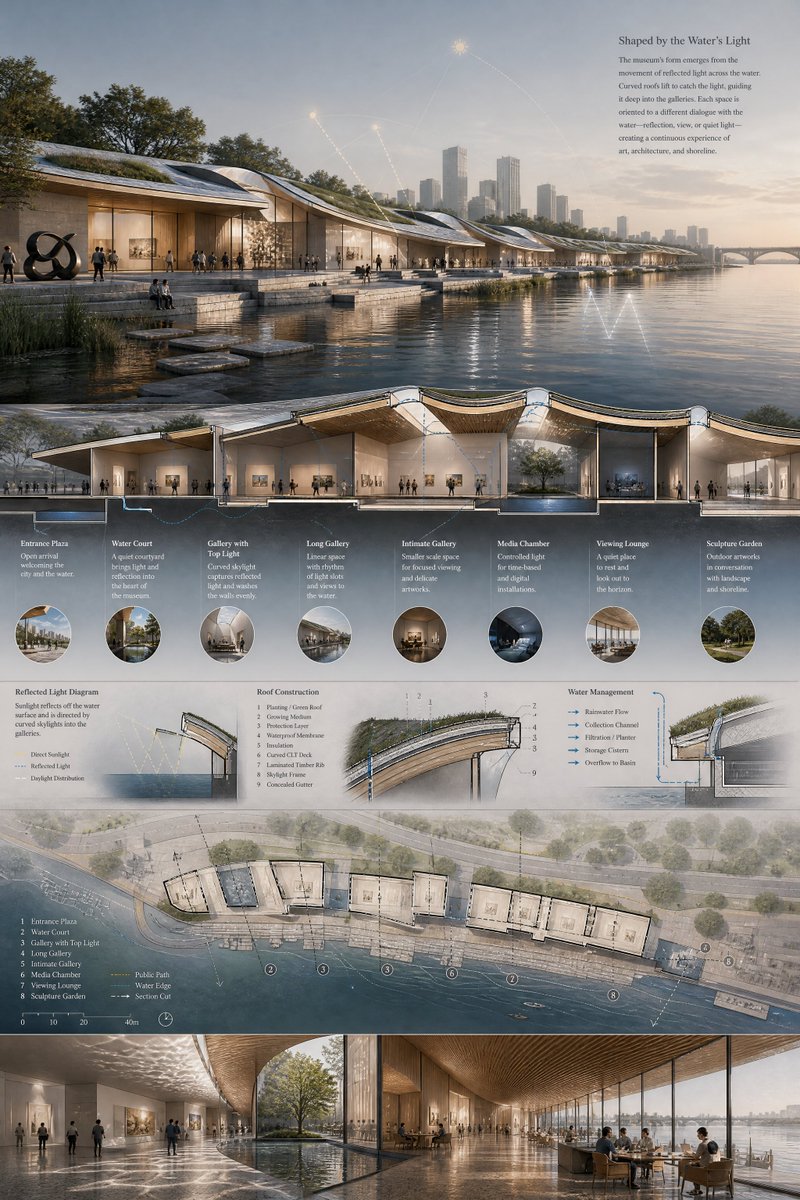
Junta de Arquitectura del Museo de la Ribera
Genera un panel de presentación arquitectónica vertical detallado para un museo reflectante frente al mar, con representaciones, secciones, diagramas, planos e interiores.
Este es un ejemplo GPT Image 2 para Interiorismo y arquitectura . Utilice la plantilla lista para copiar que aparece a continuación para generar imágenes similares y revise la atribución de Awesome GPT Image 2 Prompts y los derechos de uso comercial antes de reutilizarla.
Free 1K preview
Generate one preview image instantly, no sign-up required.
Prompt
Mensaje listo para copiar
Goal: Create a tall architectural presentation board for a waterfront museum concept titled {argument name="project title" default="Shaped by the Water's Light"}, showing how reflected daylight from a river shapes the building form, galleries, and landscape.

Canvas: Vertical 2:3 architectural competition board, muted warm-gray and blue palette, photorealistic renderings mixed with technical diagrams, thin serif typography, calm museum atmosphere at golden hour.

Main hero rendering: At the top, show a long low riverside museum stretching horizontally along the water. The building has a gently undulating green roof with curved skylight openings and warm glowing glass gallery walls below. The river occupies the foreground with mirrorlike reflections; a city skyline rises in the hazy distance, trees line the promenade, and a bridge appears far right. Add small human figures walking along the quay and entering the museum. Include subtle white diagram lines arcing from a glowing sun point to the roof, water, and reflected light patterns on the river.

Top-right text block: Set a small title reading "Shaped by the Water's Light" with a short poetic paragraph explaining that the museum's form emerges from reflected light across the water, curved roofs catch the light, and galleries are oriented to a dialogue between water, reflection, view, and quiet light.

Middle sectional perspective: Below the hero image, include one long horizontal cutaway section through the museum, revealing exactly 8 labeled spaces from left to right: 1) Entrance Plaza, 2) Water Court, 3) Gallery with Top Light, 4) Long Gallery, 5) Intimate Gallery, 6) Media Chamber, 7) Viewing Lounge, 8) Sculpture Garden. Each label should have a short descriptive caption underneath and a small circular thumbnail image below it. Show warm interior galleries, visitors, display walls, tree courts, water channels, structural columns, curved roof layers, skylights, and reflected light bouncing from the water into the interiors.

Technical diagram band: Under the section, include exactly 3 technical diagrams: a "Reflected Light Diagram" showing sun, water surface, dashed reflection rays, direct sunlight, reflected light, and daylight distribution; a "Roof Construction" detail showing a layered curved roof assembly with numbered callouts including green roof planting, growing medium, protection layer, waterproof membrane, insulation, curved CLT deck, laminated timber rib, skylight frame, and concealed gutter; and a "Water Management" detail showing rainwater flow, collection channel, filtration planter, storage cistern, and overflow to basin with blue arrows.

Plan drawing: Add a wide site plan beneath the diagrams, viewed from above, showing the long museum footprint following the river edge. Include exactly 8 numbered program markers matching the section labels, a public path, water edge, section cut line, contour-like river lines, trees, roads, terraces, small boats, and a scale bar. Use pale beige drawing paper tones with blue-gray water and fine black architectural linework.

Bottom renderings: Along the bottom edge, place exactly 2 large interior perspective renderings side by side. Left: a reflective gallery hall with rippled light patterns on the floor and ceiling, visitors, artworks, and a water court with a tree. Right: a warm wood-ceiling viewing lounge or café with people seated at tables beside full-height glass overlooking the river.

Visual style: Contemporary architectural visualization by {argument name="design studio" default="a competition architecture studio"}, elegant and slightly traditional, warm timber interiors, stone terraces, glass walls, soft daylight, detailed entourage, realistic reflections, atmospheric haze, precise diagram overlays, museum-board layout.

Constraints: Keep the board information-dense but readable; use the exact counts specified: 8 labeled spaces, 8 circular thumbnails, 3 technical diagrams, 8 plan markers, and 2 bottom renderings. Use English text only, thin professional typography, no watermark, no logos, no extra panels.
Variables de solicitud
Marcadores de posición de argumentos editables que se encuentran en la solicitud, con sus valores predeterminados.
Best for
- - Interiorismo y arquitectura visual exploration
- - Image generation and reference-image edits
- - Reusable briefs that keep source attribution visible
Change these parts
- - Subject, product, character, or scene
- - Aspect ratio, camera, lighting, and background
- - Brand, text, color, and output constraints
Recommended model and settings
- - Model: gpt-image-2
- - Input mode: Texto a imagen
- - Aspect ratio: source
- - Commercial status: review original source
How to use this prompt
- 1. Copy the prompt and preserve its structure for the first test.
- 2. Replace the subject, context, and publishing channel.
- 3. Change one camera, lighting, or style variable per iteration.
- 4. Inspect the output, source, text, and rights before reuse.
Limitations, source, and reuse cautions
- - Generated output is an editable draft, not factual, legal, or rights evidence.
- - Review the linked source, people, brands, logos, text, and third-party media before commercial use.
Más casos en esta categoría
Priorizados por categoría, compatibilidad con el modo de entrada, calidad y menor riesgo.
Notas sobre la reutilización y la fuente
Utilice esta opción de forma segura después de previsualizar el caso.
- 1.Copia la solicitud o ábrela directamente en Dovoo con el botón de generación.
- 2.Ajusta las variables, la relación de aspecto y las imágenes de referencia según tus necesidades.
- 3.Antes de publicar o utilizar el servicio de forma remunerada, verifique los derechos de autor, los requisitos de atribución y los riesgos relacionados con la marca o la imagen de la persona.