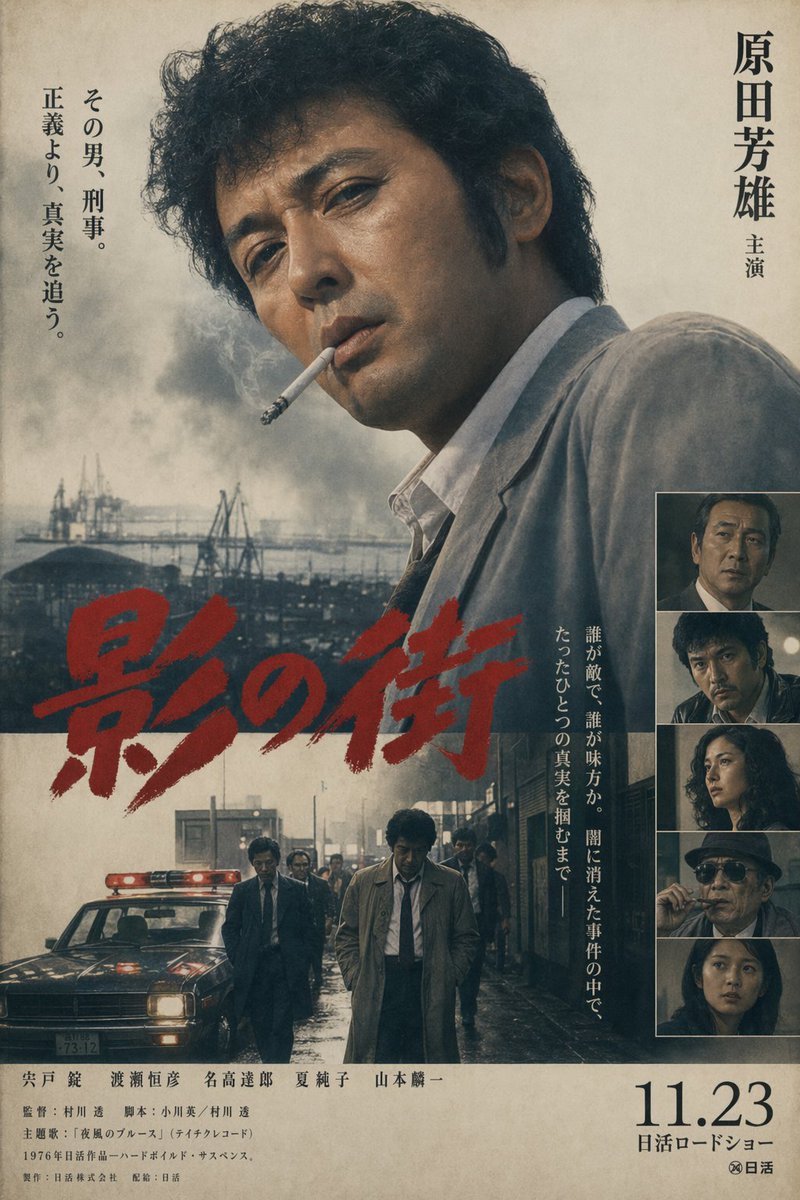
Póster de película de crimen japonesa vintage
Un póster cinematográfico japonés retro y crudo para una película de detectives de estilo duro, útil para generar imágenes promocionales de películas de los años 70 con tipografía y diseño auténticos.
Este es un ejemplo GPT Image 2 para Diseño gráfico y carteles . Utilice la plantilla lista para copiar que aparece a continuación para generar imágenes similares y revise la atribución de Awesome GPT Image 2 Prompts y los derechos de uso comercial antes de reutilizarla.
Free 1K preview
Generate one preview image instantly, no sign-up required.
Prompt
Mensaje listo para copiar
A vintage late-1970s Japanese crime film poster in the style of a Nikkatsu theatrical one-sheet, vertically composed on aged beige paper with visible grain, faint stains, and slightly faded ink. The main image is a large, moody half-body portrait of {argument name="lead actor name" default="Yoshio Harada"} occupying the upper right and center, turned partly away from camera, with thick curly dark hair, a serious expression, and a wrinkled light gray suit jacket over an open-collar white shirt; his face is mostly in shadow. Behind him is a bleak industrial waterfront with cranes, low factory structures, and heavy gray smoke rising into a washed-out sky. Across the lower middle, place a huge hand-brushed red Japanese title reading {argument name="title text" default="影の街"}, painted diagonally and aggressively, partially overlapping the portrait and the lower scene. In the lower half, add a second scene: a rainy urban street at dusk or night with wet reflective pavement, a dark police car at left with a glowing red roof light, and 6 men in suits and trench coats walking forward, with 1 central detective figure in a beige trench coat and loosened tie leading the group. On the far right, include a vertical strip of 5 stacked inset cast portraits framed in thin borders, each a dark cinematic still with different characters. Add vertical Japanese typography: on the upper right, the actor credit “原田芳雄 主演”; on the upper left, a 2-line tagline column reading “その男、刑事。 正義より、真実を追う。”; and near the lower right of the main image, another vertical blurb reading “誰が敵で、誰が味方か。闇に消えた事件の中で、ただひとつの真実を掴むまで—”. At the bottom, include dense small Japanese credits spanning the width, plus a large release date on the lower right reading {argument name="release date" default="11.23"} with “日活ロードショー” beneath it and a small studio mark. Use muted charcoal, sepia, smoky blue-gray, and off-white tones, with the red title as the only vivid color. The overall feeling is hard-boiled, melancholic, gritty, and cinematic, like a lost 1970s Japanese detective movie poster.Variables de solicitud
Marcadores de posición de argumentos editables que se encuentran en la solicitud, con sus valores predeterminados.
Best for
- - Diseño gráfico y carteles visual exploration
- - Image generation and reference-image edits
- - Reusable briefs that keep source attribution visible
Change these parts
- - Subject, product, character, or scene
- - Aspect ratio, camera, lighting, and background
- - Brand, text, color, and output constraints
Recommended model and settings
- - Model: gpt-image-2
- - Input mode: Texto a imagen
- - Aspect ratio: source
- - Commercial status: review original source
How to use this prompt
- 1. Copy the prompt and preserve its structure for the first test.
- 2. Replace the subject, context, and publishing channel.
- 3. Change one camera, lighting, or style variable per iteration.
- 4. Inspect the output, source, text, and rights before reuse.
Limitations, source, and reuse cautions
- - Generated output is an editable draft, not factual, legal, or rights evidence.
- - Review the linked source, people, brands, logos, text, and third-party media before commercial use.
Más casos en esta categoría
Priorizados por categoría, compatibilidad con el modo de entrada, calidad y menor riesgo.
Notas sobre la reutilización y la fuente
Utilice esta opción de forma segura después de previsualizar el caso.
- 1.Copia la solicitud o ábrela directamente en Dovoo con el botón de generación.
- 2.Ajusta las variables, la relación de aspecto y las imágenes de referencia según tus necesidades.
- 3.Antes de publicar o utilizar el servicio de forma remunerada, verifique los derechos de autor, los requisitos de atribución y los riesgos relacionados con la marca o la imagen de la persona.