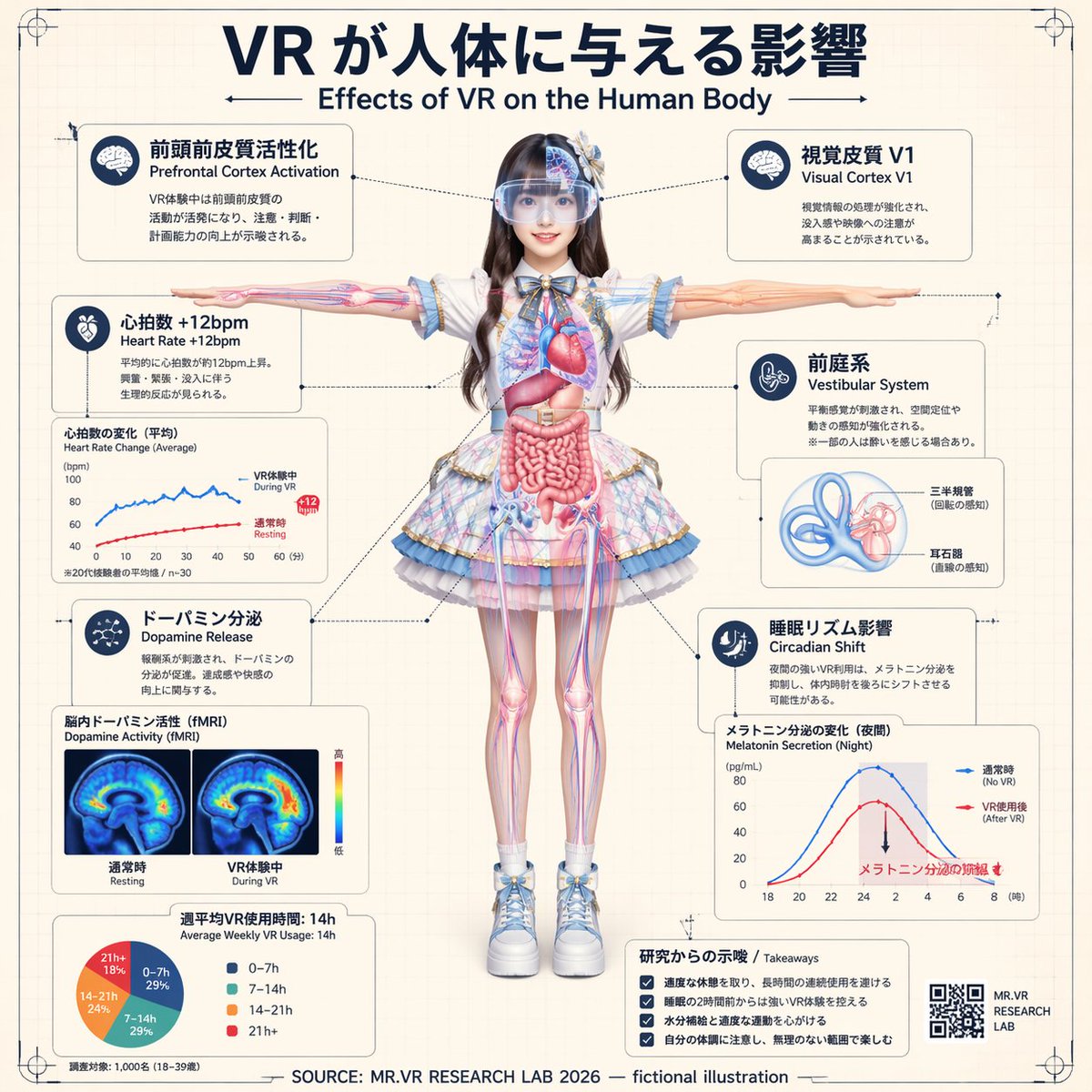
Infografik: Auswirkungen von VR auf den menschlichen Körper
Ein zweisprachiges japanisch-englisches wissenschaftliches Poster, das ein Anime-Mädchen mit anatomischen Überlagerungen und mehreren Diagrammen zeigt und sich zur Nachbildung von lehrreichen VR-Gesundheitsinfografiken eignet.
Dies ist ein GPT Image 2 -Prompt für Grafik & Poster . Verwenden Sie den unten stehenden, kopierfertigen Prompt, um ähnliche Grafiken zu erstellen, und überprüfen Sie vor der Wiederverwendung Awesome GPT Image 2 Prompts -Quellenangaben sowie die kommerziellen Nutzungsrechte.
Benötigen Sie den vollständigen Prompt-Satz? Verwenden Sie den Grafik & Poster Weitere verwandte Beispiele finden Sie im Themen-Hub oder öffnen Sie die GPT Image 2 Prompt-Katalog für das vollständige Beispielverzeichnis, wiederverwendbare Strukturen und Quellenangaben.
Free 1K preview
Generate one preview image instantly, no sign-up required.
4000/4000
Eingabeaufforderung
Kopierfertige Eingabeaufforderung
{
  "anatomy_overlay": {
    "visible_parts": [
      "glowing brain in the head",
      "heart and lungs in the chest",
      "digestive organs in the abdomen",
      "reproductive/urinary region glow in the pelvis",
      "arteries through both arms",
      "veins through both arms",
      "arteries and veins through both legs",
      "inner ear balance structures highlighted near the head"
    ],
    "visible_parts_count": 8
  },
  "character": {
    "age_appearance": "teen to young adult",
    "face": "Show every face clearly with natural, detailed facial features",
    "gender_presentation": "female",
    "hair": {
      "color": "dark brown",
      "style": "long wavy twin sections falling over shoulders and down past chest, center-parted with small decorative floral hair accessory"
    },
    "outfit": "frilly pastel idol dress with short puff sleeves, layered skirt, blue ribbon bow at the collar, lace trim, white ankle socks, blue high-top sneakers",
    "pose": "standing straight, full body centered, arms extended horizontally to both sides"
  },
  "composition": "symmetrical poster with callouts on both sides of the character, charts anchored in the lower corners, title large and bold at top",
  "layout": {
    "border": "thin decorative technical frame around all edges with corner ornaments and small measurement-like marks",
    "branding": {
      "count": 3,
      "items": [
        "SOURCE: MR.VR RESEARCH LAB 2026",
        "MR.VR RESEARCH LAB",
        "QR code at bottom right"
      ]
    },
    "charts": {
      "count": 4,
      "items": [
        {
          "chart_type": "line graph with blue and red lines",
          "labels": [
            "During VR experience",
            "Normal state",
            "+12"
          ],
          "position": "left lower-middle",
          "subtitle": "Heart Rate Change (Average)",
          "title": "心拍数の変化(平均)"
        },
        {
          "chart_type": "two brain scan panels with color scale",
          "labels": [
            "Normal state",
            "During VR experience",
            "Resting",
            "During VR"
          ],
          "position": "left lower",
          "subtitle": "Dopamine Activity (fMRI)",
          "title": "脳内ドーパミン活性(fMRI)"
        },
        {
          "chart_type": "line graph with blue and red curves",
          "labels": [
            "Normal state",
            "After VR viewing",
            "No VR",
            "After VR",
            "メラトニン分泌が抑制"
          ],
          "position": "right lower",
          "subtitle": "Melatonin Secretion (Night)",
          "title": "メラトニン分泌の変化(夜間)"
        },
        {
          "chart_type": "pie chart",
          "labels": [
            "0–7h",
            "7–14h",
            "14–21h",
            "21h+"
          ],
          "position": "left lower",
          "subtitle": "Average Weekly VR Usage: 14h",
          "title": "Weekly average VR usage time: 14h"
        }
      ]
    },
    "diagrams": {
      "count": 1,
      "items": [
        {
          "labels": [
            "Semicircular canals",
            "Otolith organs"
          ],
          "position": "right middle-lower near vestibular box",
          "title": "inner ear balance diagram"
        }
      ]
    },
    "info_boxes": {
      "count": 6,
      "items": [
        {
          "icon": "brain",
          "position": "upper left",
          "subtitle": "Prefrontal Cortex Activation",
          "title": "Prefrontal cortex activation"
        },
        {
          "icon": "brain",
          "position": "upper right",
          "subtitle": "Visual Cortex V1",
          "title": "Visual cortex V1"
        },
        {
          "icon": "heart",
          "position": "left upper-middle",
          "subtitle": "Heart Rate +12bpm",
          "title": "Heart rate +12bpm"
        },
        {
          "icon": "head and balance",
          "position": "right middle",
          "subtitle": "Vestibular System",
          "title": "Vestibular system"
        },
        {
          "icon": "molecule/network",
          "position": "left lower-middle",
          "subtitle": "Dopamine Release",
          "title": "ドーパミン分泌"
        },
        {
          "icon": "moon and stars",
          "position": "right lower-middle",
          "subtitle": "Circadian Shift",
          "title": "睡眠リズム影響"
        }
      ]
    },
    "main_centerpiece": "full-body character in T-pose-like stance with dotted callout lines connecting body regions to surrounding information boxes",
    "research_box": {
      "bullet_count": 4,
      "count": 1,
      "position": "bottom center-right",
      "title": "研究からの示唆 / Takeaways"
    },
    "title_block": {
      "count": 2,
      "lines": [
        "VR が人体に与える影響",
        "Effects of VR on the Human Body"
      ],
      "position": "top center"
    }
  },
  "quality": "sharp, publication-ready, square format",
  "style": {
    "background": "warm off-white paper tone with faint grid",
    "overall": "clean Japanese educational infographic mixed with kawaii anime character art and scientific visualization",
    "palette": "navy blue, cream, soft pastel pink, pastel blue, medical reds and blues",
    "rendering": "high-detail polished poster design, crisp vector UI boxes, soft character shading, realistic anatomy illustrations composited into the body"
  },
  "subject": "front-facing full-body anime idol girl with semi-transparent anatomical overlay",
  "text_density": "high, bilingual Japanese and English subtitles throughout",
  "type": "medical infographic poster"
}
Best for
- - Grafik & Poster visual exploration
- - Image generation and reference-image edits
- - Reusable briefs that keep source attribution visible
Change these parts
- - Subject, product, character, or scene
- - Aspect ratio, camera, lighting, and background
- - Brand, text, color, and output constraints
Recommended model and settings
- - Model: gpt-image-2
- - Input mode: Text zu Bild
- - Aspect ratio: source
- - Commercial status: review original source
How to use this prompt
- 1. Copy the prompt and preserve its structure for the first test.
- 2. Replace the subject, context, and publishing channel.
- 3. Change one camera, lighting, or style variable per iteration.
- 4. Inspect the output, source, text, and rights before reuse.
Limitations, source, and reuse cautions
- - Generated output is an editable draft, not factual, legal, or rights evidence.
- - Review the linked source, people, brands, logos, text, and third-party media before commercial use.
Importiert von Awesome GPT Image 2 Prompts . Quellenangabe erforderlich. Status der kommerziellen Nutzung: allowed ; Rechte an der Quelle vor kostenpflichtiger Nutzung prüfen.
Weitere Fälle in dieser Kategorie
Priorisiert nach Kategorie, Kompatibilität der Eingabemodi, Qualität und geringerem Risiko.

Hinweise zur Wiederverwendung und Quellenangabe
Verwenden Sie diese Eingabeaufforderung sicher, nachdem Sie den Fall in der Vorschau angezeigt haben.
- 1.Kopieren Sie die Eingabeaufforderung oder öffnen Sie sie direkt in Dovoo mit der Schaltfläche „Generieren“.
- 2.Passen Sie Variablen, Seitenverhältnis und Referenzbilder an Ihren Anwendungsfall an.
- 3.Vor der Veröffentlichung oder kostenpflichtigen Nutzung sollten Sie die Rechte an der Quelle, die Anforderungen an die Namensnennung sowie die Risiken für die Marke oder das Abbild prüfen.