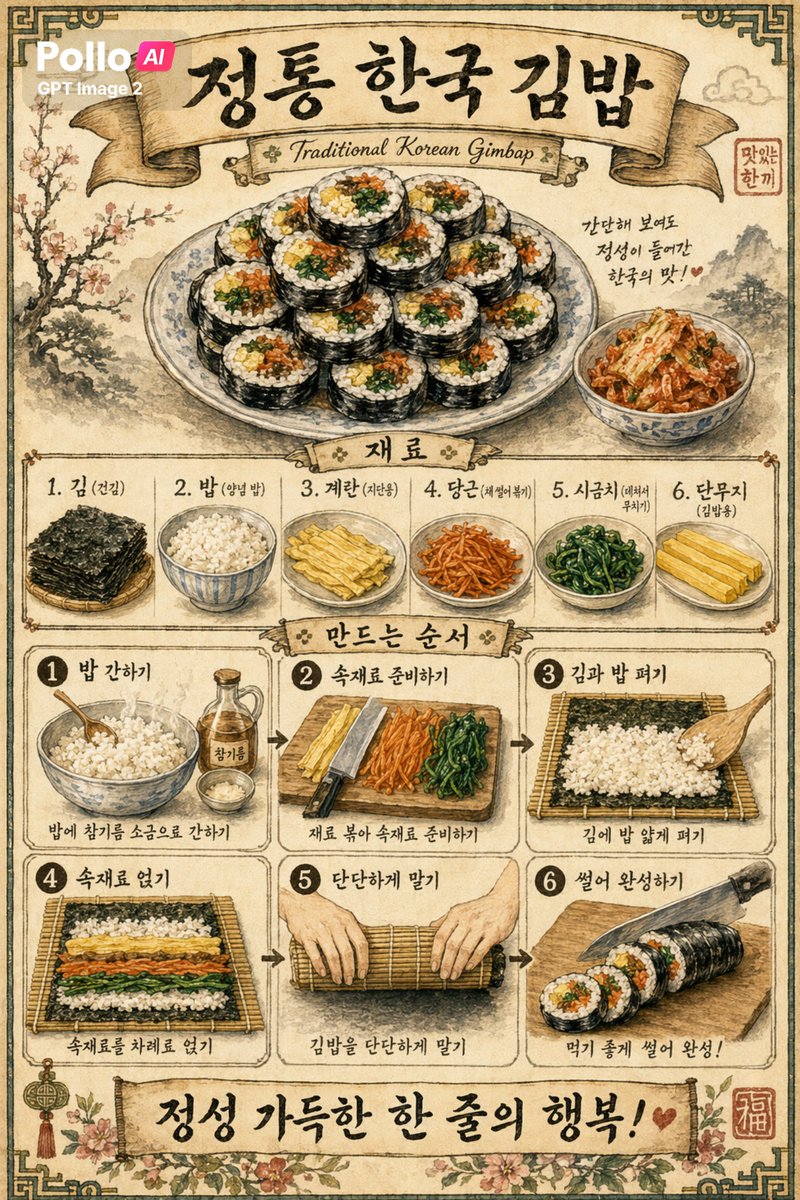
Vintage koreanisches Gimbap-Rezept-Poster
Diese Funktion generiert ein detailliertes Infografik-Poster im koreanischen Retro-Stil für Gimbap, das sich für Lebensmittelmarketing, Menügestaltung oder kulturell thematisierte Rezeptillustrationen eignet.
Dies ist ein GPT Image 2 -Prompt für Speisen und Getränke . Verwenden Sie den unten stehenden, kopierfertigen Prompt, um ähnliche Grafiken zu erstellen, und überprüfen Sie vor der Wiederverwendung Awesome GPT Image 2 Prompts -Quellenangaben sowie die kommerziellen Nutzungsrechte.
Free 1K preview
Generate one preview image instantly, no sign-up required.
Eingabeaufforderung
Kopierfertige Eingabeaufforderung
Create a retro-style Korean food poster with a background of aged beige parchment featuring subtle stains and texture, framed by a dark, decorative border, and employing a traditional hand-painted sumi-e and watercolor illustration style. The poster is a single, vertically arranged infographic, themed around {argument name="dish name" default="정통 한국 김밥"}, topped with elegant, large-scale Korean calligraphy, and featuring a curved ribbon banner with the text {argument name="subtitle text" default="Traditional Korean Gimbap"} at the bottom. At the top center, showcase a beautiful porcelain dish piled high with 12 slices of kimbap, each slice clearly showing the fillings of white rice, yellow egg, orange carrot, green spinach, and dark seaweed. To the right of the dish, place a small bowl of kimchi, accompanied by a short handwritten Korean note: “간단한 보여도 정성이 들어간 한국의 맛! ♥”. Add a small red seal with Korean characters near the upper right corner. In the middle, add an area labeled “재료” (Ingredients) with a ribbon title, arranging 6 ingredient blocks horizontally: 1. 김 (건김) showcasing stacked sheets of dried seaweed, 2. 밥 (양념 밥) showcasing a bowl of seasoned rice, 3. 계란 (지단용) showcasing sliced, cooked egg strips, 4. 당근 (채썰어볶기) showcasing shredded and stir-fried carrots, 5. 시금치 (데쳐서 무치기) showcasing seasoned spinach, and 6. 단무지 (김밥용) showcasing yellow pickled radish strips. Below, add another ribbon title “만드는 순서” (How to Make) and display 6 framed step blocks arranged in two rows of three columns, connected from left to right with arrows. Step 1 is labeled “1 밥 간하기” and shows a bowl of rice with sesame oil and salt, with the caption “밥에 참기름 소금으로 간하기”. Step 2 is labeled “2 속재료 준비하기” and shows a cutting board with eggs, carrots, spinach, and a knife, with the caption “재료 볶아 속재료 준비하기”. Step 3 is labeled “3 김과 밥 펴기” and shows seaweed on a bamboo mat with rice spread on it, with the caption “김에 밥 얇게 펴기”. Step 4 is labeled “4 속재료 얹기” and shows the fillings arranged horizontally on the rice, with the caption “속재료를 차례로 얹기”. Step 5 is labeled “5 단단하게 말기” and shows hands tightly rolling the bamboo mat, with the caption “김밥을 단단하게 말기”. Step 6 is labeled “6 썰어 완성하기” and shows a chef's knife slicing the kimbap roll into pieces, with the caption “먹기 좋게 썰어 완성!”. Add a wide banner at the bottom with prominent Korean calligraphy {argument name="bottom slogan" default="정성 가득한 한 줄의 행복!"} and a small heart. Decorate the lower corners with floral patterns and add a red square seal with the Chinese character “福” in the lower right corner. Use soft shades of dark brown, brown, cream, olive green, and faded red, combined with fine sketch outlines, soft watercolor shading, and authentic print poster composition. Add a small, modern overlay logo in the upper left corner with the text {argument name="brand text" default="Pollo AI GPT Image 2"}.Eingabeaufforderungsvariablen
In der Eingabeaufforderung befinden sich bearbeitbare Argumentplatzhalter mit ihren Standardwerten.
Best for
- - Speisen und Getränke visual exploration
- - Image generation and reference-image edits
- - Reusable briefs that keep source attribution visible
Change these parts
- - Subject, product, character, or scene
- - Aspect ratio, camera, lighting, and background
- - Brand, text, color, and output constraints
Recommended model and settings
- - Model: gpt-image-2
- - Input mode: Text zu Bild
- - Aspect ratio: source
- - Commercial status: review original source
How to use this prompt
- 1. Copy the prompt and preserve its structure for the first test.
- 2. Replace the subject, context, and publishing channel.
- 3. Change one camera, lighting, or style variable per iteration.
- 4. Inspect the output, source, text, and rights before reuse.
Limitations, source, and reuse cautions
- - Generated output is an editable draft, not factual, legal, or rights evidence.
- - Review the linked source, people, brands, logos, text, and third-party media before commercial use.
Weitere Fälle in dieser Kategorie
Priorisiert nach Kategorie, Kompatibilität der Eingabemodi, Qualität und geringerem Risiko.


Hinweise zur Wiederverwendung und Quellenangabe
Verwenden Sie diese Eingabeaufforderung sicher, nachdem Sie den Fall in der Vorschau angezeigt haben.
- 1.Kopieren Sie die Eingabeaufforderung oder öffnen Sie sie direkt in Dovoo mit der Schaltfläche „Generieren“.
- 2.Passen Sie Variablen, Seitenverhältnis und Referenzbilder an Ihren Anwendungsfall an.
- 3.Vor der Veröffentlichung oder kostenpflichtigen Nutzung sollten Sie die Rechte an der Quelle, die Anforderungen an die Namensnennung sowie die Risiken für die Marke oder das Abbild prüfen.