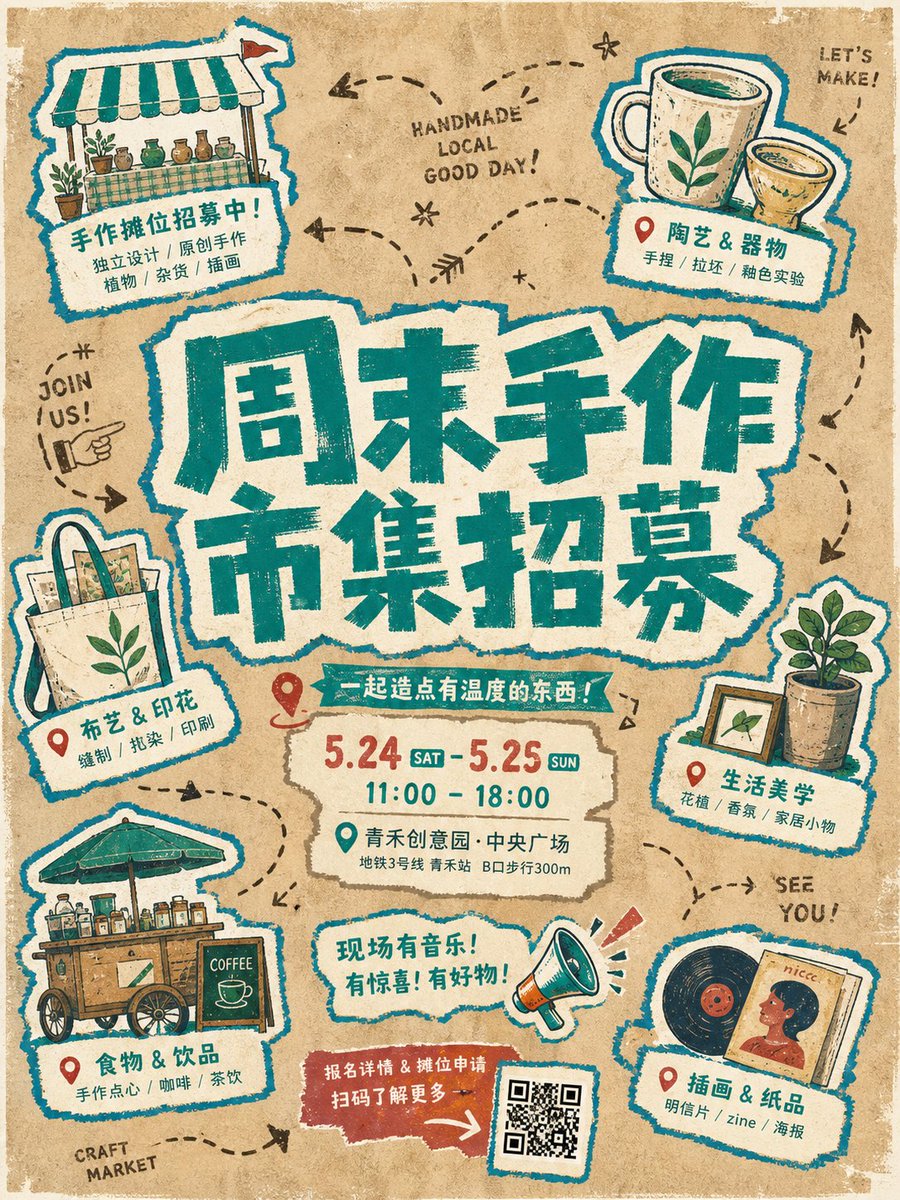
Torn Paper Poster Aesthetic
A creative prompt for generating handmade-style cultural posters featuring torn paper textures, fluorescent colors, and sticker-like badges for an urban event look.
Dies ist ein GPT Image 2 -Prompt für Grafik & Poster . Verwenden Sie den unten stehenden, kopierfertigen Prompt, um ähnliche Grafiken zu erstellen, und überprüfen Sie vor der Wiederverwendung Awesome GPT Image 2 Prompts -Quellenangaben sowie die kommerziellen Nutzungsrechte.
Free 1K preview
Generate one preview image instantly, no sign-up required.
Eingabeaufforderung
Kopierfertige Eingabeaufforderung
At first glance, a group of irregularly overlapping fluorescent hand-torn paper title blocks forms a strong visual anchor: {argument name="主标题" default="huge, centered, staggered lines"}, with glyphs formed as if by thick brush strokes and paper-cutting combined, thick strokes, rough and broken edges, exaggerated corners, varied counter sizes, and slight local misalignments, making the text look like hand-printed graphics rather than neat typesetting. Build a circular, loose but clear reading path activity information system around the title, with several blue-and-white outlined hand-drawn sticker badges distributed around it; each badge is connected to a small illustration, location marker, or symbol related to the theme and a white label, varying in size and slightly in direction, as if stuck on the paper at random; the subject and label share an eye-catching blue outer contour and yellow fill, forming a unified brushstroke across elements. The background uses warm fibrous paper and old poster texture, a large area of tan base color, retaining paper grain, indentations, slight color differences, and printing bleeding edges; organize the empty space with dark brown hand-drawn dotted lines, arcs, arrows, and a small amount of English geometric lettering, but without being obtrusive. Main colors are locked to {argument name="主色" default="ochre brown, bright yellow, vivid blue, cream white"}, using flat coating and limited overlapping colors, without using modern gradients, glass textures, or over-smooth digital shadows. All graphics, text, stickers, and background share slightly unstable manual outlines, overprinting offsets, thickness variations, and local wear, retaining imperfect production traces; clear information hierarchy, central title heaviest, surrounding modules forming rhythm and breathing, the whole piece is like an urban cultural activity poster completed by clipping, hand-drawing, screen printing, and old paper.Eingabeaufforderungsvariablen
In der Eingabeaufforderung befinden sich bearbeitbare Argumentplatzhalter mit ihren Standardwerten.
Best for
- - Grafik & Poster visual exploration
- - Image generation and reference-image edits
- - Reusable briefs that keep source attribution visible
Change these parts
- - Subject, product, character, or scene
- - Aspect ratio, camera, lighting, and background
- - Brand, text, color, and output constraints
Recommended model and settings
- - Model: gpt-image-2
- - Input mode: Text zu Bild
- - Aspect ratio: source
- - Commercial status: review original source
How to use this prompt
- 1. Copy the prompt and preserve its structure for the first test.
- 2. Replace the subject, context, and publishing channel.
- 3. Change one camera, lighting, or style variable per iteration.
- 4. Inspect the output, source, text, and rights before reuse.
Limitations, source, and reuse cautions
- - Generated output is an editable draft, not factual, legal, or rights evidence.
- - Review the linked source, people, brands, logos, text, and third-party media before commercial use.
Weitere Fälle in dieser Kategorie
Priorisiert nach Kategorie, Kompatibilität der Eingabemodi, Qualität und geringerem Risiko.

Hinweise zur Wiederverwendung und Quellenangabe
Verwenden Sie diese Eingabeaufforderung sicher, nachdem Sie den Fall in der Vorschau angezeigt haben.
- 1.Kopieren Sie die Eingabeaufforderung oder öffnen Sie sie direkt in Dovoo mit der Schaltfläche „Generieren“.
- 2.Passen Sie Variablen, Seitenverhältnis und Referenzbilder an Ihren Anwendungsfall an.
- 3.Vor der Veröffentlichung oder kostenpflichtigen Nutzung sollten Sie die Rechte an der Quelle, die Anforderungen an die Namensnennung sowie die Risiken für die Marke oder das Abbild prüfen.