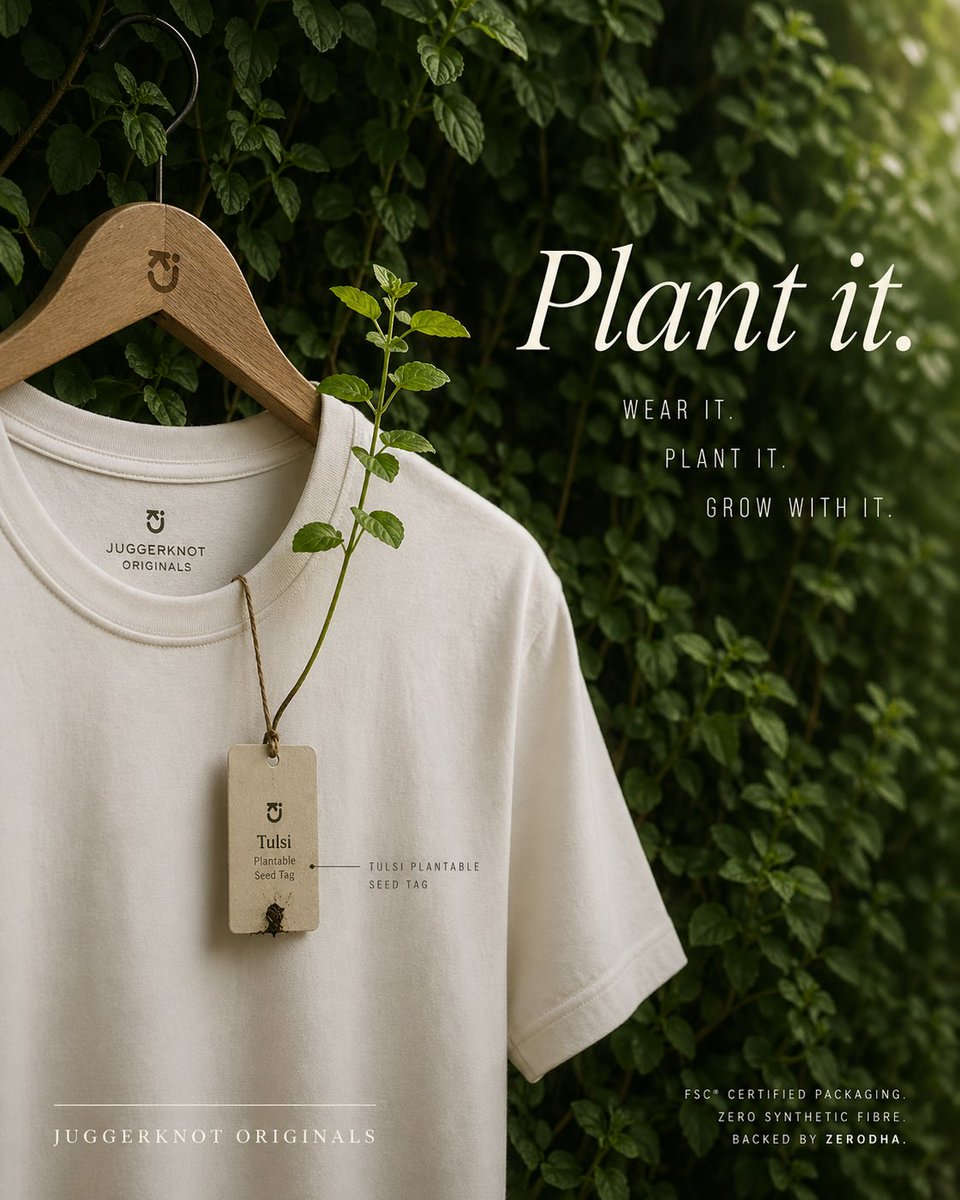
Nachhaltiges T-Shirt mit pflanzbarem Etikett (Werbung)
Eine hochwertige vertikale Modeanzeige, die ein minimalistisches T-Shirt mit einem pflanzbaren Samenetikett zeigt, aus dem ein Tulsi-Spross wächst – ideal für nachhaltiges Bekleidungsbranding und Kampagnenvisualisierungen.
Dies ist ein GPT Image 2 -Prompt für Produkt & Vertrieb . Verwenden Sie den unten stehenden, kopierfertigen Prompt, um ähnliche Grafiken zu erstellen, und überprüfen Sie vor der Wiederverwendung Awesome GPT Image 2 Prompts -Quellenangaben sowie die kommerziellen Nutzungsrechte.
Free 1K preview
Generate one preview image instantly, no sign-up required.
Eingabeaufforderung
Kopierfertige Eingabeaufforderung
A premium eco-conscious fashion advertisement, shot as a refined editorial product photo. A single off-white or natural cream crew-neck T-shirt hangs on a smooth wooden hanger with a black metal hook, placed against a lush wall of dense green leaves and climbing vines. The hanger has a small minimalist brand monogram engraved near the neck. The shirt is shown from the upper torso down to part of the hem, slightly angled, with soft natural folds and high-quality cotton texture. Printed inside the collar is a minimalist brand mark and the text "JUGGERKNOT ORIGINALS". Hanging from the neckline is 1 rectangular recycled-paper seed tag tied with rustic brown twine; the tag reads "Tulsi" and "Plantable Seed Tag" with a tiny sprouting seed detail near the bottom. From the tag, 1 real tulsi plant stem grows upward across the front of the shirt, with several fresh green leaves, visually demonstrating that the tag is plantable. Add a small fine-label annotation near the tag reading "TULSI PLANTABLE SEED TAG". On the right side, large elegant white serif typography says {argument name="headline text" default="Plant it."}. Beneath it, place 3 stacked lines of narrow uppercase sans-serif copy: "WEAR IT.", "PLANT IT.", and "GROW WITH IT.". At the lower left, add the brand name in spaced uppercase serif text: {argument name="brand name" default="JUGGERKNOT ORIGINALS"}, with a thin horizontal line above it. At the lower right, add 3 lines of small uppercase sans-serif text: "FSC® CERTIFIED PACKAGING.", "ZERO SYNTHETIC FIBRE", and "BACKED BY ZERODHA.". Use soft diffused daylight, shallow depth of field, moody green-and-cream color grading, luxury sustainable-brand aesthetics, clean composition, vertical poster layout, subtle shadows, and a calm organic atmosphere. Keep the design minimal, premium, and photorealistic, with the shirt occupying the left half and the typography balanced on the right.Eingabeaufforderungsvariablen
In der Eingabeaufforderung befinden sich bearbeitbare Argumentplatzhalter mit ihren Standardwerten.
Best for
- - Produkt & Vertrieb visual exploration
- - Image generation and reference-image edits
- - Reusable briefs that keep source attribution visible
Change these parts
- - Subject, product, character, or scene
- - Aspect ratio, camera, lighting, and background
- - Brand, text, color, and output constraints
Recommended model and settings
- - Model: gpt-image-2
- - Input mode: Text zu Bild
- - Aspect ratio: source
- - Commercial status: review original source
How to use this prompt
- 1. Copy the prompt and preserve its structure for the first test.
- 2. Replace the subject, context, and publishing channel.
- 3. Change one camera, lighting, or style variable per iteration.
- 4. Inspect the output, source, text, and rights before reuse.
Limitations, source, and reuse cautions
- - Generated output is an editable draft, not factual, legal, or rights evidence.
- - Review the linked source, people, brands, logos, text, and third-party media before commercial use.
Weitere Fälle in dieser Kategorie
Priorisiert nach Kategorie, Kompatibilität der Eingabemodi, Qualität und geringerem Risiko.

Hinweise zur Wiederverwendung und Quellenangabe
Verwenden Sie diese Eingabeaufforderung sicher, nachdem Sie den Fall in der Vorschau angezeigt haben.
- 1.Kopieren Sie die Eingabeaufforderung oder öffnen Sie sie direkt in Dovoo mit der Schaltfläche „Generieren“.
- 2.Passen Sie Variablen, Seitenverhältnis und Referenzbilder an Ihren Anwendungsfall an.
- 3.Vor der Veröffentlichung oder kostenpflichtigen Nutzung sollten Sie die Rechte an der Quelle, die Anforderungen an die Namensnennung sowie die Risiken für die Marke oder das Abbild prüfen.