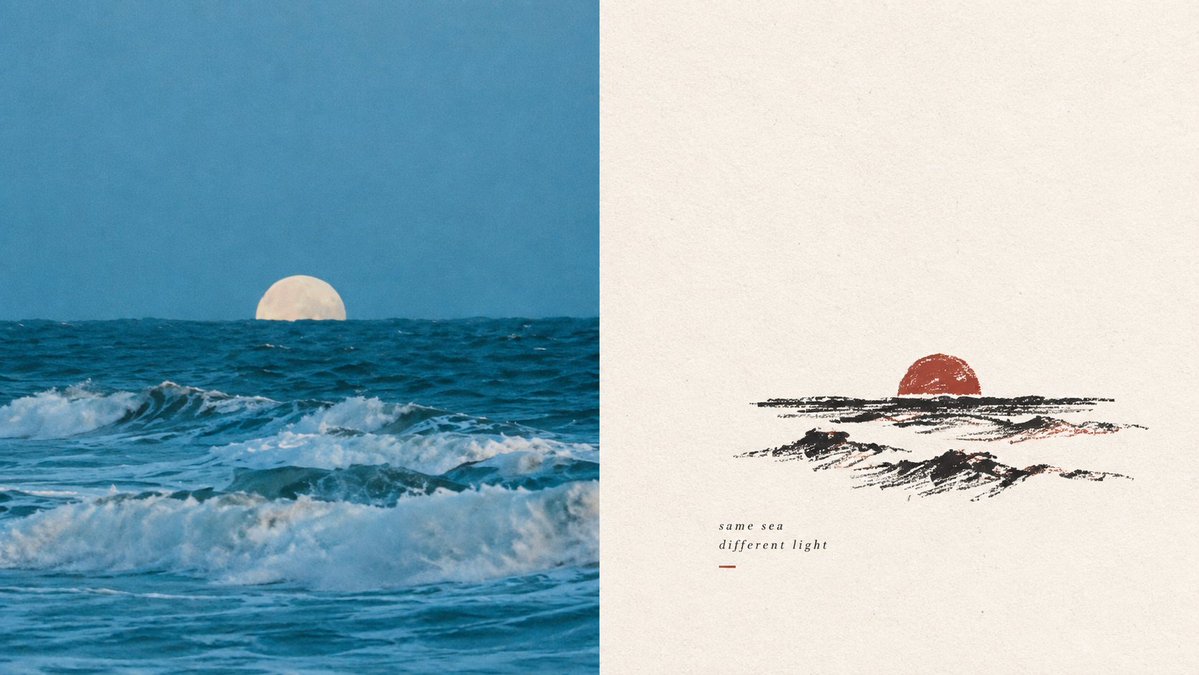
Same Sea Different Light Diptych
A wide split-screen wallpaper pairing a realistic ocean moonrise photograph with a minimalist charcoal-and-red seascape illustration.
Dies ist ein GPT Image 2 -Prompt für Landschaft & Natur . Verwenden Sie den unten stehenden, kopierfertigen Prompt, um ähnliche Grafiken zu erstellen, und überprüfen Sie vor der Wiederverwendung Awesome GPT Image 2 Prompts -Quellenangaben sowie die kommerziellen Nutzungsrechte.
Benötigen Sie den vollständigen Prompt-Satz? Verwenden Sie den Landschaft & Natur Weitere verwandte Beispiele finden Sie im Themen-Hub oder öffnen Sie die GPT Image 2 Prompt-Katalog für das vollständige Beispielverzeichnis, wiederverwendbare Strukturen und Quellenangaben.
Free 1K preview
Generate one preview image instantly, no sign-up required.
1804/4000
Eingabeaufforderung
Kopierfertige Eingabeaufforderung
Goal: Create a calm aesthetic diptych wallpaper comparing the same seascape in two visual languages: realistic ocean photography on the left and minimalist charcoal-and-red ink illustration on the right.

Canvas: Wide horizontal 16:9 composition, split exactly into 2 equal vertical panels with a sharp center divide and no outer border.

Left panel: A realistic telephoto photograph of {argument name="seascape subject" default="deep blue ocean waves with a pale full moon half-rising on the horizon"}. Use layered rolling waves in the foreground, white sea foam, a dark horizon line slightly above center, and a muted blue sky. The moon is a single pale cream disk, partially hidden behind the horizon, centered slightly right within the left panel. Color palette: teal blue, cyan, deep navy, white foam, soft cream moon. Mood: quiet, early morning, still and contemplative.

Right panel: Warm off-white textured paper background with a small minimalist charcoal drawing positioned slightly right of center and slightly below mid-height. The drawing contains exactly 3 main visual elements: 1 red semicircle sun, 1 thin black horizon band, and 1 group of rough black wave strokes beneath it with sparse red accents. The illustration should feel hand-drawn with dry brush, charcoal pencil, and ink scratches, leaving large negative space.

Text content: Add exactly 1 small italic serif caption beneath and left of the illustration reading “{argument name="caption text" default="same sea\ndifferent light"}” in dark gray or black, split across 2 lines. Add exactly 1 short thin red underline below the caption.

Style: Quiet editorial art print, red-and-black charcoal aesthetic, subtle paper grain, poetic minimalism, balanced asymmetry, muted colors, no people, no boats, no extra text, no watermark.
Eingabeaufforderungsvariablen
In der Eingabeaufforderung befinden sich bearbeitbare Argumentplatzhalter mit ihren Standardwerten.
Variable
seascape subject
Standard
deep blue ocean waves with a pale full moon half-rising on the horizon
Variable
caption text
Standard
same sea\ndifferent light
Best for
- - Landschaft & Natur visual exploration
- - Image generation and reference-image edits
- - Reusable briefs that keep source attribution visible
Change these parts
- - Subject, product, character, or scene
- - Aspect ratio, camera, lighting, and background
- - Brand, text, color, and output constraints
Recommended model and settings
- - Model: gpt-image-2
- - Input mode: Text zu Bild
- - Aspect ratio: source
- - Commercial status: review original source
How to use this prompt
- 1. Copy the prompt and preserve its structure for the first test.
- 2. Replace the subject, context, and publishing channel.
- 3. Change one camera, lighting, or style variable per iteration.
- 4. Inspect the output, source, text, and rights before reuse.
Limitations, source, and reuse cautions
- - Generated output is an editable draft, not factual, legal, or rights evidence.
- - Review the linked source, people, brands, logos, text, and third-party media before commercial use.
Importiert von Awesome GPT Image 2 Prompts . Quellenangabe erforderlich. Status der kommerziellen Nutzung: allowed ; Rechte an der Quelle vor kostenpflichtiger Nutzung prüfen.
Weitere Fälle in dieser Kategorie
Priorisiert nach Kategorie, Kompatibilität der Eingabemodi, Qualität und geringerem Risiko.
Hinweise zur Wiederverwendung und Quellenangabe
Verwenden Sie diese Eingabeaufforderung sicher, nachdem Sie den Fall in der Vorschau angezeigt haben.
- 1.Kopieren Sie die Eingabeaufforderung oder öffnen Sie sie direkt in Dovoo mit der Schaltfläche „Generieren“.
- 2.Passen Sie Variablen, Seitenverhältnis und Referenzbilder an Ihren Anwendungsfall an.
- 3.Vor der Veröffentlichung oder kostenpflichtigen Nutzung sollten Sie die Rechte an der Quelle, die Anforderungen an die Namensnennung sowie die Risiken für die Marke oder das Abbild prüfen.