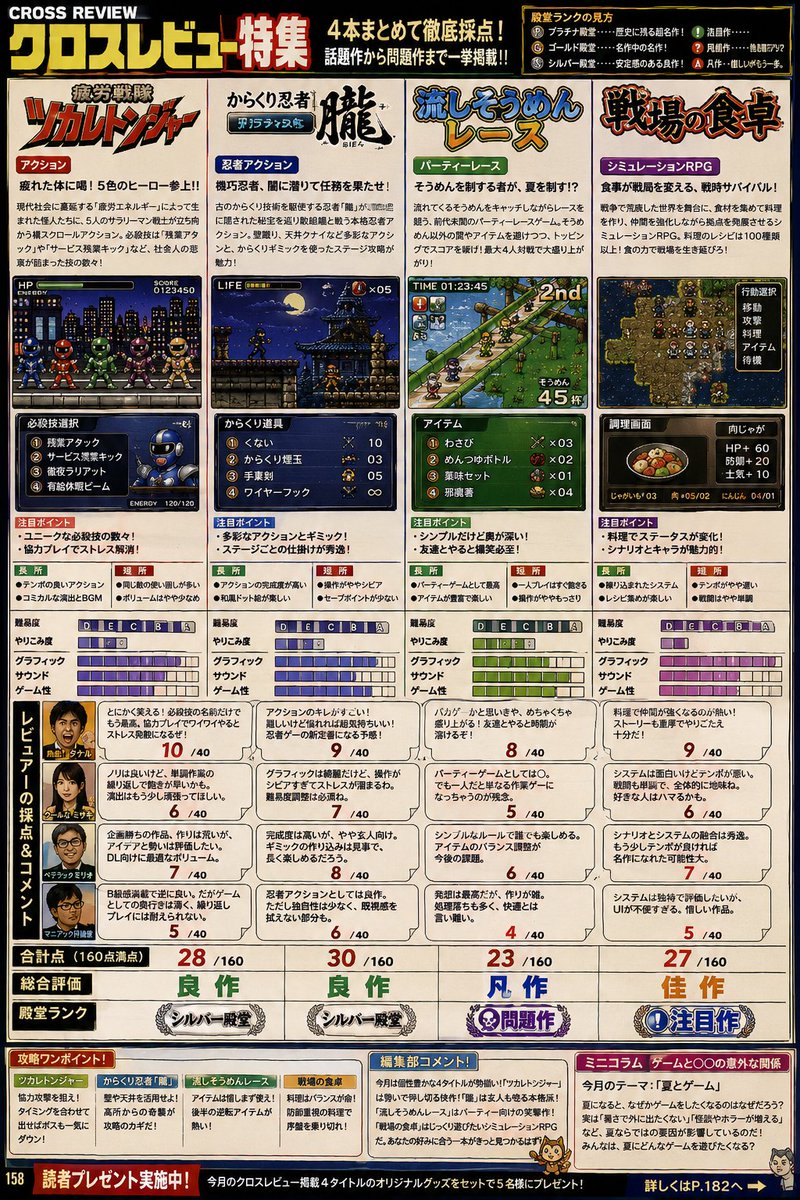
Retro Japanese Gaming Magazine Review Page
Generates a dense, highly detailed editorial layout for a 1990s Japanese gaming magazine, featuring multiple game reviews with scores and pixel art screenshots.
Dies ist ein GPT Image 2 -Prompt für Grafik & Poster . Verwenden Sie den unten stehenden, kopierfertigen Prompt, um ähnliche Grafiken zu erstellen, und überprüfen Sie vor der Wiederverwendung Awesome GPT Image 2 Prompts -Quellenangaben sowie die kommerziellen Nutzungsrechte.
Free 1K preview
Generate one preview image instantly, no sign-up required.
Eingabeaufforderung
Kopierfertige Eingabeaufforderung
At the start of generation, the user enters four game titles. If left blank, they are created randomly.

【Game 1】
({argument name="game title 1" default="Game Title"})

【Game 2】
({argument name="game title 2" default="Game Title"})

【Game 3】
({argument name="game title 3" default="Game Title"})

【Game 4】
(Game Title)

The subsequent magazine content is automatically generated by inferring the worldview, genre, and game content from the entered titles.

---

Style of a cross-review feature page found in Japanese gaming magazines from the late 1990s to early 2000s.

One vertical page.

Information-dense magazine layout.

Do not use real game companies, real game consoles, or real magazine names.

Completely original fictional game review feature.

---

Display four games simultaneously.

Automatically generate the following for each game:

- Game title logo
- Genre
- Game content introduction
- Catchphrase
- Pixel art screenshot
- In-game style UI screen
- Review comments
- Scoring results
- Overall evaluation

Game screens are produced by inferring content from the title.

Examples:

Robot title -> 16-bit style mech action
Fantasy title -> Classic RPG
Racing title -> High-speed racing game
Horror title -> Exploration adventure
Shooting title -> Vertical or horizontal scrolling STG

Depicted as distinct game genres.

Screenshots have persuasive power as if they are actual game screens during play.

Include UI appropriate for the genre, such as mini-maps, HP gauges, score displays, and dialogue windows.

---

Four review personnel:

- Hot-blooded male reviewer
- Calm female reviewer
- Veteran editor
- Maniacal game critic

Each with a face illustration.

Review comments in speech bubble format.

Opinions differ for each game.

---

Ratings are random.

Mixed from high praise to harsh criticism.

Examples:

"Very high level of perfection"
"Rough around the edges but shows promise"
"Works for specific tastes"
"Interesting idea"
"Difficulty with balance adjustment"
"Quite a sharp title"
"Hard to wrap my head around"

A mix of positive and biting comments.

---

Score is out of 40.

Four reviewers score individually.

Examples:

10 / 10 / 9 / 10
8 / 7 / 8 / 6
5 / 4 / 6 / 5
2 / 1 / 3 / 2

Automatically display according to the evaluation results:

- Platinum Hall of Fame
- Gold Hall of Fame
- Silver Hall of Fame
- Notable Title
- Good Title
- Commendable Title
- Ordinary Title
- Controversial Title

---

The page further includes:

- Key points of interest
- Strengths
- Weaknesses
- Difficulty chart
- Replayability level
- Graphic rating
- Sound rating
- Gameplay rating
- Editorial department comments
- Strategy tips
- Mini column

---

Overwhelming amount of information across the page.

Numerous subheadings.

Numerous sidebars.

Numerous graphs.

Numerous icons.

Fine decorations.

Texture of retro printed matter.

Slightly faded paper.

Density like a game guide book or a collectible magazine feature page.

A layout where more information is discovered the more it is read.

Completely original design that does not look like real games or real manufacturers.

professional Japanese gaming magazine editorial layout, retro review page, pixel art game screenshots, reviewer portraits, dense typography, score charts, magazine print design, high detail, authentic late 1990s and early 2000s Japanese game culture, collectible magazine feature, highly detailed editorial design
Eingabeaufforderungsvariablen
In der Eingabeaufforderung befinden sich bearbeitbare Argumentplatzhalter mit ihren Standardwerten.
Best for
- - Grafik & Poster visual exploration
- - Image generation and reference-image edits
- - Reusable briefs that keep source attribution visible
Change these parts
- - Subject, product, character, or scene
- - Aspect ratio, camera, lighting, and background
- - Brand, text, color, and output constraints
Recommended model and settings
- - Model: gpt-image-2
- - Input mode: Text zu Bild
- - Aspect ratio: source
- - Commercial status: review original source
How to use this prompt
- 1. Copy the prompt and preserve its structure for the first test.
- 2. Replace the subject, context, and publishing channel.
- 3. Change one camera, lighting, or style variable per iteration.
- 4. Inspect the output, source, text, and rights before reuse.
Limitations, source, and reuse cautions
- - Generated output is an editable draft, not factual, legal, or rights evidence.
- - Review the linked source, people, brands, logos, text, and third-party media before commercial use.
Weitere Fälle in dieser Kategorie
Priorisiert nach Kategorie, Kompatibilität der Eingabemodi, Qualität und geringerem Risiko.



Hinweise zur Wiederverwendung und Quellenangabe
Verwenden Sie diese Eingabeaufforderung sicher, nachdem Sie den Fall in der Vorschau angezeigt haben.
- 1.Kopieren Sie die Eingabeaufforderung oder öffnen Sie sie direkt in Dovoo mit der Schaltfläche „Generieren“.
- 2.Passen Sie Variablen, Seitenverhältnis und Referenzbilder an Ihren Anwendungsfall an.
- 3.Vor der Veröffentlichung oder kostenpflichtigen Nutzung sollten Sie die Rechte an der Quelle, die Anforderungen an die Namensnennung sowie die Risiken für die Marke oder das Abbild prüfen.