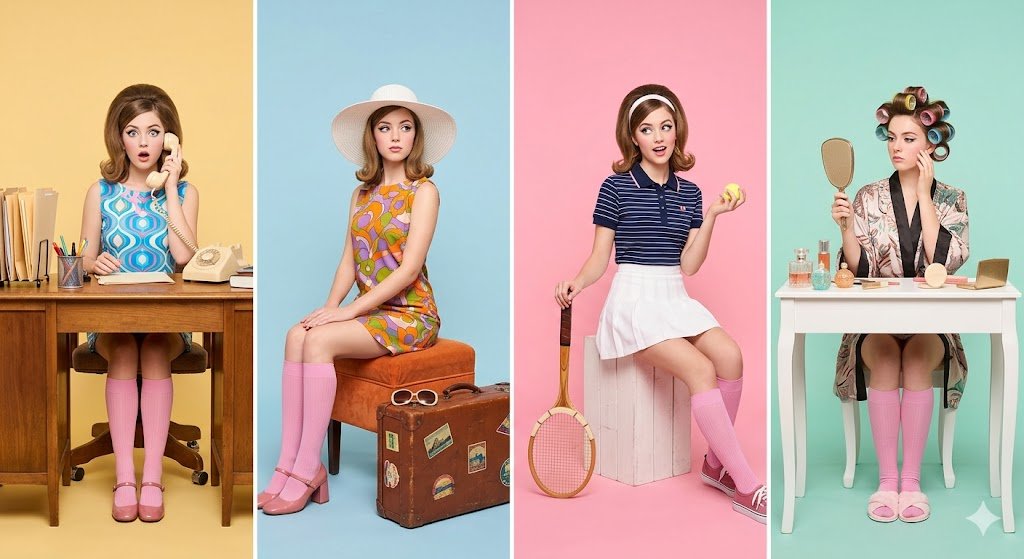
Retro 1960s Four-Panel Fashion Editorial
Generates a vintage-style studio photography grid featuring a single subject in four distinct character roles with bold pastel blocking.
Dies ist ein GPT Image 2 -Prompt für Mode & Schönheit . Verwenden Sie den unten stehenden, kopierfertigen Prompt, um ähnliche Grafiken zu erstellen, und überprüfen Sie vor der Wiederverwendung Awesome GPT Image 2 Prompts -Quellenangaben sowie die kommerziellen Nutzungsrechte.
Benötigen Sie den vollständigen Prompt-Satz? Verwenden Sie den Mode & Schönheit Weitere verwandte Beispiele finden Sie im Themen-Hub oder öffnen Sie die GPT Image 2 Prompt-Katalog für das vollständige Beispielverzeichnis, wiederverwendbare Strukturen und Quellenangaben.
Free 1K preview
Generate one preview image instantly, no sign-up required.
1367/4000
Eingabeaufforderung
Kopierfertige Eingabeaufforderung
Retro studio photography featuring the same woman in four distinct character roles, laid out side by side in a horizontal panel grid. Each panel has its own bold {argument name="colors" default="pastel backdrop (yellow, blue, pink, mint)"}. She's styled in {argument name="era" default="1960s vintage fashion"} throughout, colorful prints, pink knee-high socks, and bold makeup.

Left panel (Office): Seated at a desk surrounded by props, a rotary telephone, file folders, stationery. Patterned dress, expression of surprise while on the phone.
Second panel (Travel): Wide-brimmed hat, vibrant ensemble, posed with a vintage suitcase and travel accessories, elegant posture.
Third panel (Sports): Retro athletic outfit, holding a tennis racket and ball with laid-back playful energy.
Right panel (Home): Wearing a robe with rollers in her hair, holding a hand mirror at a vanity table with beauty products arranged around her.

Panels are neatly divided with symmetrical framing and consistent lighting and camera angle throughout. Soft bright studio light, high-end fashion editorial aesthetic, razor-sharp detail, vivid saturated colors, near-shadowless, no text, no logos, no watermarks.
Style: {argument name="style" default="pop art nostalgia, Wes Anderson symmetry, fashion editorial photography, pastel color blocking"}, high resolution, 8K, clean composition.
Eingabeaufforderungsvariablen
In der Eingabeaufforderung befinden sich bearbeitbare Argumentplatzhalter mit ihren Standardwerten.
Variable
colors
Standard
pastel backdrop (yellow, blue, pink, mint)
Variable
era
Standard
1960s vintage fashion
Variable
style
Standard
pop art nostalgia, Wes Anderson symmetry, fashion editorial photography, pastel color blocking
Best for
- - Mode & Schönheit visual exploration
- - Image generation and reference-image edits
- - Reusable briefs that keep source attribution visible
Change these parts
- - Subject, product, character, or scene
- - Aspect ratio, camera, lighting, and background
- - Brand, text, color, and output constraints
Recommended model and settings
- - Model: gpt-image-2
- - Input mode: Text zu Bild
- - Aspect ratio: source
- - Commercial status: review original source
How to use this prompt
- 1. Copy the prompt and preserve its structure for the first test.
- 2. Replace the subject, context, and publishing channel.
- 3. Change one camera, lighting, or style variable per iteration.
- 4. Inspect the output, source, text, and rights before reuse.
Limitations, source, and reuse cautions
- - Generated output is an editable draft, not factual, legal, or rights evidence.
- - Review the linked source, people, brands, logos, text, and third-party media before commercial use.
Importiert von Awesome GPT Image 2 Prompts . Quellenangabe erforderlich. Status der kommerziellen Nutzung: allowed ; Rechte an der Quelle vor kostenpflichtiger Nutzung prüfen.
Weitere Fälle in dieser Kategorie
Priorisiert nach Kategorie, Kompatibilität der Eingabemodi, Qualität und geringerem Risiko.
Hinweise zur Wiederverwendung und Quellenangabe
Verwenden Sie diese Eingabeaufforderung sicher, nachdem Sie den Fall in der Vorschau angezeigt haben.
- 1.Kopieren Sie die Eingabeaufforderung oder öffnen Sie sie direkt in Dovoo mit der Schaltfläche „Generieren“.
- 2.Passen Sie Variablen, Seitenverhältnis und Referenzbilder an Ihren Anwendungsfall an.
- 3.Vor der Veröffentlichung oder kostenpflichtigen Nutzung sollten Sie die Rechte an der Quelle, die Anforderungen an die Namensnennung sowie die Risiken für die Marke oder das Abbild prüfen.