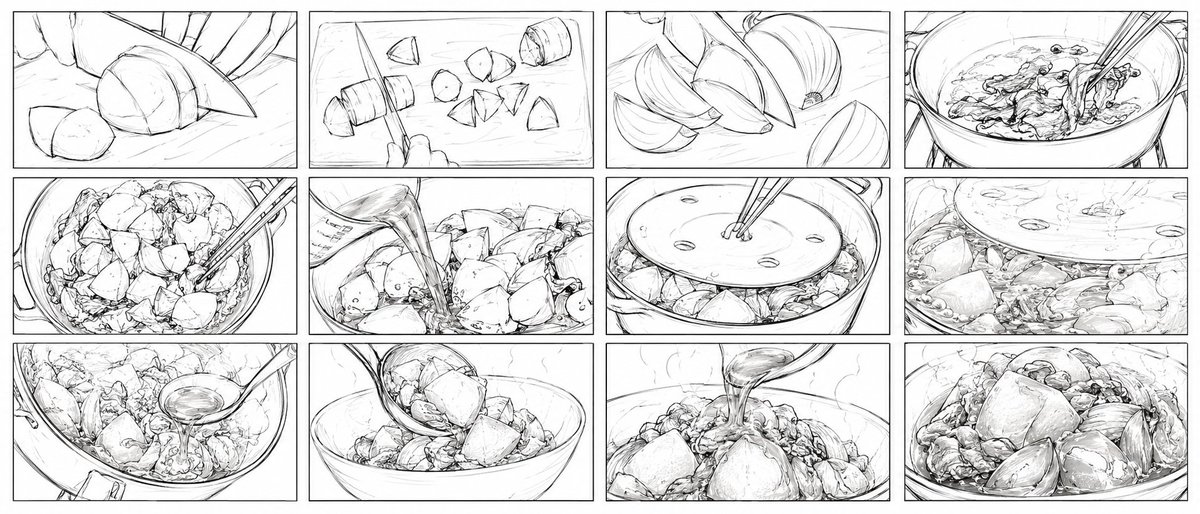
Nikujaga Anime Cooking Storyboard
Creates a 12-panel monochrome anime storyboard sheet for a short Japanese nikujaga cooking video.
Dies ist ein GPT Image 2 -Prompt für Anime & Spiel . Verwenden Sie den unten stehenden, kopierfertigen Prompt, um ähnliche Grafiken zu erstellen, und überprüfen Sie vor der Wiederverwendung Awesome GPT Image 2 Prompts -Quellenangaben sowie die kommerziellen Nutzungsrechte.
Benötigen Sie den vollständigen Prompt-Satz? Verwenden Sie den Anime & Spiel Weitere verwandte Beispiele finden Sie im Themen-Hub oder öffnen Sie die GPT Image 2 Prompt-Katalog für das vollständige Beispielverzeichnis, wiederverwendbare Strukturen und Quellenangaben.
Free 1K preview
Generate one preview image instantly, no sign-up required.
2879/4000
Eingabeaufforderung
Kopierfertige Eingabeaufforderung
Goal: Create a single wide storyboard sheet for a {argument name="video topic" default="15-second Japanese 2D anime cooking short about nikujaga"}, showing a complete cooking sequence in clean monochrome pencil line art.

Canvas: Extra-wide 21:9 aspect ratio storyboard image, white background, thin black outer border. Arrange exactly 12 rectangular panels in a 4 columns × 3 rows grid, with narrow white gutters and thin black panel borders. Use cinematic close-up kitchen shots, dynamic anime storyboarding, hand-drawn graphite sketch texture, no color, no captions, no speech bubbles, no panel numbers.

Visual style: Japanese 2D animation storyboard rough, detailed food illustration, expressive pencil hatching, visible construction lines, energetic motion lines, realistic cookware perspective, close-up macro framing. Keep all drawings black-and-white with subtle gray shading only.

Storyboard panels: Include exactly 12 discrete panels, left to right, top to bottom:
1. Close-up of a potato being cut on a cutting board, one hand holding it, chef’s knife slicing into it, a few peeled potato pieces nearby.
2. Close-up of a carrot being chopped into thick round and wedge-like chunks, knife mid-cut, scattered vegetable pieces on the board.
3. Close-up of onion wedges and onion halves on a cutting board, layers clearly visible, knife or hand partly entering frame.
4. Top-down angle into a pot or deep pan where thin slices of meat are being stir-fried with chopsticks, broth or oil bubbling lightly.
5. Pot close-up filled with meat and chunky vegetables, chopsticks mixing potato pieces, carrot chunks, and onion.
6. Seasoning liquid being poured from a small container into the pot over the vegetables and meat, emphasizing the pouring stream.
7. A round drop-lid placed over the simmering ingredients inside the pot, chopsticks adjusting the lid through its holes.
8. Simmering pot with the drop-lid partly lifted, steam rising and ingredients visible beneath the lid.
9. Ladle stirring or scooping the finished stew inside the pot, steam and glossy sauce around meat and vegetables.
10. A ladle transferring chunky nikujaga from the pot into a serving bowl, large potato pieces falling into the bowl.
11. Sauce or broth being poured over the plated nikujaga in a bowl, steam rising, glossy highlights on potatoes and meat.
12. Final hero shot of a full bowl of nikujaga with large potatoes, onion wedges, carrot chunks, thin beef slices, and broth, viewed close-up from a low angle.

Constraints: The image must read as one cohesive storyboard sheet, not separate illustrations. Use exactly 12 panels and no text. Emphasize nikujaga ingredients: {argument name="main ingredients" default="potatoes, onions, carrots, thinly sliced beef, soy-based simmering broth"}. Maintain a hand-sketched anime production-board look suitable for planning a short cooking video.
Eingabeaufforderungsvariablen
In der Eingabeaufforderung befinden sich bearbeitbare Argumentplatzhalter mit ihren Standardwerten.
Variable
video topic
Standard
15-second Japanese 2D anime cooking short about nikujaga
Variable
main ingredients
Standard
potatoes, onions, carrots, thinly sliced beef, soy-based simmering broth
Best for
- - Anime & Spiel visual exploration
- - Image generation and reference-image edits
- - Reusable briefs that keep source attribution visible
Change these parts
- - Subject, product, character, or scene
- - Aspect ratio, camera, lighting, and background
- - Brand, text, color, and output constraints
Recommended model and settings
- - Model: gpt-image-2
- - Input mode: Text zu Bild
- - Aspect ratio: source
- - Commercial status: review original source
How to use this prompt
- 1. Copy the prompt and preserve its structure for the first test.
- 2. Replace the subject, context, and publishing channel.
- 3. Change one camera, lighting, or style variable per iteration.
- 4. Inspect the output, source, text, and rights before reuse.
Limitations, source, and reuse cautions
- - Generated output is an editable draft, not factual, legal, or rights evidence.
- - Review the linked source, people, brands, logos, text, and third-party media before commercial use.
Importiert von Awesome GPT Image 2 Prompts . Quellenangabe erforderlich. Status der kommerziellen Nutzung: allowed ; Rechte an der Quelle vor kostenpflichtiger Nutzung prüfen.
Weitere Fälle in dieser Kategorie
Priorisiert nach Kategorie, Kompatibilität der Eingabemodi, Qualität und geringerem Risiko.
Hinweise zur Wiederverwendung und Quellenangabe
Verwenden Sie diese Eingabeaufforderung sicher, nachdem Sie den Fall in der Vorschau angezeigt haben.
- 1.Kopieren Sie die Eingabeaufforderung oder öffnen Sie sie direkt in Dovoo mit der Schaltfläche „Generieren“.
- 2.Passen Sie Variablen, Seitenverhältnis und Referenzbilder an Ihren Anwendungsfall an.
- 3.Vor der Veröffentlichung oder kostenpflichtigen Nutzung sollten Sie die Rechte an der Quelle, die Anforderungen an die Namensnennung sowie die Risiken für die Marke oder das Abbild prüfen.