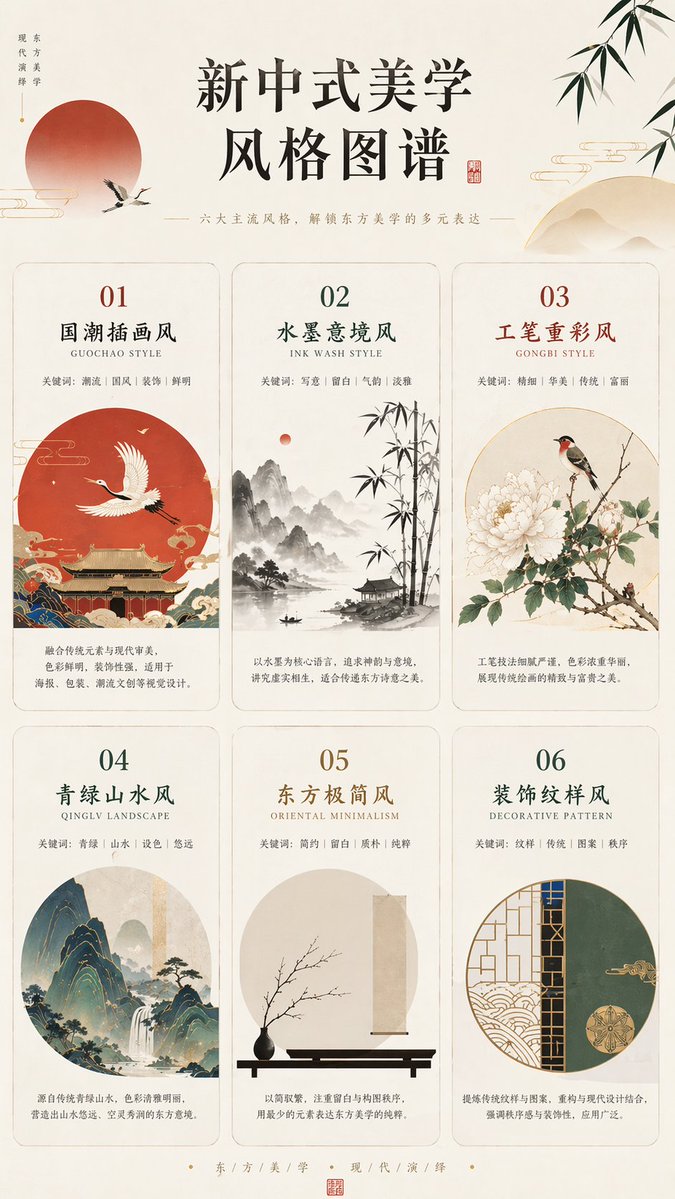
Neue chinesische Ästhetik-Stiltabelle
Diese Aufforderung generiert ein ausgefeiltes Infografik-Poster, das sechs wichtige neue chinesische visuelle Stile zur redaktionellen Inspiration, als Designreferenz oder für ästhetische Trendboards präsentiert.
Dies ist ein GPT Image 2 -Prompt für Grafik & Poster . Verwenden Sie den unten stehenden, kopierfertigen Prompt, um ähnliche Grafiken zu erstellen, und überprüfen Sie vor der Wiederverwendung Awesome GPT Image 2 Prompts -Quellenangaben sowie die kommerziellen Nutzungsrechte.
Free 1K preview
Generate one preview image instantly, no sign-up required.
Eingabeaufforderung
Kopierfertige Eingabeaufforderung
{
  "type": "Chinese aesthetic style chart poster",
  "theme": "{argument name=\"headline text\" default=\"New Chinese Style Aesthetic Atlas\"}",
  "subtitle": "Six major mainstream styles, unlocking the diverse expression of Oriental aesthetics",
  "orientation": "vertical poster",
  "aspect_ratio": "2:3",
  "background": {
    "color": "warm ivory parchment",
    "texture": "subtle rice-paper grain",
    "decorative_elements_count": 7,
    "decorative_elements": [
      "large red sun at upper left",
      "two flying cranes near the sun",
      "bamboo leaves hanging from upper right corner",
      "soft beige abstract mountains at upper right",
      "thin gold cloud lines on left",
      "thin gold cloud lines on right",
      "small red seal stamp near title area and bottom center"
    ]
  },
  "style": "elegant new Chinese design, refined editorial infographic, balanced negative space, premium print poster",
  "layout": {
    "grid": {
      "columns": 3,
      "rows": 2,
      "card_count": 6
    },
    "sections": [
      {
        "title": "01 National Trend Illustration Style",
        "subtitle": "GUOCHAO STYLE",
        "position": "top-left",
        "count": 1,
        "keywords": [
          "Trend",
          "Guofeng",
          "Decoration",
          "Vivid"
        ],
        "image": "a bold illustration with a large red sun, a white crane in flight, ornate traditional palace rooftops, stylized blue waves and clouds in saturated red, gold, teal, and cream",
        "description": "Blending traditional elements with modern aesthetics, featuring vivid colors and strong decorative qualities, suitable for visual design such as posters, packaging, and trendy cultural creations."
      },
      {
        "title": "02 Ink Wash Style",
        "subtitle": "INK WASH STYLE",
        "position": "top-center",
        "count": 1,
        "keywords": [
          "xieyi",
          "negative space",
          "qiyun",
          "danya"
        ],
        "image": "misty monochrome landscape with layered mountains, lake water, a small boat, pavilion, bamboo stalks, and a tiny red sun, rendered in soft ink wash",
        "description": "Centered around ink as its core language, it pursues spirit and artistic conception, emphasizing the interplay of emptiness and substance, and is suitable for conveying the poetic beauty of the Orient."
      },
      {
        "title": "03 Gongbi Heavy Color Style",
        "subtitle": "GONGBI STYLE",
        "position": "top-right",
        "count": 1,
        "keywords": [
          "refined",
          "splendid",
          "traditional",
          "luxurious"
        ],
        "image": "meticulous gongbi painting of a bird perched on a flowering branch with a large white peony, detailed outlines and rich soft colors inside a pale circular frame",
        "description": "meticulous and precise brushwork, rich and gorgeous colors, showcasing the exquisite and opulent beauty of traditional painting."
      },
      {
        "title": "04 Qinglü Shan Shui Style",
        "subtitle": "QINGLÜ LANDSCAPE",
        "position": "bottom-left",
        "count": 1,
        "keywords": [
          "qinglü",
          "shanshui",
          "shese",
          "youyuan"
        ],
        "image": "blue-green shanshui landscape in a circular frame with layered mountains, waterfall, pine trees, mist, and mineral pigments in teal, slate blue, and muted gold",
        "description": "Originating from the traditional qinglü landscape painting, the colors are clear and bright, creating a distant, ethereal, and refined oriental artistic conception."
      },
      {
        "title": "05 Eastern Minimalism",
        "subtitle": "ORIENTAL MINIMALISM",
        "position": "bottom-center",
        "count": 1,
        "keywords": [
          "Minimalist",
          "negative space",
          "Rustic",
          "Pure"
        ],
        "image": "minimal still life with a black vase holding a bare branch, a low dark wooden table, and a hanging scroll against a pale wall with abundant empty space",
        "description": "Control complexity with simplicity, focusing on negative space and compositional order, using the fewest elements to express the purity of Eastern aesthetics."
      },
      {
        "title": "06 Decorative Pattern Style",
        "subtitle": "DECORATIVE PATTERN",
        "position": "bottom-right",
        "count": 1,
        "keywords": [
          "pattern",
          "traditional",
          "Pattern",
          "Order"
        ],
        "image": "decorative geometric composition in a circular frame combining lattice window motifs, wave patterns, dark green panels, gold lines, and a round ornamental emblem",
        "description": "Refine traditional patterns and designs, reconstruct them with modern design, emphasize a sense of order and decoration, and apply them widely."
      }
    ],
    "header": {
      "top_left_vertical_text": "Eastern Aesthetics, Modern Interpretation",
      "bottom_text": "Eastern Aesthetics · Modern Interpretation"
    }
  },
  "typography": {
    "title_font": "large bold Songti-style Chinese serif",
    "subtitle_font": "small elegant serif",
    "number_style": "large colored numerals 01 to 06 above each card",
    "body_text": "small Chinese serif paragraphs",
    "english_labels": true
  },
  "color_palette": {
    "main": [
      "ivory",
      "black",
      "deep red",
      "gold",
      "sage green",
      "teal",
      "mist gray",
      "beige"
    ]
  },
  "rendering": "clean high-resolution poster design, sharp print typography, delicate Chinese illustration details, symmetrical spacing, museum-grade editorial aesthetic"
}
Eingabeaufforderungsvariablen
In der Eingabeaufforderung befinden sich bearbeitbare Argumentplatzhalter mit ihren Standardwerten.
Best for
- - Grafik & Poster visual exploration
- - Image generation and reference-image edits
- - Reusable briefs that keep source attribution visible
Change these parts
- - Subject, product, character, or scene
- - Aspect ratio, camera, lighting, and background
- - Brand, text, color, and output constraints
Recommended model and settings
- - Model: gpt-image-2
- - Input mode: Text zu Bild
- - Aspect ratio: source
- - Commercial status: review original source
How to use this prompt
- 1. Copy the prompt and preserve its structure for the first test.
- 2. Replace the subject, context, and publishing channel.
- 3. Change one camera, lighting, or style variable per iteration.
- 4. Inspect the output, source, text, and rights before reuse.
Limitations, source, and reuse cautions
- - Generated output is an editable draft, not factual, legal, or rights evidence.
- - Review the linked source, people, brands, logos, text, and third-party media before commercial use.
Weitere Fälle in dieser Kategorie
Priorisiert nach Kategorie, Kompatibilität der Eingabemodi, Qualität und geringerem Risiko.

Hinweise zur Wiederverwendung und Quellenangabe
Verwenden Sie diese Eingabeaufforderung sicher, nachdem Sie den Fall in der Vorschau angezeigt haben.
- 1.Kopieren Sie die Eingabeaufforderung oder öffnen Sie sie direkt in Dovoo mit der Schaltfläche „Generieren“.
- 2.Passen Sie Variablen, Seitenverhältnis und Referenzbilder an Ihren Anwendungsfall an.
- 3.Vor der Veröffentlichung oder kostenpflichtigen Nutzung sollten Sie die Rechte an der Quelle, die Anforderungen an die Namensnennung sowie die Risiken für die Marke oder das Abbild prüfen.