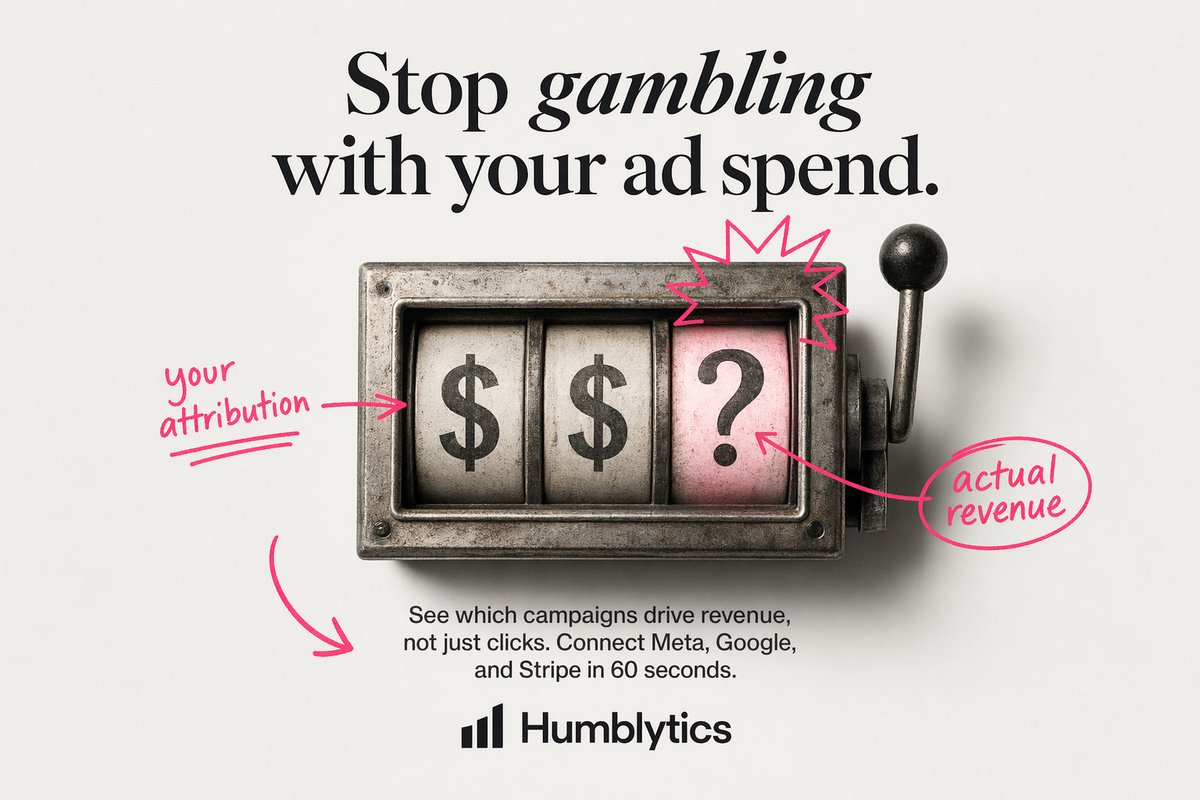
Minimale Attributionsanzeige für Spielautomaten
Diese Eingabeaufforderung generiert eine ansprechende statische Marketinganzeige mit einer nostalgischen Spielautomaten-Metapher, handgeschriebenen Anmerkungen und einer markanten, zentrierten Typografie für die Promotion von Analyse- oder Attributionssoftware.
Dies ist ein GPT Image 2 -Prompt für Produkt & Vertrieb . Verwenden Sie den unten stehenden, kopierfertigen Prompt, um ähnliche Grafiken zu erstellen, und überprüfen Sie vor der Wiederverwendung Awesome GPT Image 2 Prompts -Quellenangaben sowie die kommerziellen Nutzungsrechte.
Free 1K preview
Generate one preview image instantly, no sign-up required.
Eingabeaufforderung
Kopierfertige Eingabeaufforderung
Create a clean minimalist static ad on an off-white light gray studio background with a centered editorial layout. At the top, place a large luxury-fashion-style serif headline in black reading {argument name="headline text" default="Stop gambling with your ad spend."}, with the word "gambling" set in italic serif for emphasis. In the middle, show a vintage metal slot-machine window viewed straight on, slightly weathered and realistic, with 3 vertical reels inside a rectangular steel housing and a lever with a black knob on the right side. The 3 reels must display, from left to right, "$", "$", and "?". Make the rightmost reel background pale pink while the first 2 reels are aged white. Add a hand-drawn neon-pink annotation style over the image: 1 arrow-and-note on the left pointing to the first reel reading {argument name="left annotation" default="your attribution"}, 1 starburst scribble above the pink question-mark reel, 1 arrow from the question-mark reel to a circled note on the right reading {argument name="right annotation" default="actual revenue"}, and 1 large curved arrow in the lower left pointing toward the body copy area. Below the slot machine, center a short sans-serif paragraph in black reading {argument name="body text" default="See which campaigns drive revenue, not just clicks. Connect Meta, Google, and Stripe in 60 seconds."}. At the bottom center, place a simple black analytics-style bar logo icon followed by the bold sans-serif brand name {argument name="brand name" default="Humblytics"}. Use strong text fidelity, polished product-ad composition, soft studio shadows, restrained palette of black, steel gray, off-white, and hot pink, and a modern direct-response ad aesthetic.Eingabeaufforderungsvariablen
In der Eingabeaufforderung befinden sich bearbeitbare Argumentplatzhalter mit ihren Standardwerten.
Best for
- - Produkt & Vertrieb visual exploration
- - Image generation and reference-image edits
- - Reusable briefs that keep source attribution visible
Change these parts
- - Subject, product, character, or scene
- - Aspect ratio, camera, lighting, and background
- - Brand, text, color, and output constraints
Recommended model and settings
- - Model: gpt-image-2
- - Input mode: Text zu Bild
- - Aspect ratio: source
- - Commercial status: review original source
How to use this prompt
- 1. Copy the prompt and preserve its structure for the first test.
- 2. Replace the subject, context, and publishing channel.
- 3. Change one camera, lighting, or style variable per iteration.
- 4. Inspect the output, source, text, and rights before reuse.
Limitations, source, and reuse cautions
- - Generated output is an editable draft, not factual, legal, or rights evidence.
- - Review the linked source, people, brands, logos, text, and third-party media before commercial use.
Weitere Fälle in dieser Kategorie
Priorisiert nach Kategorie, Kompatibilität der Eingabemodi, Qualität und geringerem Risiko.
Hinweise zur Wiederverwendung und Quellenangabe
Verwenden Sie diese Eingabeaufforderung sicher, nachdem Sie den Fall in der Vorschau angezeigt haben.
- 1.Kopieren Sie die Eingabeaufforderung oder öffnen Sie sie direkt in Dovoo mit der Schaltfläche „Generieren“.
- 2.Passen Sie Variablen, Seitenverhältnis und Referenzbilder an Ihren Anwendungsfall an.
- 3.Vor der Veröffentlichung oder kostenpflichtigen Nutzung sollten Sie die Rechte an der Quelle, die Anforderungen an die Namensnennung sowie die Risiken für die Marke oder das Abbild prüfen.