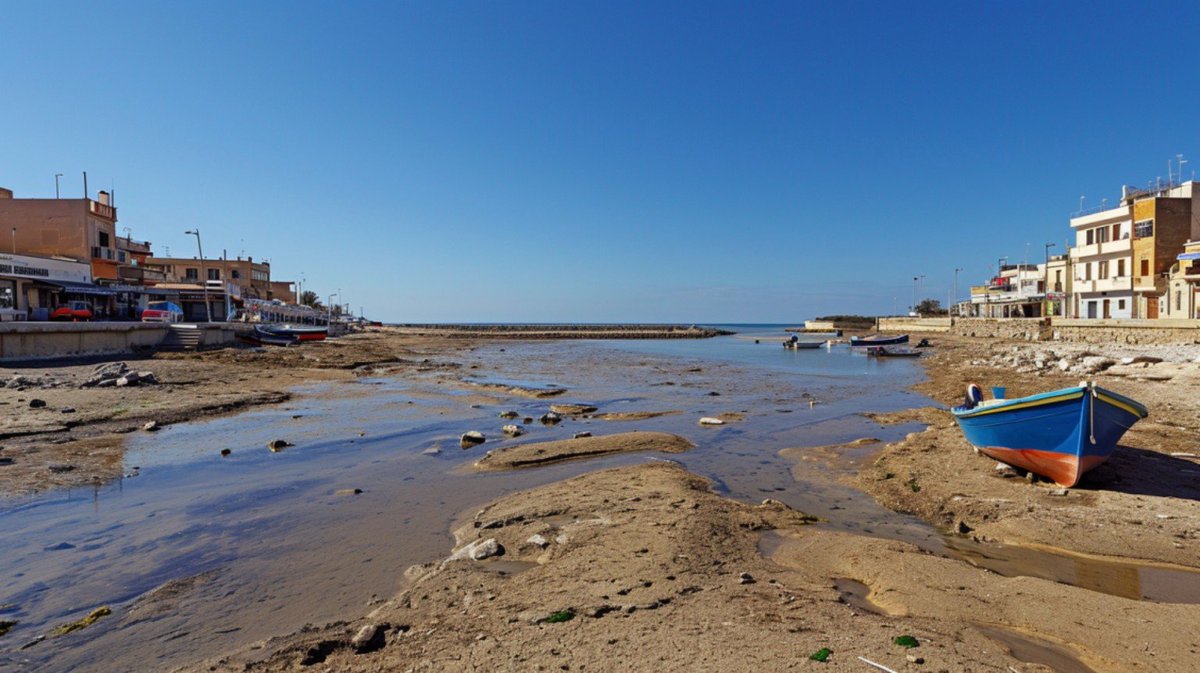
Mediterranean Low Tide Harbor
A realistic wide-angle travel photograph prompt for generating a quiet Mediterranean fishing harbor at low tide with boats, buildings, and bright midday light.
Dies ist ein GPT Image 2 -Prompt für Landschaft & Natur . Verwenden Sie den unten stehenden, kopierfertigen Prompt, um ähnliche Grafiken zu erstellen, und überprüfen Sie vor der Wiederverwendung Awesome GPT Image 2 Prompts -Quellenangaben sowie die kommerziellen Nutzungsrechte.
Free 1K preview
Generate one preview image instantly, no sign-up required.
Eingabeaufforderung
Kopierfertige Eingabeaufforderung
Create an ultra-realistic wide-angle documentary landscape photograph of a quiet Mediterranean fishing village inlet at low tide under a clear deep blue sky. The scene is shot from ground level on a muddy, sandy tidal flat with shallow reflective water channels winding toward the sea in the center distance. On the right foreground, place one prominent small wooden fishing boat beached on the sand, painted {argument name="boat color" default="bright blue with a red-orange lower hull and yellow trim"}, casting a dark shadow. In the midground, include exactly three additional small boats floating or resting in the shallow harbor: one red-and-blue boat near the left quay, one small dark boat near the center-right water, and one blue-and-white boat farther right. Low-rise coastal buildings line both sides of the inlet: older tan and beige shopfronts and apartments on the left quay, white and cream apartment blocks on the right seawall, with sparse streetlights, railings, parked cars, and a stone embankment. The horizon opens to a calm blue sea beyond a low breakwater. Lighting should be harsh bright midday sun with crisp shadows, natural colors, candid travel-photography realism, slight lens softness and minor imperfections, 16:9 aspect ratio, no people visible, no text overlay, no watermark.Eingabeaufforderungsvariablen
In der Eingabeaufforderung befinden sich bearbeitbare Argumentplatzhalter mit ihren Standardwerten.
Best for
- - Landschaft & Natur visual exploration
- - Image generation and reference-image edits
- - Reusable briefs that keep source attribution visible
Change these parts
- - Subject, product, character, or scene
- - Aspect ratio, camera, lighting, and background
- - Brand, text, color, and output constraints
Recommended model and settings
- - Model: gpt-image-2
- - Input mode: Text zu Bild
- - Aspect ratio: source
- - Commercial status: review original source
How to use this prompt
- 1. Copy the prompt and preserve its structure for the first test.
- 2. Replace the subject, context, and publishing channel.
- 3. Change one camera, lighting, or style variable per iteration.
- 4. Inspect the output, source, text, and rights before reuse.
Limitations, source, and reuse cautions
- - Generated output is an editable draft, not factual, legal, or rights evidence.
- - Review the linked source, people, brands, logos, text, and third-party media before commercial use.
Weitere Fälle in dieser Kategorie
Priorisiert nach Kategorie, Kompatibilität der Eingabemodi, Qualität und geringerem Risiko.
Hinweise zur Wiederverwendung und Quellenangabe
Verwenden Sie diese Eingabeaufforderung sicher, nachdem Sie den Fall in der Vorschau angezeigt haben.
- 1.Kopieren Sie die Eingabeaufforderung oder öffnen Sie sie direkt in Dovoo mit der Schaltfläche „Generieren“.
- 2.Passen Sie Variablen, Seitenverhältnis und Referenzbilder an Ihren Anwendungsfall an.
- 3.Vor der Veröffentlichung oder kostenpflichtigen Nutzung sollten Sie die Rechte an der Quelle, die Anforderungen an die Namensnennung sowie die Risiken für die Marke oder das Abbild prüfen.