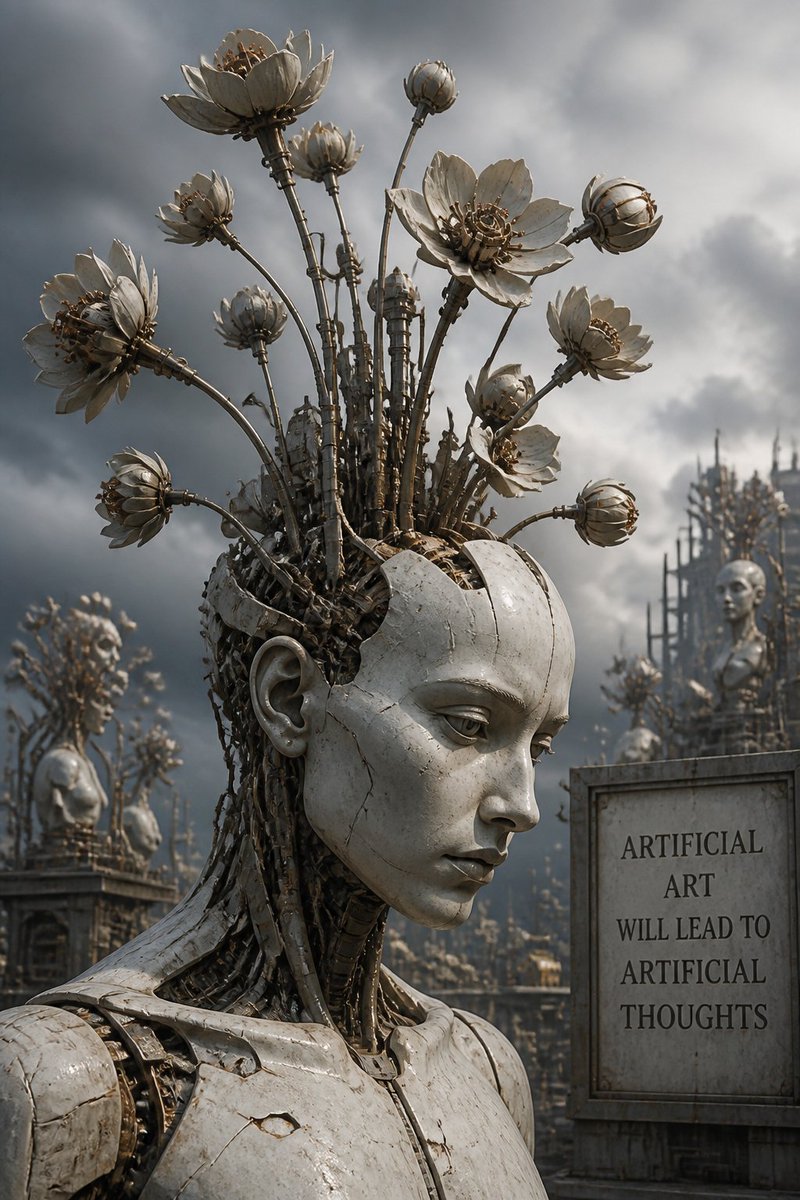
Mechanisches Lotus-Android-Porträt
Eine filmische Vorgabe zur Erstellung einer surrealen, fotorealistischen Androidenbüste, die in einem dystopischen künstlichen Garten mit mechanischen Blumen gekrönt ist.
Dies ist ein GPT Image 2 -Prompt für Porträt & Charakter . Verwenden Sie den unten stehenden, kopierfertigen Prompt, um ähnliche Grafiken zu erstellen, und überprüfen Sie vor der Wiederverwendung Awesome GPT Image 2 Prompts -Quellenangaben sowie die kommerziellen Nutzungsrechte.
Free 1K preview
Generate one preview image instantly, no sign-up required.
Eingabeaufforderung
Kopierfertige Eingabeaufforderung
Create a dark cinematic surreal sci-fi portrait in a ruined artificial garden: a cracked white porcelain humanoid android bust seen from the chest up, turned slightly left, with exposed brass and steel mechanisms in the neck and skull, one realistic human-like ear visible on the left side, and a smooth vertical gray rectangular featureless mask covering the entire face. From the open head grows an elaborate crown of exactly 11 mechanical lotus-like flowers and seed pods on long thin articulated metal stems: 5 open flowers with layered ivory metal petals, 5 closed round pods, and 1 small half-open bloom, all tarnished, jointed, and biomechanical. The android body is made of aged ceramic armor plates with hairline cracks, chips, seams, rivets, and exposed dark cables. Background: a dystopian cemetery or museum city of artificial statues and skeletal towers under a stormy gray sky, shallow depth of field, with a stone sign on the right that clearly reads “ARTIFICIAL ART WILL LEAD TO ARTIFICIAL THOUGHTS” in black serif capital letters over five centered lines. Use muted ivory, gunmetal, brass, charcoal, and cold gray tones, dramatic overcast lighting, high-detail photorealism, baroque mechanical ornamentation, melancholic atmosphere, vertical 2:3 composition, no watermark, no extra text besides the sign. Customize the scene as a portrait of {argument name="android subject" default="a cracked white porcelain humanoid android"} with {argument name="head growth" default="mechanical lotus-like flowers and seed pods"}, set in {argument name="background setting" default="a ruined artificial garden cemetery"}, with the sign text {argument name="sign text" default="ARTIFICIAL ART WILL LEAD TO ARTIFICIAL THOUGHTS"}, using {argument name="color palette" default="muted ivory, gunmetal, brass, charcoal, and cold gray"}.Eingabeaufforderungsvariablen
In der Eingabeaufforderung befinden sich bearbeitbare Argumentplatzhalter mit ihren Standardwerten.
Best for
- - Porträt & Charakter visual exploration
- - Image generation and reference-image edits
- - Reusable briefs that keep source attribution visible
Change these parts
- - Subject, product, character, or scene
- - Aspect ratio, camera, lighting, and background
- - Brand, text, color, and output constraints
Recommended model and settings
- - Model: gpt-image-2
- - Input mode: Text zu Bild
- - Aspect ratio: source
- - Commercial status: review original source
How to use this prompt
- 1. Copy the prompt and preserve its structure for the first test.
- 2. Replace the subject, context, and publishing channel.
- 3. Change one camera, lighting, or style variable per iteration.
- 4. Inspect the output, source, text, and rights before reuse.
Limitations, source, and reuse cautions
- - Generated output is an editable draft, not factual, legal, or rights evidence.
- - Review the linked source, people, brands, logos, text, and third-party media before commercial use.
Weitere Fälle in dieser Kategorie
Priorisiert nach Kategorie, Kompatibilität der Eingabemodi, Qualität und geringerem Risiko.
Hinweise zur Wiederverwendung und Quellenangabe
Verwenden Sie diese Eingabeaufforderung sicher, nachdem Sie den Fall in der Vorschau angezeigt haben.
- 1.Kopieren Sie die Eingabeaufforderung oder öffnen Sie sie direkt in Dovoo mit der Schaltfläche „Generieren“.
- 2.Passen Sie Variablen, Seitenverhältnis und Referenzbilder an Ihren Anwendungsfall an.
- 3.Vor der Veröffentlichung oder kostenpflichtigen Nutzung sollten Sie die Rechte an der Quelle, die Anforderungen an die Namensnennung sowie die Risiken für die Marke oder das Abbild prüfen.