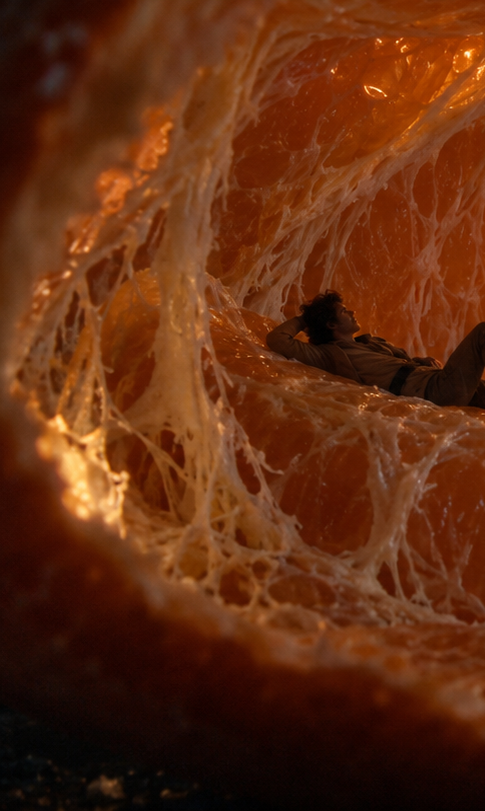
Miniature World Inside a Tangerine
A complex macro photography prompt depicting tiny humans living inside a peeled tangerine, focused on realistic light transmission through citrus segments.
Dies ist ein GPT Image 2 -Prompt für Andere Inspiration . Verwenden Sie den unten stehenden, kopierfertigen Prompt, um ähnliche Grafiken zu erstellen, und überprüfen Sie vor der Wiederverwendung Awesome GPT Image 2 Prompts -Quellenangaben sowie die kommerziellen Nutzungsrechte.
Benötigen Sie den vollständigen Prompt-Satz? Verwenden Sie den Andere Inspiration Weitere verwandte Beispiele finden Sie im Themen-Hub oder öffnen Sie die GPT Image 2 Prompt-Katalog für das vollständige Beispielverzeichnis, wiederverwendbare Strukturen und Quellenangaben.
Free 1K preview
Generate one preview image instantly, no sign-up required.
2016/4000
Eingabeaufforderung
Kopierfertige Eingabeaufforderung
Macro cinematic photography inside a {argument name="fruit" default="peeled tangerine"} resting on a dark stone surface. The peel folds outward like petals, forming a cave. Overhead, the citrus segments arch into a translucent orange dome, while the white pith reads like pale plaster.
{argument name="occupants" default="Three figures, each about two centimeters tall"}, inhabit the cave: one lies on a citrus segment as if it were a bed; one climbs upward along the white pith ridge between two segments as if it were a staircase; one stands at the cave entrance looking out into darkness. A single tangerine seed lies on the ground, scaled like a massive millstone. Every membrane layer and every individual juice vesicle is fully resolved.
A {argument name="lighting" default="single low-angle sun"} is positioned behind the fruit and is the only light source, producing true transmitted light through the citrus flesh. The orange brightness of the dome must come from light physically passing through the fruit itself, not from any artificial glow effect. Individual juice vesicles illuminate one by one in transmission, while thicker pith appears as darker veins. The cave floor is illuminated only by this transmitted light. Outside the cave entrance is completely black. No fill light.
Anamorphic 2.39:1, anamorphic lens with macro adapter, f/4. Sparse defocused light points outside the cave appear as vertically oval bokeh with subtle horizontal anamorphic stretch. Deep focus, focus stacked.
Kodak Vision3 500T motion picture negative, tungsten white balance, warm saturated transmitted orange highlights with deep cyan shadows. Black Pro-Mist 1/4. Strong transmitted-light edges along the thinnest parts of the fruit show visible red halation.
Overall exposure reduced by one stop. The darkness outside the cave remains truly black. Fine film grain, more visible in the shadows. No digital sharpening, no HDR, no orange-and-teal grading, no lens-flare effects, no artificial glow, no CGI plastic texture.
Eingabeaufforderungsvariablen
In der Eingabeaufforderung befinden sich bearbeitbare Argumentplatzhalter mit ihren Standardwerten.
Variable
fruit
Standard
peeled tangerine
Variable
occupants
Standard
Three figures, each about two centimeters tall
Variable
lighting
Standard
single low-angle sun
Best for
- - Andere Inspiration visual exploration
- - Image generation and reference-image edits
- - Reusable briefs that keep source attribution visible
Change these parts
- - Subject, product, character, or scene
- - Aspect ratio, camera, lighting, and background
- - Brand, text, color, and output constraints
Recommended model and settings
- - Model: gpt-image-2
- - Input mode: Text zu Bild
- - Aspect ratio: source
- - Commercial status: review original source
How to use this prompt
- 1. Copy the prompt and preserve its structure for the first test.
- 2. Replace the subject, context, and publishing channel.
- 3. Change one camera, lighting, or style variable per iteration.
- 4. Inspect the output, source, text, and rights before reuse.
Limitations, source, and reuse cautions
- - Generated output is an editable draft, not factual, legal, or rights evidence.
- - Review the linked source, people, brands, logos, text, and third-party media before commercial use.
Importiert von Awesome GPT Image 2 Prompts . Quellenangabe erforderlich. Status der kommerziellen Nutzung: allowed ; Rechte an der Quelle vor kostenpflichtiger Nutzung prüfen.
Weitere Fälle in dieser Kategorie
Priorisiert nach Kategorie, Kompatibilität der Eingabemodi, Qualität und geringerem Risiko.
Hinweise zur Wiederverwendung und Quellenangabe
Verwenden Sie diese Eingabeaufforderung sicher, nachdem Sie den Fall in der Vorschau angezeigt haben.
- 1.Kopieren Sie die Eingabeaufforderung oder öffnen Sie sie direkt in Dovoo mit der Schaltfläche „Generieren“.
- 2.Passen Sie Variablen, Seitenverhältnis und Referenzbilder an Ihren Anwendungsfall an.
- 3.Vor der Veröffentlichung oder kostenpflichtigen Nutzung sollten Sie die Rechte an der Quelle, die Anforderungen an die Namensnennung sowie die Risiken für die Marke oder das Abbild prüfen.