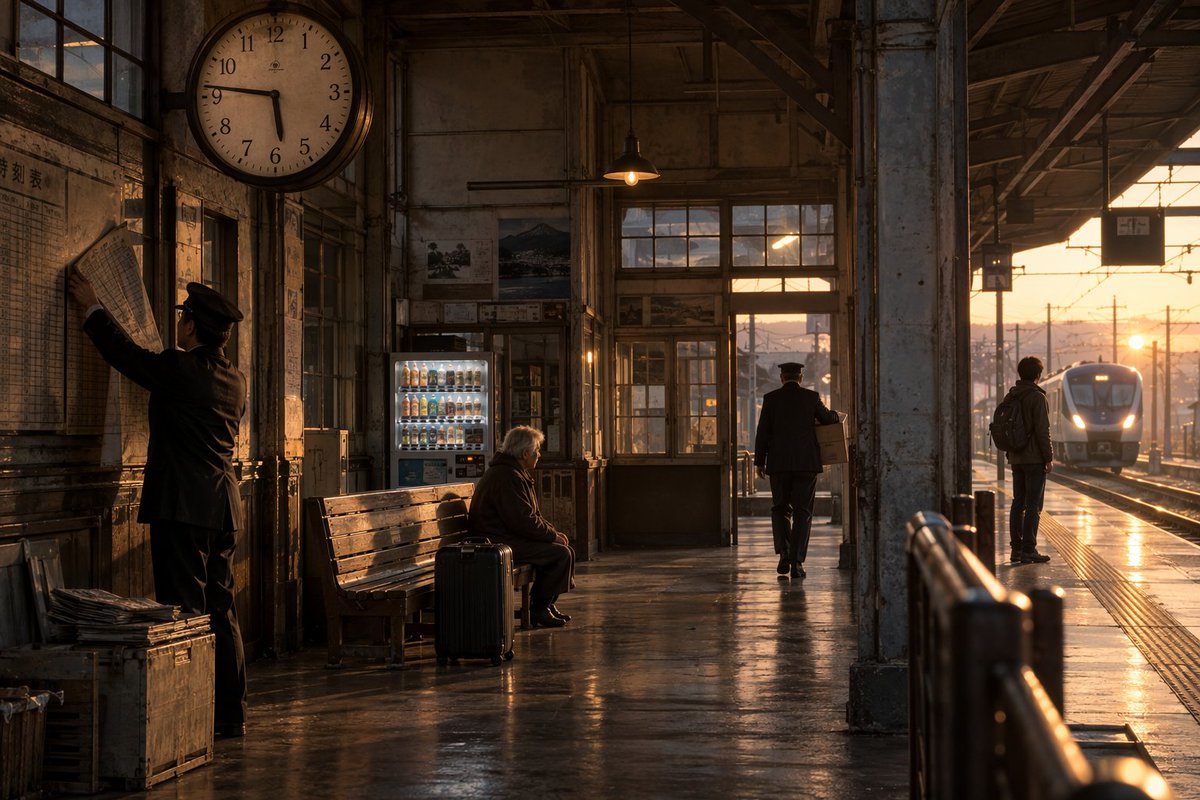
Old Japanese Station at Sunset
A cinematic photorealistic prompt for generating a nostalgic rainy Japanese train station platform with four figures and an approaching train.
Dies ist ein GPT Image 2 -Prompt für Landschaft & Natur . Verwenden Sie den unten stehenden, kopierfertigen Prompt, um ähnliche Grafiken zu erstellen, und überprüfen Sie vor der Wiederverwendung Awesome GPT Image 2 Prompts -Quellenangaben sowie die kommerziellen Nutzungsrechte.
Benötigen Sie den vollständigen Prompt-Satz? Verwenden Sie den Landschaft & Natur Weitere verwandte Beispiele finden Sie im Themen-Hub oder öffnen Sie die GPT Image 2 Prompt-Katalog für das vollständige Beispielverzeichnis, wiederverwendbare Strukturen und Quellenangaben.
Free 1K preview
Generate one preview image instantly, no sign-up required.
1852/4000
Eingabeaufforderung
Kopierfertige Eingabeaufforderung
Create a cinematic, realistic scene: a Japanese countryside old train station platform during the golden hour after the rain, with a view from the covered station hall looking out towards the tracks. The architecture should present a weathered and nostalgic texture: dark wooden beams, peeling plaster walls, old metal pillars, large gridded windows, worn benches, timetable items, posters, and wet concrete pavement reflecting a warm sunset. The scene should include 4 people: on the far left, a silhouetted uniformed station attendant is checking or updating a large paper timetable on the wall; in the left-center, an elderly man sits alone on a wooden chair with a black suitcase beside him; a uniformed staff member holding a folder or clipboard is walking away in the middle corridor; on the right platform, a young traveler with a backpack faces an approaching modern train. A large circular analog station clock hangs on the left wall, displaying the time as {argument name="clock time" default="9:45"}; a brightly lit vending machine is in the left background; newspapers or crates are stacked in the lower left foreground; a modern train with headlights on is approaching on the right track. The scene should create a quiet, melancholic, and realistic atmosphere, with a warm orange sunset shining in from the right, distant mountains, power lines, long shadows, soft mist, fine textures, and natural depth of field visible in the distance. The image should not contain any text titles or watermarks. Use a wide 3:2 aspect ratio, ultra-detailed documentary photography style, shot with {argument name="camera lens" default="nostalgic rural Japanese station"}, presenting a nostalgic atmosphere of {argument name="lighting mood" default="Warm, cinematic sunset reflections"} and {argument name="location" default="Old Japanese train station"}.Eingabeaufforderungsvariablen
In der Eingabeaufforderung befinden sich bearbeitbare Argumentplatzhalter mit ihren Standardwerten.
Variable
clock time
Standard
9:45
Variable
camera lens
Standard
nostalgic rural Japanese station
Variable
lighting mood
Standard
Warm, cinematic sunset reflections
Variable
location
Standard
Old Japanese train station
Best for
- - Landschaft & Natur visual exploration
- - Image generation and reference-image edits
- - Reusable briefs that keep source attribution visible
Change these parts
- - Subject, product, character, or scene
- - Aspect ratio, camera, lighting, and background
- - Brand, text, color, and output constraints
Recommended model and settings
- - Model: gpt-image-2
- - Input mode: Text zu Bild
- - Aspect ratio: source
- - Commercial status: review original source
How to use this prompt
- 1. Copy the prompt and preserve its structure for the first test.
- 2. Replace the subject, context, and publishing channel.
- 3. Change one camera, lighting, or style variable per iteration.
- 4. Inspect the output, source, text, and rights before reuse.
Limitations, source, and reuse cautions
- - Generated output is an editable draft, not factual, legal, or rights evidence.
- - Review the linked source, people, brands, logos, text, and third-party media before commercial use.
Importiert von Awesome GPT Image 2 Prompts . Quellenangabe erforderlich. Status der kommerziellen Nutzung: allowed ; Rechte an der Quelle vor kostenpflichtiger Nutzung prüfen.
Weitere Fälle in dieser Kategorie
Priorisiert nach Kategorie, Kompatibilität der Eingabemodi, Qualität und geringerem Risiko.
Hinweise zur Wiederverwendung und Quellenangabe
Verwenden Sie diese Eingabeaufforderung sicher, nachdem Sie den Fall in der Vorschau angezeigt haben.
- 1.Kopieren Sie die Eingabeaufforderung oder öffnen Sie sie direkt in Dovoo mit der Schaltfläche „Generieren“.
- 2.Passen Sie Variablen, Seitenverhältnis und Referenzbilder an Ihren Anwendungsfall an.
- 3.Vor der Veröffentlichung oder kostenpflichtigen Nutzung sollten Sie die Rechte an der Quelle, die Anforderungen an die Namensnennung sowie die Risiken für die Marke oder das Abbild prüfen.