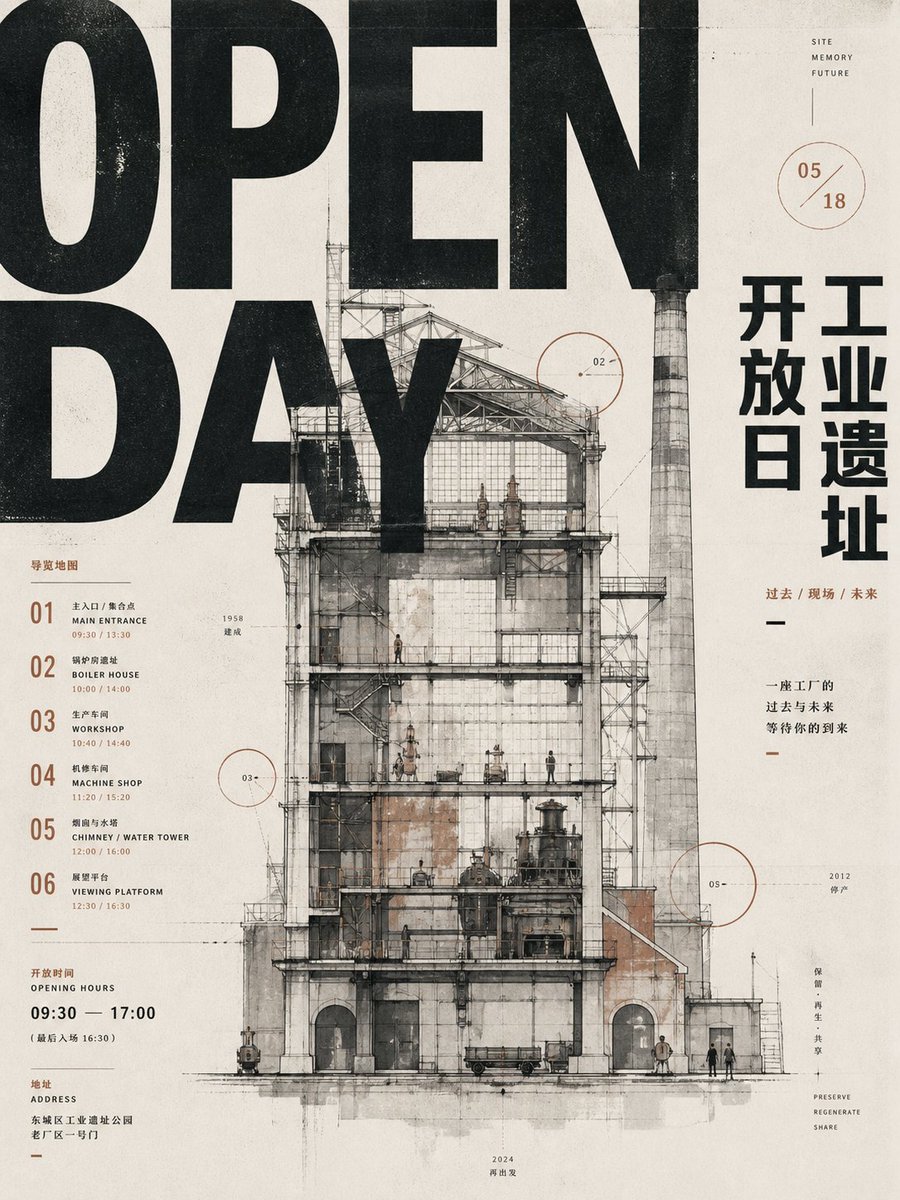
Industrial Heritage Open Day Poster
A detailed prompt for generating a distressed industrial-site open day poster with giant typography, Chinese layout text, and an architectural factory cutaway.
Dies ist ein GPT Image 2 -Prompt für Grafik & Poster . Verwenden Sie den unten stehenden, kopierfertigen Prompt, um ähnliche Grafiken zu erstellen, und überprüfen Sie vor der Wiederverwendung Awesome GPT Image 2 Prompts -Quellenangaben sowie die kommerziellen Nutzungsrechte.
Free 1K preview
Generate one preview image instantly, no sign-up required.
Eingabeaufforderung
Kopierfertige Eingabeaufforderung
Goal: Create a vertical industrial heritage opening-day poster for {argument name="event name" default="OPEN DAY"}, combining oversized brutal typography, Chinese museum-poster text, architectural cross-section drawing, ink stains, and aged printed-paper texture.

Canvas: Portrait 3:4 poster, off-white warm paper background with visible grain, scratches, speckles, faint fold lines, light gray smudges, and subtle letterpress/risograph misregistration. Use a restrained palette of black, charcoal gray, faded beige, rust brown, and thin red-brown annotation lines.

Layout: Dominant typography fills the upper and left side: huge cropped black condensed sans-serif letters reading “OPEN” across the top and “DAY” beneath it, so large that the words are partially cut off by the canvas edges and overlap the architecture. Center the composition on a detailed old factory building elevation/cutaway, occupying most of the lower two-thirds. Place a tall chimney on the right side of the building, rising into the upper area. Keep the right margin for vertical Chinese title text and small annotations. Keep the left margin for a numbered guide list and opening-hour details.

Main subject: A ruined industrial site rendered as a precise architectural ink-and-watercolor section drawing. Show a tall multi-level factory frame with exposed steel trusses, scaffolding, platforms, staircases, old brick and concrete walls, large rectangular windows, arched ground-floor openings, pipes, tanks, small machinery, rail-cart-like objects, and tiny human figures for scale. Add a very tall cylindrical striped smokestack/chimney to the right, weathered and gray. The building should feel like an open industrial relic being preserved and regenerated, with transparent cutaway floors and visible internal structure.

Text content: Include exactly 6 numbered guide entries on the left, each with a large two-digit number and bilingual-style small labels: 01 Main Entrance, 02 Boiler House, 03 Workshop, 04 Machine Shop, 05 Chimney / Water Tower, 06 Viewing Platform. Include small time ranges next to entries, such as 09:30 / 13:30, 10:00 / 14:00, 10:40 / 14:40, 11:20 / 15:20, 12:00 / 16:00, 12:30 / 16:30. Add an opening-hours block reading “OPENING HOURS 09:30 — 17:00” with smaller Chinese text beneath. Add an address block with small Chinese text. On the right side, add large vertical Chinese characters for {argument name="Chinese title" default="开工 开放日 工业遗址"}, arranged in three stacked columns. Add a small caption reading “过去 / 现场 / 未来” and a short Chinese slogan below it. Add tiny English words near the upper right: “SITE / MEMORY / FUTURE”. Near the lower right add tiny stacked words: “PRESERVE / REGENERATE / SHARE”.

Annotations: Include exactly 3 thin red-brown circular callout graphics labeled 02, 03, and 05 positioned around the building; also include one separate circular date mark near the upper right reading {argument name="date mark" default="05 / 18"}. Add delicate leader lines, small tick marks, microscopic labels, and a few year notes such as 1958, 2012, and 2024.

Visual style: Industrial design poster, architectural blueprint meets ink-wash illustration, archival museum print, worn offset printing, black distressed typography, gridded but asymmetrical Swiss poster composition, subtle rust stains and ink bleeds. The typography should look bold, printed, slightly rough, and physically integrated with the paper. Keep all elements flat and poster-like, not photorealistic.

Constraints: Use exactly one main factory building, exactly one tall chimney, exactly 6 guide-list items, exactly 3 numbered architectural callout circles plus 1 date circle. Avoid bright colors, glossy effects, modern glass architecture, extra logos, QR codes, or watermarks.
Eingabeaufforderungsvariablen
In der Eingabeaufforderung befinden sich bearbeitbare Argumentplatzhalter mit ihren Standardwerten.
Best for
- - Grafik & Poster visual exploration
- - Image generation and reference-image edits
- - Reusable briefs that keep source attribution visible
Change these parts
- - Subject, product, character, or scene
- - Aspect ratio, camera, lighting, and background
- - Brand, text, color, and output constraints
Recommended model and settings
- - Model: gpt-image-2
- - Input mode: Text zu Bild
- - Aspect ratio: source
- - Commercial status: review original source
How to use this prompt
- 1. Copy the prompt and preserve its structure for the first test.
- 2. Replace the subject, context, and publishing channel.
- 3. Change one camera, lighting, or style variable per iteration.
- 4. Inspect the output, source, text, and rights before reuse.
Limitations, source, and reuse cautions
- - Generated output is an editable draft, not factual, legal, or rights evidence.
- - Review the linked source, people, brands, logos, text, and third-party media before commercial use.
Weitere Fälle in dieser Kategorie
Priorisiert nach Kategorie, Kompatibilität der Eingabemodi, Qualität und geringerem Risiko.
Hinweise zur Wiederverwendung und Quellenangabe
Verwenden Sie diese Eingabeaufforderung sicher, nachdem Sie den Fall in der Vorschau angezeigt haben.
- 1.Kopieren Sie die Eingabeaufforderung oder öffnen Sie sie direkt in Dovoo mit der Schaltfläche „Generieren“.
- 2.Passen Sie Variablen, Seitenverhältnis und Referenzbilder an Ihren Anwendungsfall an.
- 3.Vor der Veröffentlichung oder kostenpflichtigen Nutzung sollten Sie die Rechte an der Quelle, die Anforderungen an die Namensnennung sowie die Risiken für die Marke oder das Abbild prüfen.