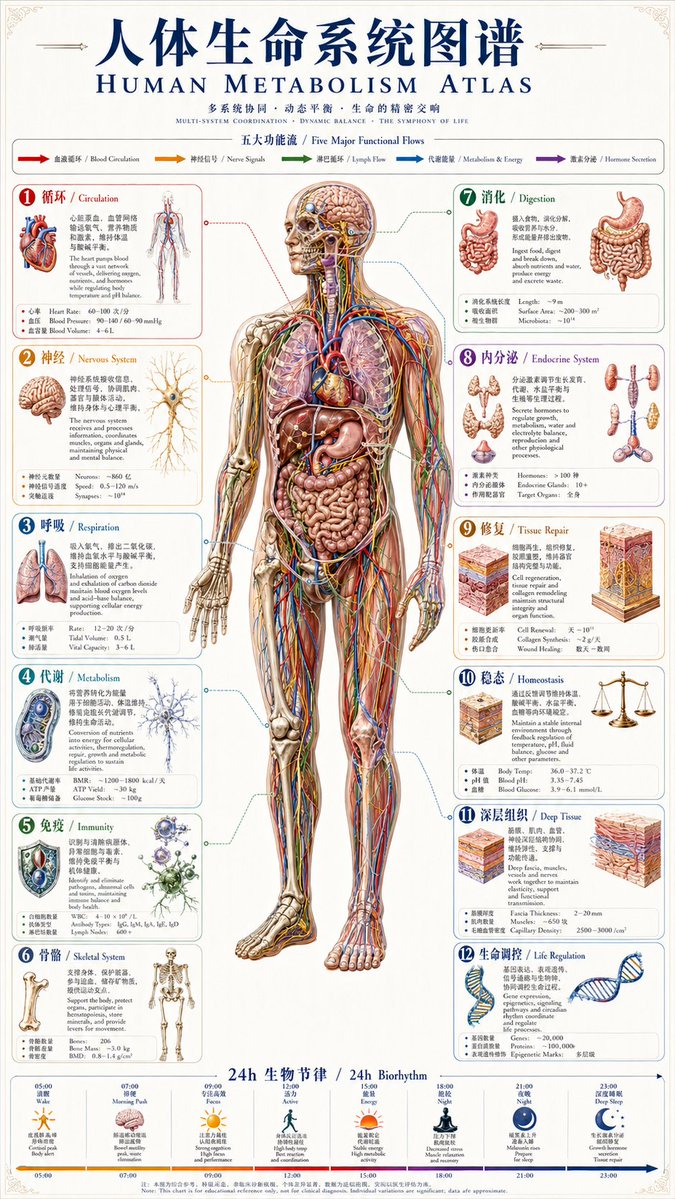
Poster zum menschlichen Stoffwechselatlas
Ein dichtes, zweisprachiges Infografik-Poster zur Anatomie, das den menschlichen Körper in der Mitte mit 12 beschrifteten Lebenssystem-Panels und einem 24-Stunden-Biorhythmus-Zeitstrahl zeigt, ideal für medizinische Bildmaterial in Schulungen oder redaktionellen Beiträgen.
Dies ist ein GPT Image 2 -Prompt für Grafik & Poster . Verwenden Sie den unten stehenden, kopierfertigen Prompt, um ähnliche Grafiken zu erstellen, und überprüfen Sie vor der Wiederverwendung Awesome GPT Image 2 Prompts -Quellenangaben sowie die kommerziellen Nutzungsrechte.
Free 1K preview
Generate one preview image instantly, no sign-up required.
Free text preview doesn’t preserve reference-image consistency.
Eingabeaufforderung
Kopierfertige Eingabeaufforderung
{
  "type": "bilingual medical infographic poster",
  "topic": "{argument name=\"headline text\" default=\"Human Life System Atlas\"}",
  "subtitle": "HUMAN METABOLISM ATLAS",
  "style": "elegant educational atlas, clean cream background, thin ornamental border, highly detailed scientific illustration mixed with infographic design, Chinese-first bilingual labels with smaller English translations, polished print-poster composition",
  "palette": {
    "background": "warm ivory",
    "accent colors": [
      "deep navy",
      "red",
      "orange",
      "green",
      "blue",
      "purple"
    ],
    "linework": "fine medical-illustration lines"
  },
  "layout": {
    "orientation": "vertical poster",
    "centerpiece": "front-facing full-body anatomical human figure with skin removed, showing muscles, organs, arteries, veins, lymphatic pathways, and nerves, standing upright with arms relaxed slightly away from the body",
    "top_header": {
      "count": 4,
      "items": [
        "main Chinese title",
        "large English subtitle",
        "small Chinese tagline",
        "functional flow legend"
      ]
    },
    "side_sections": {
      "left_column_count": 6,
      "right_column_count": 6,
      "total_count": 12
    },
    "bottom_timeline": {
      "title": "24-Hour Biological Rhythm / 24h Biorhythm",
      "count": 7,
      "labels": [
        "05:00 Wake",
        "07:00 Morning Peak",
        "09:00 Focus",
        "12:00 Active",
        "15:00 Energy",
        "18:00 Relax",
        "21:00 Night"
      ]
    }
  },
  "legend": {
    "title": "Five Major Functional Flows / Five Major Functional Flows",
    "count": 5,
    "items": [
      {
        "label": "Blood Circulation / Blood Circulation",
        "color": "red"
      },
      {
        "label": "Nerve Signal / Nerve Signal",
        "color": "orange"
      },
      {
        "label": "Lymphatic Circulation / Lymph Flow",
        "color": "green"
      },
      {
        "label": "Metabolism & Energy",
        "color": "blue"
      },
      {
        "label": "Hormone Secretion",
        "color": "purple"
      }
    ]
  },
  "sections": [
    {
      "number": 1,
      "title": "Circulation",
      "position": "upper left",
      "count": 3,
      "visuals": [
        "anatomical heart",
        "vascular diagram",
        "small stat callout list"
      ],
      "theme_color": "red"
    },
    {
      "number": 2,
      "title": "Nervous System",
      "position": "left upper-middle",
      "count": 3,
      "visuals": [
        "brain illustration",
        "neuron cell drawing",
        "small stat callout list"
      ],
      "theme_color": "orange"
    },
    {
      "number": 3,
      "title": "Respiration / Respiration",
      "position": "left middle",
      "count": 2,
      "visuals": [
        "lungs illustration",
        "small stat callout list"
      ],
      "theme_color": "blue"
    },
    {
      "number": 4,
      "title": "Metabolism / Metabolism",
      "position": "left lower-middle",
      "count": 3,
      "visuals": [
        "cell cross-section",
        "metabolic pathway style neuron-like graphic",
        "small stat callout list"
      ],
      "theme_color": "teal"
    },
    {
      "number": 5,
      "title": "Immunity / Immunity",
      "position": "left lower",
      "count": 3,
      "visuals": [
        "shield icon",
        "microbe or immune particle cluster",
        "small stat callout list"
      ],
      "theme_color": "green"
    },
    {
      "number": 6,
      "title": "Skeletal System / Skeletal System",
      "position": "bottom left",
      "count": 3,
      "visuals": [
        "long bone illustration",
        "full skeleton figure",
        "small stat callout list"
      ],
      "theme_color": "olive"
    },
    {
      "number": 7,
      "title": "Digestion / Digestion",
      "position": "upper right",
      "count": 3,
      "visuals": [
        "intestine illustration",
        "stomach and digestive tract illustration",
        "small stat callout list"
      ],
      "theme_color": "green"
    },
    {
      "number": 8,
      "title": "Endocrine / Endocrine System",
      "position": "right upper-middle",
      "count": 3,
      "visuals": [
        "thyroid-like gland cluster",
        "multiple endocrine gland diagrams",
        "small stat callout list"
      ],
      "theme_color": "purple"
    },
    {
      "number": 9,
      "title": "Repair / Tissue Repair",
      "position": "right middle",
      "count": 3,
      "visuals": [
        "skin tissue block",
        "larger tissue cross-section block",
        "small stat callout list"
      ],
      "theme_color": "brown"
    },
    {
      "number": 10,
      "title": "Homeostasis / Homeostasis",
      "position": "right lower-middle",
      "count": 3,
      "visuals": [
        "tissue cube",
        "balance scale icon",
        "small stat callout list"
      ],
      "theme_color": "blue"
    },
    {
      "number": 11,
      "title": "Deep Tissue / Deep Tissue",
      "position": "right lower",
      "count": 3,
      "visuals": [
        "layered tissue block",
        "muscle-fiber tissue cutaway",
        "small stat callout list"
      ],
      "theme_color": "navy"
    },
    {
      "number": 12,
      "title": "Life Regulation / Life Regulation",
      "position": "bottom right",
      "count": 3,
      "visuals": [
        "DNA double helix",
        "genetic information motif",
        "small stat callout list"
      ],
      "theme_color": "blue"
    }
  ],
  "text_density": "high, magazine-quality infographic text blocks in Chinese with concise English translations beneath headings and key terms",
  "connectors": "each side panel is linked to the corresponding body region with thin dotted colored guide lines",
  "rendering": "ultra-detailed anatomy, realistic organ textures, precise vessels and nerves, refined infographic typography, sharp print-ready composition",
  "quality": "high resolution, poster design, symmetrical and information-dense"
}
Eingabeaufforderungsvariablen
In der Eingabeaufforderung befinden sich bearbeitbare Argumentplatzhalter mit ihren Standardwerten.
Best for
- - Grafik & Poster visual exploration
- - Image generation and reference-image edits
- - Reusable briefs that keep source attribution visible
Change these parts
- - Subject, product, character, or scene
- - Aspect ratio, camera, lighting, and background
- - Brand, text, color, and output constraints
Recommended model and settings
- - Model: gpt-image-2
- - Input mode: Bild zu Bild
- - Aspect ratio: source
- - Commercial status: review original source
How to use this prompt
- 1. Copy the prompt and preserve its structure for the first test.
- 2. Replace the subject, context, and publishing channel.
- 3. Change one camera, lighting, or style variable per iteration.
- 4. Inspect the output, source, text, and rights before reuse.
Limitations, source, and reuse cautions
- - Generated output is an editable draft, not factual, legal, or rights evidence.
- - Review the linked source, people, brands, logos, text, and third-party media before commercial use.
Weitere Fälle in dieser Kategorie
Priorisiert nach Kategorie, Kompatibilität der Eingabemodi, Qualität und geringerem Risiko.





Hinweise zur Wiederverwendung und Quellenangabe
Verwenden Sie diese Eingabeaufforderung sicher, nachdem Sie den Fall in der Vorschau angezeigt haben.
- 1.Kopieren Sie die Eingabeaufforderung oder öffnen Sie sie direkt in Dovoo mit der Schaltfläche „Generieren“.
- 2.Passen Sie Variablen, Seitenverhältnis und Referenzbilder an Ihren Anwendungsfall an.
- 3.Vor der Veröffentlichung oder kostenpflichtigen Nutzung sollten Sie die Rechte an der Quelle, die Anforderungen an die Namensnennung sowie die Risiken für die Marke oder das Abbild prüfen.