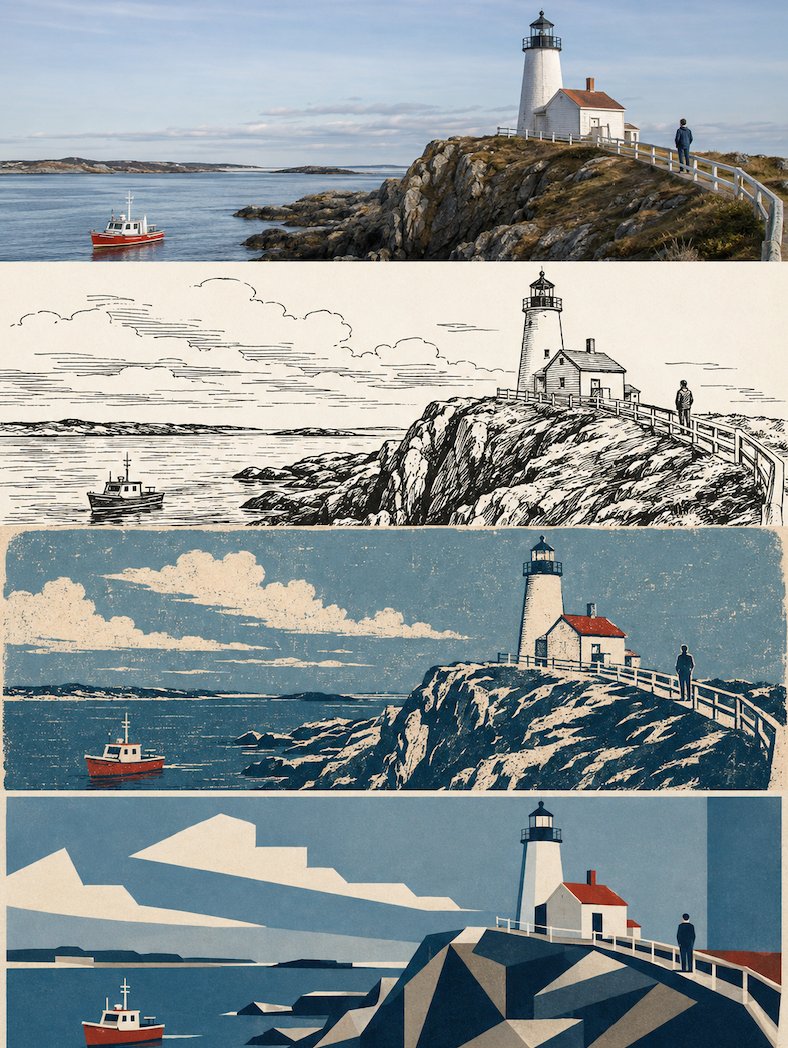
Multi-Layered Design Poster Transformation
A complex structural prompt that transforms an uploaded photo into a four-layered design poster with consistent subject across different styles.
Dies ist ein GPT Image 2 -Prompt für Grafik & Poster . Verwenden Sie den unten stehenden, kopierfertigen Prompt, um ähnliche Grafiken zu erstellen, und überprüfen Sie vor der Wiederverwendung Awesome GPT Image 2 Prompts -Quellenangaben sowie die kommerziellen Nutzungsrechte.
Free 1K preview
Generate one preview image instantly, no sign-up required.
Free text preview doesn’t preserve reference-image consistency.
Eingabeaufforderung
Kopierfertige Eingabeaufforderung
Please transform the scene from the uploaded photo into a sophisticated design poster on the current layer, without multi-image splicing, outputting each photo individually. 'No multi-image splicing' means: do not mix different uploaded photos into the same finished product; each uploaded photo must independently generate a complete four-layer style poster.

[Overall Format and Four-Layer Structure]
Overall 3:4 vertical composition. The image is strictly divided from top to bottom into four equal horizontal areas, with each area's height exactly 25% of the total, maintaining a 1:1:1:1 ratio. The layers are seamless, with no dividing lines, white gaps, or borders.

Since each layer is approximately a 3:1 extremely flat banner, the subject must be adapted horizontally within each layer: maintain stable subject position and visual focus, expanding horizontally to avoid vertical stretching, crushing, or cropping key parts. Environments like sky, walls, or ground can be extended naturally, but no blurred duplication background filling.

[Consistency Across Four Layers]
All four layers must originate from the same uploaded photo and same moment. Maintain strict consistency in subject identity, count, facial features, pose, movement, gaze, clothing, architectural structure, and narrative relationships.

[Layer 1 | Original Photography]
Faithfully preserves the authentic photography texture of the uploaded photo. Keep original identity, composition, lighting, and atmosphere. Only restrained high-end photographic color grading and exposure adjustments are allowed.

[Layer 2 | 1970s Animation Style Black and White Ink Drawing]
This layer occupies 25% of the height. All style instructions are executed within this 3:1 flat area. Maintain core subject relationships while translating to a black and white ink aesthetic.

[Source Style Full Translation]
Create a black and white... of {argument name="subject" default="[subject]"}
Eingabeaufforderungsvariablen
In der Eingabeaufforderung befinden sich bearbeitbare Argumentplatzhalter mit ihren Standardwerten.
Best for
- - Grafik & Poster visual exploration
- - Image generation and reference-image edits
- - Reusable briefs that keep source attribution visible
Change these parts
- - Subject, product, character, or scene
- - Aspect ratio, camera, lighting, and background
- - Brand, text, color, and output constraints
Recommended model and settings
- - Model: gpt-image-2
- - Input mode: Bild zu Bild
- - Aspect ratio: source
- - Commercial status: review original source
How to use this prompt
- 1. Copy the prompt and preserve its structure for the first test.
- 2. Replace the subject, context, and publishing channel.
- 3. Change one camera, lighting, or style variable per iteration.
- 4. Inspect the output, source, text, and rights before reuse.
Limitations, source, and reuse cautions
- - Generated output is an editable draft, not factual, legal, or rights evidence.
- - Review the linked source, people, brands, logos, text, and third-party media before commercial use.
Weitere Fälle in dieser Kategorie
Priorisiert nach Kategorie, Kompatibilität der Eingabemodi, Qualität und geringerem Risiko.
Hinweise zur Wiederverwendung und Quellenangabe
Verwenden Sie diese Eingabeaufforderung sicher, nachdem Sie den Fall in der Vorschau angezeigt haben.
- 1.Kopieren Sie die Eingabeaufforderung oder öffnen Sie sie direkt in Dovoo mit der Schaltfläche „Generieren“.
- 2.Passen Sie Variablen, Seitenverhältnis und Referenzbilder an Ihren Anwendungsfall an.
- 3.Vor der Veröffentlichung oder kostenpflichtigen Nutzung sollten Sie die Rechte an der Quelle, die Anforderungen an die Namensnennung sowie die Risiken für die Marke oder das Abbild prüfen.