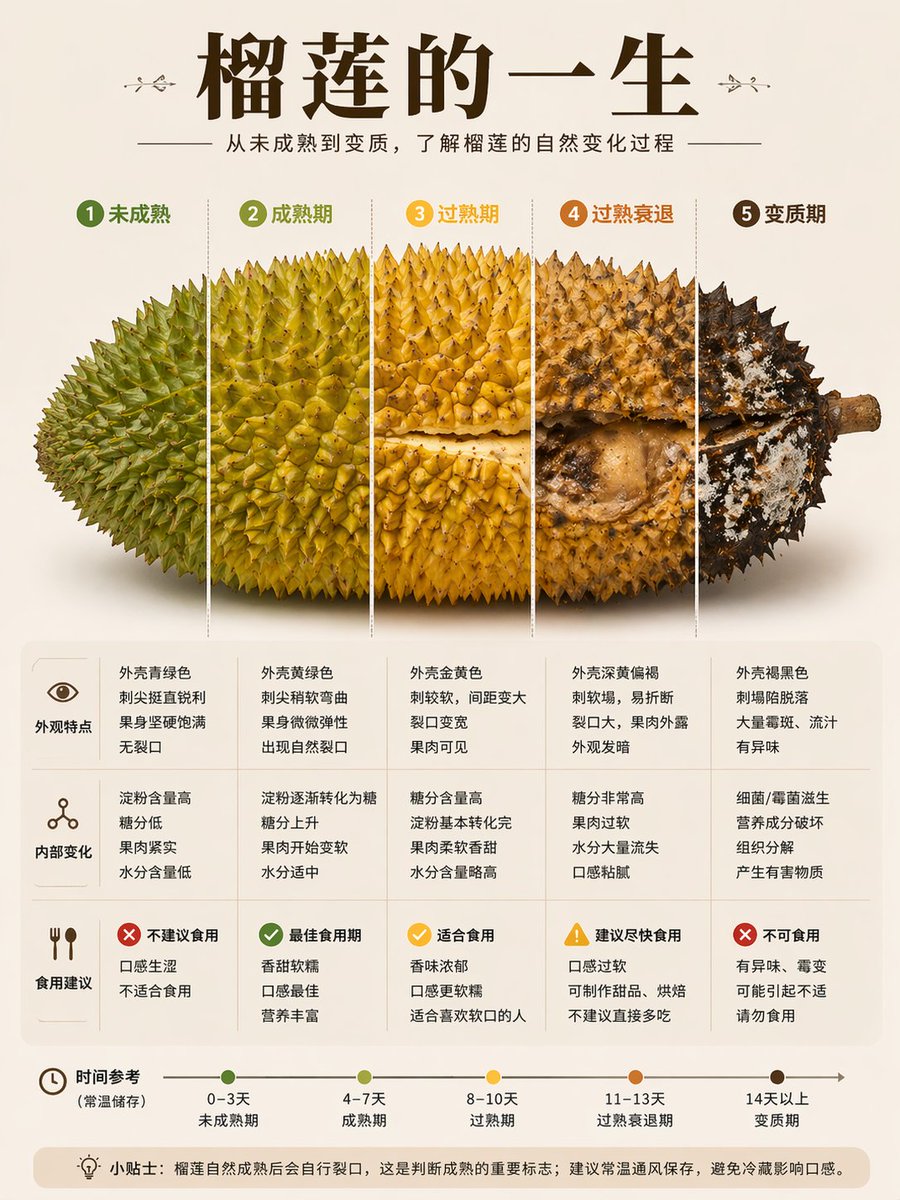
Infografik zum Reifezyklus der Durianfrucht
Ein chinesisches Infografik-Poster, das fünf Reifestadien der Durianfrucht mit realistischen Fruchtabbildungen, Vergleichshinweisen und einem Zeitplan für die Lagerung zeigt und sich für den Wissensaustausch in sozialen Medien eignet.
Dies ist ein GPT Image 2 -Prompt für Grafik & Poster . Verwenden Sie den unten stehenden, kopierfertigen Prompt, um ähnliche Grafiken zu erstellen, und überprüfen Sie vor der Wiederverwendung Awesome GPT Image 2 Prompts -Quellenangaben sowie die kommerziellen Nutzungsrechte.
Free 1K preview
Generate one preview image instantly, no sign-up required.
Eingabeaufforderung
Kopierfertige Eingabeaufforderung
{
  "type": "Chinese infographic poster",
  "topic": "jackfruit ripening lifecycle",
  "style": "clean editorial food science infographic, high information density, realistic cutout fruit photography combined with minimal flat design, warm neutral beige background, premium social-media educational graphic",
  "canvas": {
    "orientation": "portrait",
    "aspect_ratio": "3:4"
  },
  "headline": {
    "title": "{argument name=\"headline text\" default=\"The Life of a Durian\"}",
    "subtitle": "From never ripening to decaying, understand the natural changes of a durian"
  },
  "main_visual": {
    "subject": "one whole durian shown horizontally across the center, stem on the right, isolated on a light beige background with a soft diffuse shadow below",
    "segmentation": {
      "count": 5,
      "direction": "vertical slices separated by thin white divider lines",
      "stages": [
        {
          "index": 1,
          "label": "Immature",
          "badge_color": "olive green",
          "appearance": "leftmost section, green husk, dense sharp spikes, firm unripe look"
        },
        {
          "index": 2,
          "label": "Mature stage",
          "badge_color": "yellow green",
          "appearance": "greenish yellow husk, spikes slightly curved, shell beginning natural cracking"
        },
        {
          "index": 3,
          "label": "Overripe Period",
          "badge_color": "golden yellow",
          "appearance": "yellow husk, wider cracks, one horizontal opening reveals pale creamy flesh inside"
        },
        {
          "index": 4,
          "label": "Overripe decay",
          "badge_color": "orange brown",
          "appearance": "deeper yellow-brown shell, obvious split cavity with collapsed interior, darker surface stains"
        },
        {
          "index": 5,
          "label": "Deterioration stage",
          "badge_color": "dark brown",
          "appearance": "near-black rotten husk with white mold patches and severe decay around the right end near the stem"
        }
      ]
    }
  },
  "layout": {
    "sections": [
      {
        "title": "Appearance characteristics",
        "position": "lower table row 1 left label",
        "count": 5,
        "cells": [
          "Greenish-blue shell, straight and sharp thorn tips, firm and full fruit body, no cracks",
          "Yellow-green shell, slightly soft and curved thorn tips, slightly elastic fruit body, natural cracks appear",
          "Golden yellow shell, softer thorns, increased spacing, wider cracks, pulp visible",
          "Dark yellow-brown shell, collapsed thorns, easy to break, large cracks, exposed pulp, dark appearance",
          "The shell is brownish-black, with collapsed and fallen spines, numerous mold spots, oozing, and a foul odor."
        ]
      },
      {
        "title": "Internal changes",
        "position": "lower table row 2 left label",
        "count": 5,
        "cells": [
          "High starch content, low sugar content, firm flesh, and low moisture content.",
          "Starch gradually converts to sugar, sugar levels rise, the flesh begins to soften, and moisture content is moderate.",
          "High sugar content, starch is almost completely converted, the flesh is soft and fragrant, and the moisture content is slightly high.",
          "Very high sugar content, the flesh is overripe and soft, a large amount of moisture is lost, and the texture is sticky.",
          "Bacterial/mold growth, nutrient degradation, tissue decomposition, and production of harmful substances"
        ]
      },
      {
        "title": "Eating suggestions",
        "position": "lower table row 3 left label",
        "count": 5,
        "cells": [
          "Not recommended for consumption, astringent taste, not suitable for eating",
          "Best consumption period, sweet and soft, best taste, rich in nutrients",
          "Suitable for consumption, strong aroma, softer texture, suitable for those who like soft food",
          "Recommended to eat as soon as possible, overly soft texture, can be used for desserts and baking, not recommended to eat a lot directly",
          "Not edible, has an odor, moldy, may cause discomfort, do not eat"
        ]
      },
      {
        "title": "Time reference (room temperature storage)",
        "position": "bottom timeline",
        "count": 5,
        "labels": [
          "0–3 days Unripe",
          "4–7 days Ripe",
          "8–10 days Overripe",
          "11–13 days – Overripe decline period",
          "14+ days – Spoilage period"
        ]
      }
    ],
    "footer_note": "Tip: Durian will naturally crack open after ripening, which is an important indicator of maturity; it is recommended to store at room temperature in a ventilated place, avoiding refrigeration which can affect the taste."
  },
  "design_details": {
    "palette": [
      "beige",
      "dark brown",
      "olive green",
      "yellow green",
      "golden yellow",
      "orange brown"
    ],
    "typography": "large bold Chinese serif headline, smaller clean sans-serif body text",
    "icons": "4 small category icons on the left side of the table: eye for appearance, molecular/network icon for internal changes, fork-and-knife for eating advice, clock for timeline",
    "composition": "centered symmetrical infographic with large fruit dominating the upper middle and a rounded-corner comparison table beneath"
  }
}
Eingabeaufforderungsvariablen
In der Eingabeaufforderung befinden sich bearbeitbare Argumentplatzhalter mit ihren Standardwerten.
Best for
- - Grafik & Poster visual exploration
- - Image generation and reference-image edits
- - Reusable briefs that keep source attribution visible
Change these parts
- - Subject, product, character, or scene
- - Aspect ratio, camera, lighting, and background
- - Brand, text, color, and output constraints
Recommended model and settings
- - Model: gpt-image-2
- - Input mode: Text zu Bild
- - Aspect ratio: source
- - Commercial status: review original source
How to use this prompt
- 1. Copy the prompt and preserve its structure for the first test.
- 2. Replace the subject, context, and publishing channel.
- 3. Change one camera, lighting, or style variable per iteration.
- 4. Inspect the output, source, text, and rights before reuse.
Limitations, source, and reuse cautions
- - Generated output is an editable draft, not factual, legal, or rights evidence.
- - Review the linked source, people, brands, logos, text, and third-party media before commercial use.
Weitere Fälle in dieser Kategorie
Priorisiert nach Kategorie, Kompatibilität der Eingabemodi, Qualität und geringerem Risiko.






Hinweise zur Wiederverwendung und Quellenangabe
Verwenden Sie diese Eingabeaufforderung sicher, nachdem Sie den Fall in der Vorschau angezeigt haben.
- 1.Kopieren Sie die Eingabeaufforderung oder öffnen Sie sie direkt in Dovoo mit der Schaltfläche „Generieren“.
- 2.Passen Sie Variablen, Seitenverhältnis und Referenzbilder an Ihren Anwendungsfall an.
- 3.Vor der Veröffentlichung oder kostenpflichtigen Nutzung sollten Sie die Rechte an der Quelle, die Anforderungen an die Namensnennung sowie die Risiken für die Marke oder das Abbild prüfen.