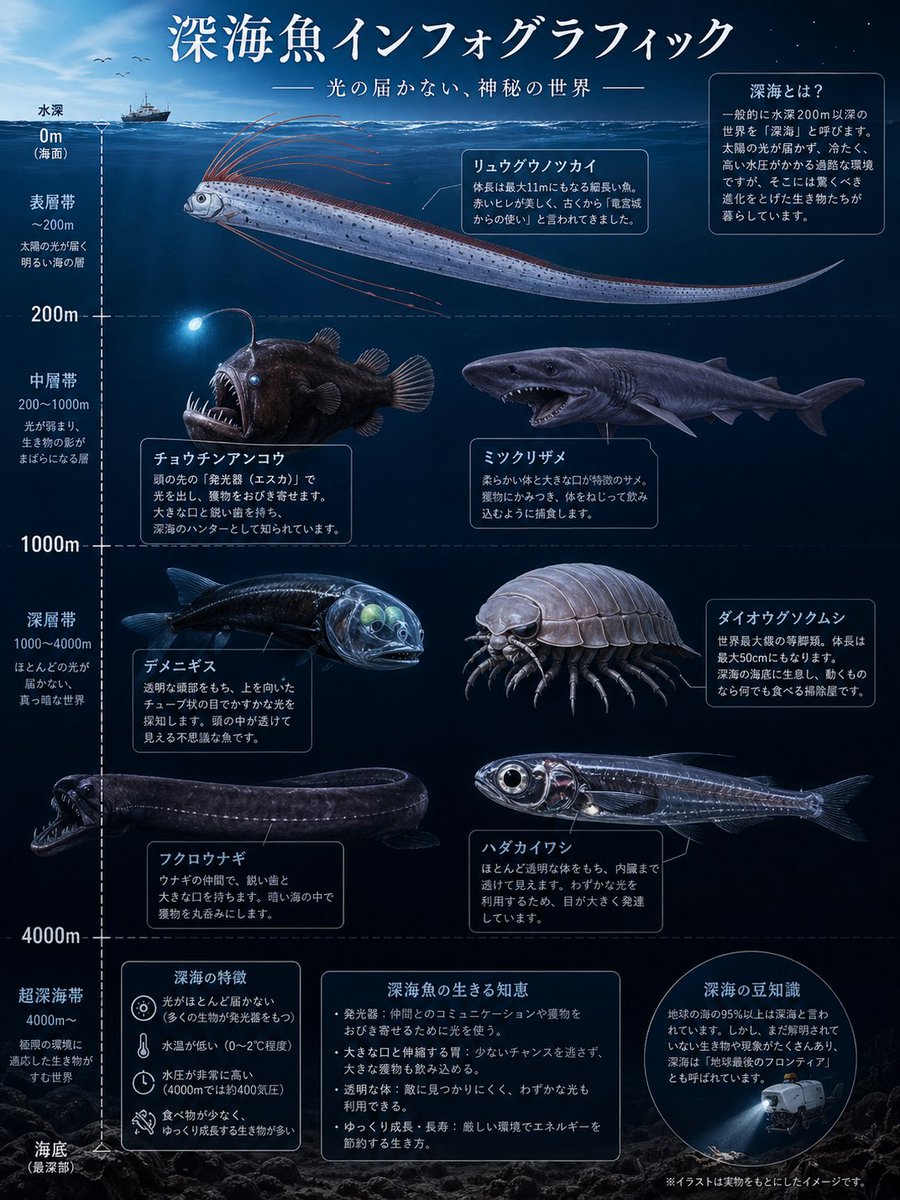
Infografik-Poster über Tiefseefische
Eine ansprechend gestaltete, japanisch inspirierte Infografik zur Meerestiefe mit 7 beschrifteten Tiefseetieren, Tiefenzonen und erklärenden Tafeln, ideal für Wissenschaftsposter oder visuelle Inhalte im Museumsstil.
Dies ist ein GPT Image 2 -Prompt für Grafik & Poster . Verwenden Sie den unten stehenden, kopierfertigen Prompt, um ähnliche Grafiken zu erstellen, und überprüfen Sie vor der Wiederverwendung Awesome GPT Image 2 Prompts -Quellenangaben sowie die kommerziellen Nutzungsrechte.
Free 1K preview
Generate one preview image instantly, no sign-up required.
Eingabeaufforderung
Kopierfertige Eingabeaufforderung
{
  "type": "deep sea fish infographic poster",
  "topic": "{argument name=\"headline text\" default=\"深海魚インフォグラフィック\"}",
  "subtitle": "— 光の届かない、神秘の世界 —",
  "style": "dramatic scientific infographic, realistic marine life illustration, dark blue ocean cross-section, polished educational poster, high-detail Japanese museum style",
  "canvas": {
    "orientation": "portrait",
    "background": "deep ocean gradient from moonlit surface blue to near-black abyss, faint particles in water, rocky seafloor at bottom, small research boat silhouette on the surface"
  },
  "layout": {
    "sections": [
      {
        "title": "depth scale",
        "position": "far left vertical column",
        "count": 7,
        "labels": [
          "0m (sea level)",
          "Surface zone ~200m",
          "200m+",
          "Mid-water zone 200~1000m",
          "Deep zone 1000m+ 1000~4000m",
          "4000m+ Ultra-Deep Abyss",
          "Seabed (Deepest Point)"
        ]
      },
      {
        "title": "featured animals",
        "position": "center and right across depth zones",
        "count": 7,
        "labels": [
          "リュウグウノツカイ",
          "チョウチンアンコウ",
          "ミツクリザメ",
          "デメニギス",
          "ダイオウグソクムシ",
          "クロウナギ",
          "ハダカイワシ"
        ]
      },
      {
        "title": "bottom information panels",
        "position": "bottom row above seafloor",
        "count": 3,
        "labels": [
          "深海の特徴",
          "深海魚の生きる知恵",
          "深海の豆知識"
        ]
      },
      {
        "title": "definition panel",
        "position": "upper right",
        "count": 1,
        "labels": [
          "深海とは?"
        ]
      }
    ],
    "centerpiece": "layered ocean-depth diagram with labeled deep-sea animals placed at approximate living depths, each with a dark translucent rounded text box and thin white leader line"
  },
  "subject": {
    "animals": [
      {
        "name": "リュウグウノツカイ",
        "common_english": "oarfish",
        "depth_zone": "upper ocean below the surface, spanning horizontally across the top third",
        "appearance": "extremely long ribbon-like silver body with black speckles, reflective sheen, red dorsal fin running the body length, long red filamentous fin rays from the head, slender tapering tail, side profile facing left"
      },
      {
        "name": "チョウチンアンコウ",
        "common_english": "anglerfish",
        "depth_zone": "around 200m to 1000m on left side",
        "appearance": "large dark brown-black body, oversized mouth with many long needle teeth, glowing blue lure extending upward from forehead, glowing bluish eye, menacing realistic texture"
      },
      {
        "name": "ミツクリザメ",
        "common_english": "goblin shark",
        "depth_zone": "mid-right around mesopelagic zone",
        "appearance": "grayish purple shark body, elongated flattened snout, open jaws with visible sharp teeth, muscular tail, side profile facing left"
      },
      {
        "name": "デメニギス",
        "common_english": "barreleye fish",
        "depth_zone": "left-middle around 1000m",
        "appearance": "small dark fish with transparent dome head, two bright green barrel-shaped eyes visible inside the head, glossy black-blue body, realistic bioluminescent feel"
      },
      {
        "name": "ダイオウグソクムシ",
        "common_english": "giant isopod",
        "depth_zone": "right-middle around deep zone",
        "appearance": "large pale gray segmented crustacean, armored shell plates, multiple legs, curved body, detailed marine arthropod anatomy"
      },
      {
        "name": "クロウナギ",
        "common_english": "cusk eel / eel-like deep-sea fish",
        "depth_zone": "lower left near 4000m",
        "appearance": "dark purple-black elongated eel-like body, broad head, sharp teeth, sinuous shape, subtle glossy highlights"
      },
      {
        "name": "ハダカイワシ",
        "common_english": "lanternfish",
        "depth_zone": "lower right near 3000m to 4000m",
        "appearance": "slender semi-transparent silver fish, oversized eye, visible internal structure, fine fins, faint photophore-like highlights"
      }
    ]
  },
  "text_panels": {
    "definition": "Explain that the deep sea generally refers to ocean regions deeper than 200 meters where sunlight barely reaches, creating a harsh high-pressure dark environment inhabited by specially adapted organisms.",
    "animal_notes": "Each of the 7 animals has a short Japanese explanatory paragraph in a dark translucent rounded rectangle near the animal.",
    "bottom_panels": "Three compact Japanese summary boxes explain deep-sea characteristics, survival adaptations of deep-sea fish, and trivia about the deep ocean.",
    "footnote": "Small note at bottom right indicating the illustration is based on real creatures."
  },
  "visual_details": {
    "lighting": "soft shafts of light near the surface, rapidly fading into darkness below; selective cool rim lighting on animals; bioluminescent glow on the anglerfish lure and subtle highlights elsewhere",
    "graphics": "dashed horizontal depth guide lines at major depths, thin white callout lines, large elegant Japanese title lettering in white, all UI boxes with thin white outlines and slightly glowing edges",
    "mood": "mysterious, educational, cinematic, awe-inspiring"
  }
}
Eingabeaufforderungsvariablen
In der Eingabeaufforderung befinden sich bearbeitbare Argumentplatzhalter mit ihren Standardwerten.
Best for
- - Grafik & Poster visual exploration
- - Image generation and reference-image edits
- - Reusable briefs that keep source attribution visible
Change these parts
- - Subject, product, character, or scene
- - Aspect ratio, camera, lighting, and background
- - Brand, text, color, and output constraints
Recommended model and settings
- - Model: gpt-image-2
- - Input mode: Text zu Bild
- - Aspect ratio: source
- - Commercial status: review original source
How to use this prompt
- 1. Copy the prompt and preserve its structure for the first test.
- 2. Replace the subject, context, and publishing channel.
- 3. Change one camera, lighting, or style variable per iteration.
- 4. Inspect the output, source, text, and rights before reuse.
Limitations, source, and reuse cautions
- - Generated output is an editable draft, not factual, legal, or rights evidence.
- - Review the linked source, people, brands, logos, text, and third-party media before commercial use.
Weitere Fälle in dieser Kategorie
Priorisiert nach Kategorie, Kompatibilität der Eingabemodi, Qualität und geringerem Risiko.


Hinweise zur Wiederverwendung und Quellenangabe
Verwenden Sie diese Eingabeaufforderung sicher, nachdem Sie den Fall in der Vorschau angezeigt haben.
- 1.Kopieren Sie die Eingabeaufforderung oder öffnen Sie sie direkt in Dovoo mit der Schaltfläche „Generieren“.
- 2.Passen Sie Variablen, Seitenverhältnis und Referenzbilder an Ihren Anwendungsfall an.
- 3.Vor der Veröffentlichung oder kostenpflichtigen Nutzung sollten Sie die Rechte an der Quelle, die Anforderungen an die Namensnennung sowie die Risiken für die Marke oder das Abbild prüfen.