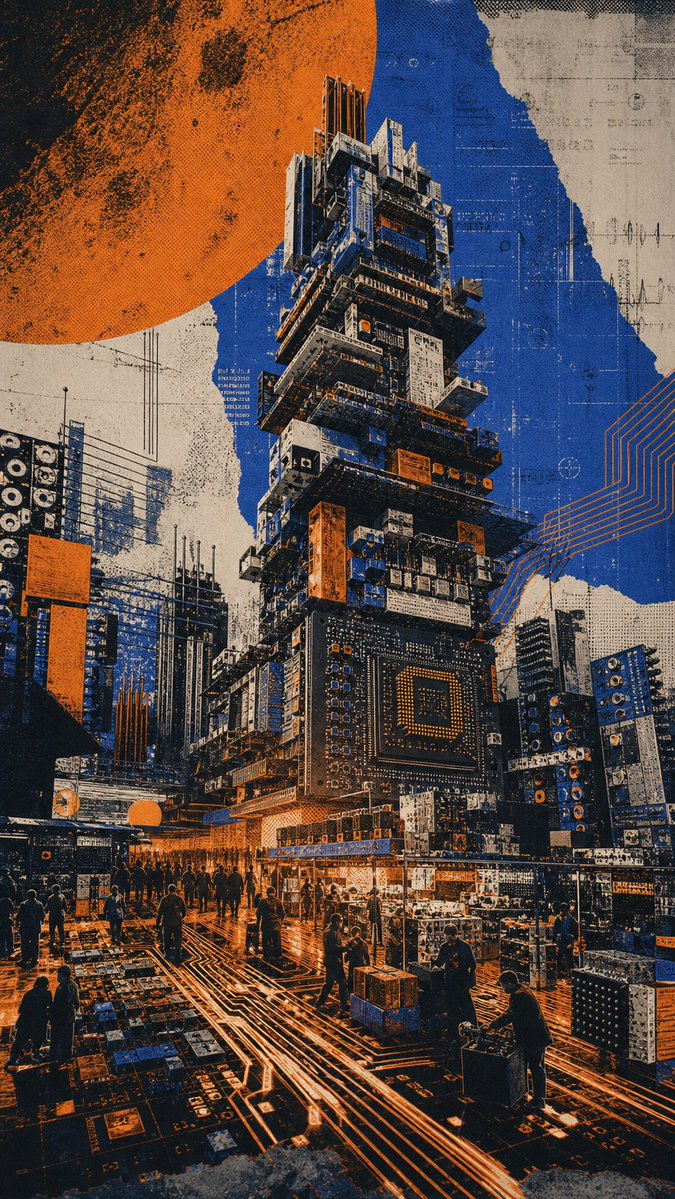
Circuit Board City Landmark Poster
Generates a gritty experimental cyberpunk city poster where a landmark transforms into a towering circuit-board megastructure.
Dies ist ein GPT Image 2 -Prompt für Grafik & Poster . Verwenden Sie den unten stehenden, kopierfertigen Prompt, um ähnliche Grafiken zu erstellen, und überprüfen Sie vor der Wiederverwendung Awesome GPT Image 2 Prompts -Quellenangaben sowie die kommerziellen Nutzungsrechte.
Free 1K preview
Generate one preview image instantly, no sign-up required.
Free text preview doesn’t preserve reference-image consistency.
Eingabeaufforderung
Kopierfertige Eingabeaufforderung
Create a vertical experimental city poster showing {argument name="city landmark" default="a recognizable dense urban landmark tower"} fused with an impossible transformation: the entire landmark has become a monumental stacked circuit-board superstructure made of microchips, server racks, electronic modules, panels, heat sinks, ports, wires, and motherboard details, while still preserving the original street-level perspective, surrounding high-rises, landmark silhouette, depth layers, and upward-looking urban canyon composition. Use a dramatic low-angle view from a crowded plaza or street market, with tiny silhouetted pedestrians in the foreground and midground, glowing orange circuit traces running across the ground like roads, and dense electronics stalls or modular tech blocks at street level. The central tower should dominate the frame, rising vertically with many irregular stacked tiers and intricate mechanical/electronic surfaces, including one large square microprocessor-like panel on the lower front. Surround it with smaller buildings also partially converted into circuit boards and speaker-like electronic grids. Add a huge partially cropped orange planet or sun in the upper left corner and a rough torn-paper collage sky split into deep cobalt blue and aged off-white areas. Style the image as a gritty screen-printed urban design poster with halftone dots, distressed ink texture, visible grain, rough paper edges, high contrast shadows, blueprint markings, faint circuit diagrams, technical line art, and orange conductive lines. Color palette: {argument name="accent color" default="burnt orange"}, {argument name="main blue" default="deep cobalt blue"}, black, cream, and worn beige, with selective metallic gray highlights. Mood should be futuristic, surreal, architectural, cyberpunk, and graphic-design focused, not photorealistic. No readable large title text, no logo, no watermark; any tiny markings should look like abstract technical annotations only.Eingabeaufforderungsvariablen
In der Eingabeaufforderung befinden sich bearbeitbare Argumentplatzhalter mit ihren Standardwerten.
Best for
- - Grafik & Poster visual exploration
- - Image generation and reference-image edits
- - Reusable briefs that keep source attribution visible
Change these parts
- - Subject, product, character, or scene
- - Aspect ratio, camera, lighting, and background
- - Brand, text, color, and output constraints
Recommended model and settings
- - Model: gpt-image-2
- - Input mode: Bild zu Bild
- - Aspect ratio: source
- - Commercial status: review original source
How to use this prompt
- 1. Copy the prompt and preserve its structure for the first test.
- 2. Replace the subject, context, and publishing channel.
- 3. Change one camera, lighting, or style variable per iteration.
- 4. Inspect the output, source, text, and rights before reuse.
Limitations, source, and reuse cautions
- - Generated output is an editable draft, not factual, legal, or rights evidence.
- - Review the linked source, people, brands, logos, text, and third-party media before commercial use.
Weitere Fälle in dieser Kategorie
Priorisiert nach Kategorie, Kompatibilität der Eingabemodi, Qualität und geringerem Risiko.

Hinweise zur Wiederverwendung und Quellenangabe
Verwenden Sie diese Eingabeaufforderung sicher, nachdem Sie den Fall in der Vorschau angezeigt haben.
- 1.Kopieren Sie die Eingabeaufforderung oder öffnen Sie sie direkt in Dovoo mit der Schaltfläche „Generieren“.
- 2.Passen Sie Variablen, Seitenverhältnis und Referenzbilder an Ihren Anwendungsfall an.
- 3.Vor der Veröffentlichung oder kostenpflichtigen Nutzung sollten Sie die Rechte an der Quelle, die Anforderungen an die Namensnennung sowie die Risiken für die Marke oder das Abbild prüfen.