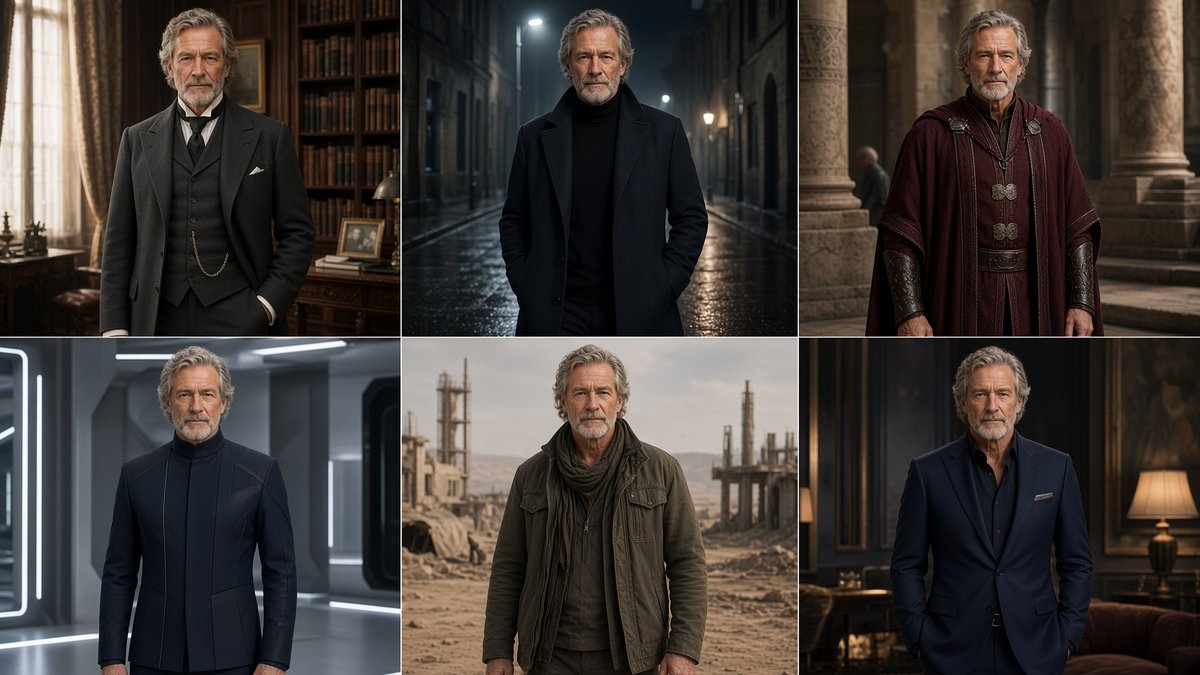
Six-Panel Cinematic Character Variations
Creates a photorealistic 3-by-2 character concept sheet showing the same older man across six cinematic genre settings.
Dies ist ein GPT Image 2 -Prompt für Porträt & Charakter . Verwenden Sie den unten stehenden, kopierfertigen Prompt, um ähnliche Grafiken zu erstellen, und überprüfen Sie vor der Wiederverwendung Awesome GPT Image 2 Prompts -Quellenangaben sowie die kommerziellen Nutzungsrechte.
Free 1K preview
Generate one preview image instantly, no sign-up required.
Free text preview doesn’t preserve reference-image consistency.
Eingabeaufforderung
Kopierfertige Eingabeaufforderung
Goal: Create a cinematic 6-panel character concept sheet showing the same older male character, {argument name="character name" default="an unnamed distinguished older man"}, reimagined across different genres and settings while keeping his face, age, posture, and stern expression consistent.

Canvas: Wide 16:9 image divided into a clean 3 columns by 2 rows grid, with thin white dividers between panels. Each panel is a realistic waist-up portrait, centered composition, high-end photographic lighting, shallow depth of field, detailed skin texture, gray wavy hair, short gray beard, serious direct gaze, hands often in pockets or relaxed at sides.

Subject details: The man is in his late 60s to early 70s, tall and dignified, rugged but refined face, silver-gray swept-back wavy hair, neatly trimmed gray beard and mustache, light skin, calm authoritative presence, looking toward the camera in all panels. Keep his facial identity identical across all six images.

Panel layout and exact count: Include exactly 6 discrete portraits:
1. Top left: Victorian or early 20th-century gentleman in a dark three-piece suit with waistcoat, tie, pocket watch chain, white pocket square, standing in an elegant private library or study with tall bookshelves, heavy curtains, warm window light, wooden desk, framed photo, and antique decor.
2. Top center: Modern noir version wearing a black turtleneck and long dark overcoat, hands in pockets, standing in a narrow wet city alley at night with streetlights, reflective pavement, cool blue-gray lighting, cinematic urban mood.
3. Top right: Ancient Roman or fantasy statesman wearing a deep burgundy cloak/tunic with ornate clasps, leather bracers, decorative belt, standing among stone columns and classical architecture, warm muted historical lighting.
4. Bottom left: Futuristic sci-fi commander wearing a sleek dark navy high-collar uniform with minimalist seams, standing in a clean metallic spaceship corridor or advanced laboratory with white glowing light strips and cool gray surfaces.
5. Bottom center: Post-apocalyptic survivor wearing a worn olive jacket, layered dark sweater, scarf, weathered practical clothing, standing in a dusty desert industrial wasteland with ruins, pipes, construction frames, and a hazy beige sky.
6. Bottom right: Contemporary luxury version wearing a fitted navy suit over a dark open-collar shirt with pocket square, hands in pockets, standing in an upscale dim lounge or hotel interior with dark paneling, warm lamps, sofa, and elegant moody decor.

Visual style: Ultra-realistic cinematic photography, consistent character likeness, premium film still quality, natural proportions, detailed fabrics, atmospheric backgrounds, dramatic but believable lighting, rich contrast, sharp subject with softly blurred background.

Constraints: No text, no logos, no captions, no watermark. Preserve the exact 3-by-2 grid and exactly six genre interpretations of the same man. Avoid changing his age, ethnicity, beard, hairstyle, or facial structure between panels. Use {argument name="overall mood" default="serious, dignified, cinematic"} and {argument name="image quality" default="photorealistic high-budget film still"}.
Eingabeaufforderungsvariablen
In der Eingabeaufforderung befinden sich bearbeitbare Argumentplatzhalter mit ihren Standardwerten.
Best for
- - Porträt & Charakter visual exploration
- - Image generation and reference-image edits
- - Reusable briefs that keep source attribution visible
Change these parts
- - Subject, product, character, or scene
- - Aspect ratio, camera, lighting, and background
- - Brand, text, color, and output constraints
Recommended model and settings
- - Model: gpt-image-2
- - Input mode: Bild zu Bild
- - Aspect ratio: source
- - Commercial status: review original source
How to use this prompt
- 1. Copy the prompt and preserve its structure for the first test.
- 2. Replace the subject, context, and publishing channel.
- 3. Change one camera, lighting, or style variable per iteration.
- 4. Inspect the output, source, text, and rights before reuse.
Limitations, source, and reuse cautions
- - Generated output is an editable draft, not factual, legal, or rights evidence.
- - Review the linked source, people, brands, logos, text, and third-party media before commercial use.
Weitere Fälle in dieser Kategorie
Priorisiert nach Kategorie, Kompatibilität der Eingabemodi, Qualität und geringerem Risiko.
Hinweise zur Wiederverwendung und Quellenangabe
Verwenden Sie diese Eingabeaufforderung sicher, nachdem Sie den Fall in der Vorschau angezeigt haben.
- 1.Kopieren Sie die Eingabeaufforderung oder öffnen Sie sie direkt in Dovoo mit der Schaltfläche „Generieren“.
- 2.Passen Sie Variablen, Seitenverhältnis und Referenzbilder an Ihren Anwendungsfall an.
- 3.Vor der Veröffentlichung oder kostenpflichtigen Nutzung sollten Sie die Rechte an der Quelle, die Anforderungen an die Namensnennung sowie die Risiken für die Marke oder das Abbild prüfen.