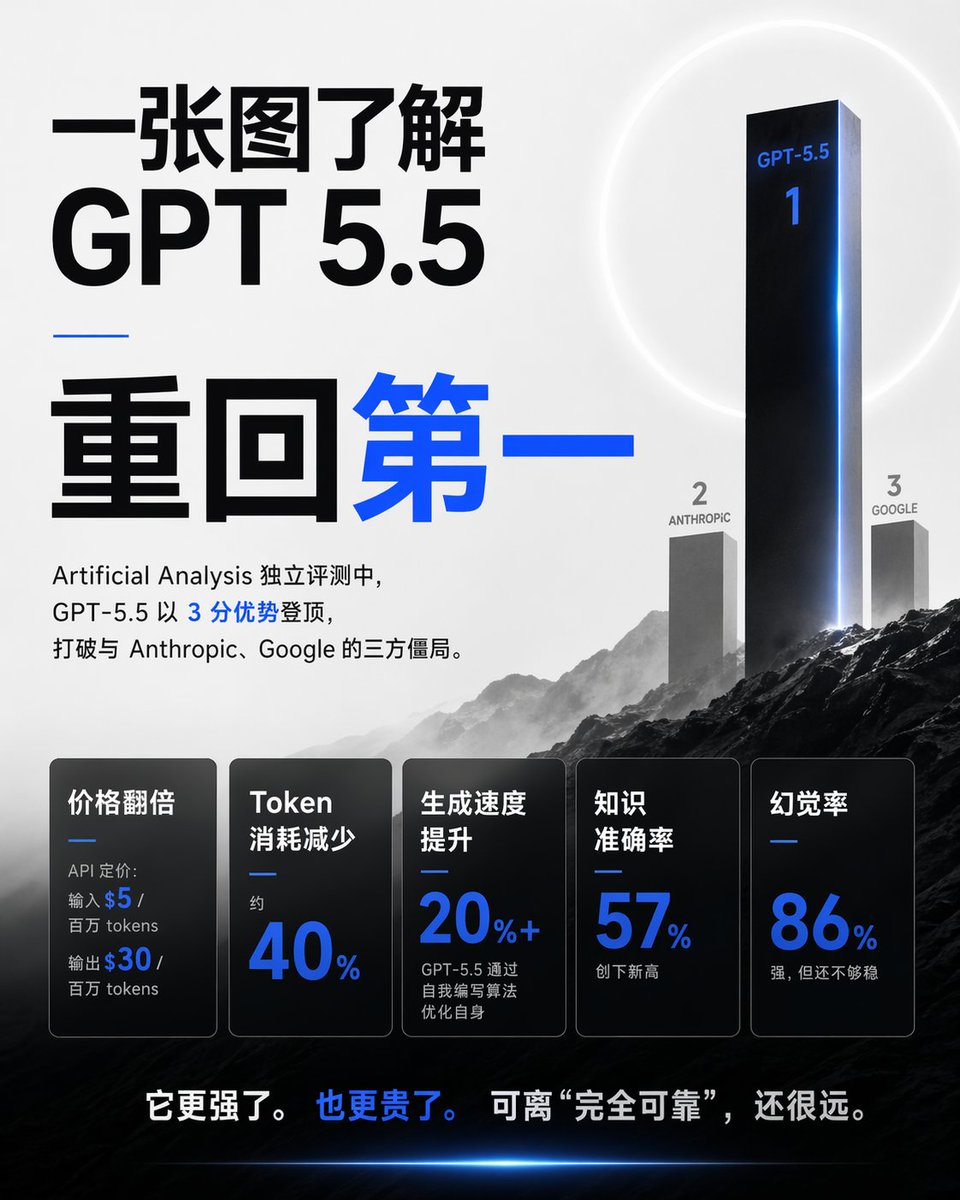
Chinese GPT 5.5 Benchmark Infographic
A square Chinese editorial infographic visualizing GPT-5.5 as the first-place AI benchmark winner with rankings, metrics, and dramatic tech-poster styling.
Dies ist ein GPT Image 2 -Prompt für Grafik & Poster . Verwenden Sie den unten stehenden, kopierfertigen Prompt, um ähnliche Grafiken zu erstellen, und überprüfen Sie vor der Wiederverwendung Awesome GPT Image 2 Prompts -Quellenangaben sowie die kommerziellen Nutzungsrechte.
Benötigen Sie den vollständigen Prompt-Satz? Verwenden Sie den Grafik & Poster Weitere verwandte Beispiele finden Sie im Themen-Hub oder öffnen Sie die GPT Image 2 Prompt-Katalog für das vollständige Beispielverzeichnis, wiederverwendbare Strukturen und Quellenangaben.
Free 1K preview
Generate one preview image instantly, no sign-up required.
3529/4000
Eingabeaufforderung
Kopierfertige Eingabeaufforderung
Objective: Create a 1:1 square Chinese tech news infographic poster that explains {argument name="topic" default="GPT 5.5"} within 30 seconds, and adopts a highly dramatic AI benchmark ranking theme.

Canvas: 768x768 square poster, with a light gray to white background in the upper half and a dark, cinematic mountain landscape in the lower half. Use high-contrast black fonts and accents of electric blue.

Layout: The left side is dominated by a large Chinese title layout. The right side features a 3D benchmark podium/ranking scene rising from the mountains. The bottom third contains 5 horizontally arranged dark, semi-transparent metric cards. A striking Chinese summary sentence is at the very bottom.

Main Title Text: Use huge black Chinese characters in the upper left corner: “Understand it in a single image.” Directly below, use huge black Latin characters: “GPT 5.5.” Below a thin, short blue horizontal line, use extra-large Chinese characters: “Back to the Top,” with “Back” in black and “Top” in bright blue.

Introductory Paragraph Below the Title: “In independent evaluations by Artificial Analysis, GPT-5.5 topped the charts with a 3-point advantage, breaking the three-way stalemate with Anthropic and Google.” Keep the number 3 in blue, with the rest of the text primarily in black.

Ranking Scene: Create 3 vertical ranking pillars on the right side, integrated into a misty mountain landscape. 1st place is a very tall, glossy black monolith with blue edge lighting, labeled “GPT-5.5” near the top and a large blue “1” below. 2nd place is a shorter gray monolith on the left, labeled “2” and “ANTHROPIC.” 3rd place is a shorter gray monolith on the right, labeled “3” and “GOOGLE.” Add a faint white halo behind the 1st place monolith and a blue glow along its right edge.

Metric Cards: Add 5 rounded-corner rectangular black/charcoal gray glass-textured cards in the bottom third, each with a thin border, subtle gradient, and a small blue divider line. These 5 cards are: 1) “Price Doubled,” with small text “API pricing: Input $5 / million tokens Output $30 / million tokens,” where $5 and $30 are in blue; 2) “Token Consumption Reduced,” with small text “approx.” and a large blue “40%”; 3) “Generation Speed Increased,” with a large blue “20% +” and small text “GPT-5.5 optimizes itself through self-written algorithms”; 4) “Knowledge Accuracy,” with a large blue “57%” and small text “New High”; 5) “Hallucination Rate,” with a large blue “86%” and small text “Strong, but not yet stable.”

Bottom Summary: Centered above the dark landscape at the bottom, write: “It’s stronger. It’s also more expensive. But still far from “completely reliable.”” with “It’s also more expensive.” in blue and the rest of the text in white.

Visual Style: High-end editorial AI benchmark poster, sharp modern sans-serif fonts, monochromatic color scheme with electric blue highlights, cinematic mist, dark rocky mountains, subtle lens flares, clean spacing, realistic 3D monoliths, no people, no logos, no watermarks.

Parameters: The main customizable theme is {argument name="model name" default="GPT-5.5"}; the leading score can be {argument name="advantage text" default="3-point advantage"}; the 2nd place competitor is {argument name="second competitor" default="Anthropic"}; the 3rd place competitor is {argument name="third competitor" default="Google"}; the bottom information can be {argument name="conclusion text" default="It's stronger. And more expensive. But still far from “completely reliable.”"}.
Eingabeaufforderungsvariablen
In der Eingabeaufforderung befinden sich bearbeitbare Argumentplatzhalter mit ihren Standardwerten.
Variable
topic
Standard
GPT 5.5
Variable
model name
Standard
GPT-5.5
Variable
advantage text
Standard
3-point advantage
Variable
second competitor
Standard
Anthropic
Variable
third competitor
Standard
Google
Variable
conclusion text
Standard
It's stronger. And more expensive. But still far from “completely reliable.”
Best for
- - Grafik & Poster visual exploration
- - Image generation and reference-image edits
- - Reusable briefs that keep source attribution visible
Change these parts
- - Subject, product, character, or scene
- - Aspect ratio, camera, lighting, and background
- - Brand, text, color, and output constraints
Recommended model and settings
- - Model: gpt-image-2
- - Input mode: Text zu Bild
- - Aspect ratio: source
- - Commercial status: review original source
How to use this prompt
- 1. Copy the prompt and preserve its structure for the first test.
- 2. Replace the subject, context, and publishing channel.
- 3. Change one camera, lighting, or style variable per iteration.
- 4. Inspect the output, source, text, and rights before reuse.
Limitations, source, and reuse cautions
- - Generated output is an editable draft, not factual, legal, or rights evidence.
- - Review the linked source, people, brands, logos, text, and third-party media before commercial use.
Importiert von Awesome GPT Image 2 Prompts . Quellenangabe erforderlich. Status der kommerziellen Nutzung: allowed ; Rechte an der Quelle vor kostenpflichtiger Nutzung prüfen.
Weitere Fälle in dieser Kategorie
Priorisiert nach Kategorie, Kompatibilität der Eingabemodi, Qualität und geringerem Risiko.

Hinweise zur Wiederverwendung und Quellenangabe
Verwenden Sie diese Eingabeaufforderung sicher, nachdem Sie den Fall in der Vorschau angezeigt haben.
- 1.Kopieren Sie die Eingabeaufforderung oder öffnen Sie sie direkt in Dovoo mit der Schaltfläche „Generieren“.
- 2.Passen Sie Variablen, Seitenverhältnis und Referenzbilder an Ihren Anwendungsfall an.
- 3.Vor der Veröffentlichung oder kostenpflichtigen Nutzung sollten Sie die Rechte an der Quelle, die Anforderungen an die Namensnennung sowie die Risiken für die Marke oder das Abbild prüfen.