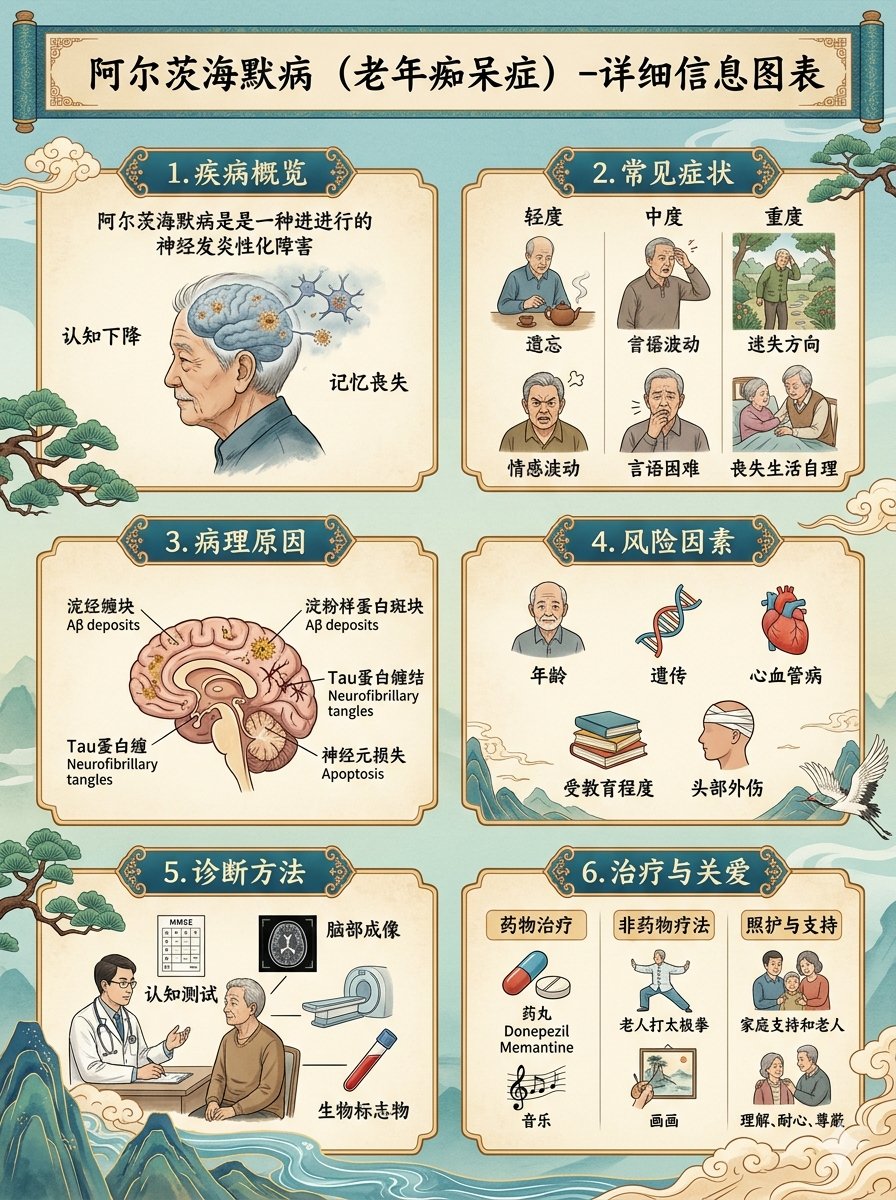
Chinesisches Alzheimer-Infografik-Poster
Ein detailliertes, traditionell im chinesischen Stil gehaltenes medizinisches Infografik-Poster, das die Alzheimer-Krankheit erklärt und für Gesundheitsaufklärung, Sensibilisierungskampagnen und wissenschaftliche Beiträge in sozialen Medien geeignet ist.
Dies ist ein GPT Image 2 -Prompt für Grafik & Poster . Verwenden Sie den unten stehenden, kopierfertigen Prompt, um ähnliche Grafiken zu erstellen, und überprüfen Sie vor der Wiederverwendung Awesome GPT Image 2 Prompts -Quellenangaben sowie die kommerziellen Nutzungsrechte.
Free 1K preview
Generate one preview image instantly, no sign-up required.
Eingabeaufforderung
Kopierfertige Eingabeaufforderung
{
  "type": "traditional Chinese medical infographic poster",
  "topic": "{argument name=\"topic\" default=\"Alzheimer's disease (dementia)\"}",
  "title": "{argument name=\"headline text\" default=\"Alzheimer's Disease (Dementia) - Detailed Infographic\"}",
  "language": "Chinese",
  "style": {
    "overall": "educational health infographic in vintage Chinese poster style",
    "rendering": "clean hand-painted illustration, soft watercolor textures, thin ink outlines, muted pastel colors",
    "palette": "teal, beige, cream, jade green, dusty blue, warm brown, light coral",
    "decorative frame": "ornate scroll-like border with gold trim",
    "background": "pale sky-blue backdrop with traditional Chinese landscape motifs, stylized clouds, pine trees, mountains, cranes, and waves"
  },
  "layout": {
    "format": "vertical poster",
    "sections": [
      {
        "title": "1. Disease Overview",
        "position": "top-left",
        "count": 1,
        "labels": [
          "Cognitive Decline",
          "Memory Loss"
        ],
        "content": "one large panel explaining that Alzheimer disease is a progressive neurodegenerative disorder, featuring an elderly side-profile portrait with a semi-transparent brain illustration showing degeneration and small neuron icons around the brain"
      },
      {
        "title": "2. Common Symptoms",
        "position": "top-right",
        "count": 6,
        "labels": [
          "Mild",
          "Moderate",
          "Severe",
          "Forgetfulness",
          "Emotional fluctuations",
          "Speech difficulties",
          "Disorientation",
          "Loss of ability to care for oneself"
        ],
        "content": "a symptom panel arranged as 3 columns by severity, with 6 vignette illustrations of elderly people: forgetting at a table, emotional fluctuation, headache or confusion, speech difficulty, getting lost outdoors, and losing ability for daily self-care with assistance from another person"
      },
      {
        "title": "3. Pathological causes",
        "position": "middle-left",
        "count": 4,
        "labels": [
          "Amyloid plaques",
          "Aβ deposits",
          "Tau protein tangles",
          "Neurofibrillary tangles",
          "Neuron loss",
          "Apoptosis"
        ],
        "content": "a cross-section anatomical brain diagram with bilingual annotations pointing to amyloid beta deposits, tau protein tangles, neurofibrillary tangles, and neuron loss"
      },
      {
        "title": "4. Risk factors",
        "position": "middle-right",
        "count": 5,
        "labels": [
          "Age",
          "Genetics",
          "Cardiovascular disease",
          "Education level",
          "Head trauma"
        ],
        "content": "five icon-based risk factors shown in a grid: an elderly bust for age, DNA helix for genetics, anatomical heart for cardiovascular disease, stacked books for education level, and a head profile with bandage for head trauma"
      },
      {
        "title": "5. Diagnostic methods",
        "position": "bottom-left",
        "count": 4,
        "labels": [
          "Cognitive testing",
          "MMSE",
          "Brain imaging",
          "Biomarker"
        ],
        "content": "a diagnosis panel with a doctor consulting an elderly patient at a desk, plus three diagnostic visuals: an MMSE test sheet, a brain imaging scan with MRI-like machine, and a test tube representing biomarkers"
      },
      {
        "title": "6. Treatment and Care",
        "position": "bottom-right",
        "count": 7,
        "labels": [
          "Drug therapy",
          "Pills",
          "Donepezil",
          "Memantine",
          "Non-pharmacological therapies",
          "Old man practicing Tai Chi",
          "Music",
          "Painting",
          "Care and support",
          "Family support and elderly care",
          "Understanding, patience, respect"
        ],
        "content": "a care and treatment panel divided into 3 columns: medication with two pills and the words Donepezil and Memantine, non-drug therapy with tai chi, music, and painting, and caregiving support with family companionship plus a smaller scene emphasizing understanding, patience, and respect"
      }
    ],
    "header": {
      "count": 1,
      "text": "large centered Chinese calligraphy title banner at the top"
    },
    "panel_style": "six rounded rectangular cream panels with decorative teal-and-gold title tabs"
  },
  "composition": {
    "symmetry": "balanced two-column arrangement with three rows of paired panels",
    "readability": "clear educational hierarchy with large title, numbered section headers, medium illustrations, and bold labels",
    "density": "information-dense but visually friendly"
  },
  "negative_constraints": [
    "no photorealism",
    "no modern flat UI",
    "no dark horror tone",
    "no clutter outside the six main panels",
    "no extra sections beyond the 6 numbered panels"
  ],
  "quality": "high-resolution, polished infographic suitable for public health education, hospital waiting rooms, science communication posts, or social media comparison graphics"
}
Eingabeaufforderungsvariablen
In der Eingabeaufforderung befinden sich bearbeitbare Argumentplatzhalter mit ihren Standardwerten.
Best for
- - Grafik & Poster visual exploration
- - Image generation and reference-image edits
- - Reusable briefs that keep source attribution visible
Change these parts
- - Subject, product, character, or scene
- - Aspect ratio, camera, lighting, and background
- - Brand, text, color, and output constraints
Recommended model and settings
- - Model: gpt-image-2
- - Input mode: Text zu Bild
- - Aspect ratio: source
- - Commercial status: review original source
How to use this prompt
- 1. Copy the prompt and preserve its structure for the first test.
- 2. Replace the subject, context, and publishing channel.
- 3. Change one camera, lighting, or style variable per iteration.
- 4. Inspect the output, source, text, and rights before reuse.
Limitations, source, and reuse cautions
- - Generated output is an editable draft, not factual, legal, or rights evidence.
- - Review the linked source, people, brands, logos, text, and third-party media before commercial use.
Weitere Fälle in dieser Kategorie
Priorisiert nach Kategorie, Kompatibilität der Eingabemodi, Qualität und geringerem Risiko.





Hinweise zur Wiederverwendung und Quellenangabe
Verwenden Sie diese Eingabeaufforderung sicher, nachdem Sie den Fall in der Vorschau angezeigt haben.
- 1.Kopieren Sie die Eingabeaufforderung oder öffnen Sie sie direkt in Dovoo mit der Schaltfläche „Generieren“.
- 2.Passen Sie Variablen, Seitenverhältnis und Referenzbilder an Ihren Anwendungsfall an.
- 3.Vor der Veröffentlichung oder kostenpflichtigen Nutzung sollten Sie die Rechte an der Quelle, die Anforderungen an die Namensnennung sowie die Risiken für die Marke oder das Abbild prüfen.