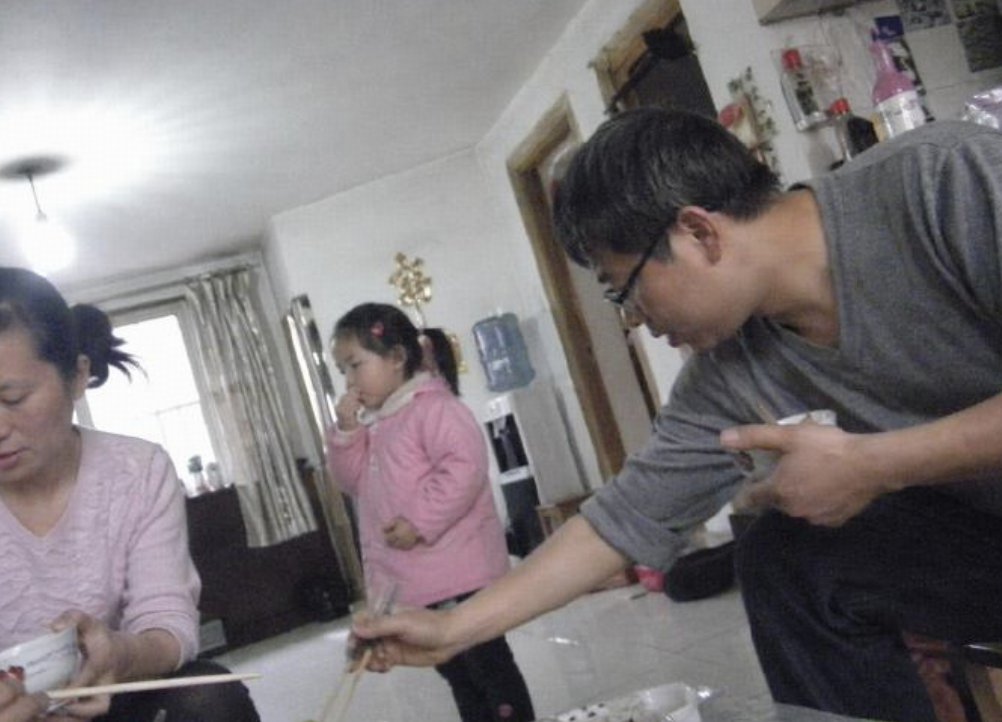
Censored Family Snapshot
Generates a tilted low-resolution candid apartment photo with three people whose faces are obscured by censor blocks, useful for uncanny realistic AI-image demonstrations.
Dies ist ein GPT Image 2 -Prompt für Porträt & Charakter . Verwenden Sie den unten stehenden, kopierfertigen Prompt, um ähnliche Grafiken zu erstellen, und überprüfen Sie vor der Wiederverwendung Awesome GPT Image 2 Prompts -Quellenangaben sowie die kommerziellen Nutzungsrechte.
Free 1K preview
Generate one preview image instantly, no sign-up required.
Eingabeaufforderung
Kopierfertige Eingabeaufforderung
Create a low-resolution, candid indoor family snapshot with an unsettling hyper-realistic AI-photo feel, shot at a slight clockwise tilt with a wide-angle phone camera and harsh ceiling-light glare. The scene is a cramped apartment dining/living room with glossy white tile floor, white walls, a bright window with beige curtains in the back left, a dark sofa or cabinet near the window, a wall-mounted water dispenser in the center background, shelves and bottles cluttered in the upper right, and everyday household objects scattered around. Show exactly 3 people: on the left, a seated adult woman in a pale pink long-sleeve top holding a white bowl and chopsticks near the bottom edge; in the center background, a standing child wearing a puffy pink jacket and dark pants, holding something near the mouth; on the right foreground, a leaning adult man in a gray long-sleeve shirt and dark pants, reaching diagonally downward with chopsticks while pointing with his other hand. Cover all 3 faces with opaque rectangular pixelated blur censor blocks in muted brown-gray tones: one tall block over the woman’s face at the far left edge, one smaller block over the child’s face, and one large block over the man’s face. Keep the composition awkward and accidental, with motion blur, compression artifacts, soft focus, noisy shadows, washed-out colors, uneven exposure, and the feeling of an old compressed family photo. Use {argument name="room type" default="small Chinese apartment dining room"}, {argument name="number of people" default="3"}, {argument name="censor style" default="opaque rectangular pixelated blur blocks"}, {argument name="main clothing color" default="pink and gray"}, and {argument name="camera style" default="tilted low-resolution phone snapshot"}. Do not add readable text, logos, watermarks, or extra people.Eingabeaufforderungsvariablen
In der Eingabeaufforderung befinden sich bearbeitbare Argumentplatzhalter mit ihren Standardwerten.
Best for
- - Porträt & Charakter visual exploration
- - Image generation and reference-image edits
- - Reusable briefs that keep source attribution visible
Change these parts
- - Subject, product, character, or scene
- - Aspect ratio, camera, lighting, and background
- - Brand, text, color, and output constraints
Recommended model and settings
- - Model: gpt-image-2
- - Input mode: Text zu Bild
- - Aspect ratio: source
- - Commercial status: review original source
How to use this prompt
- 1. Copy the prompt and preserve its structure for the first test.
- 2. Replace the subject, context, and publishing channel.
- 3. Change one camera, lighting, or style variable per iteration.
- 4. Inspect the output, source, text, and rights before reuse.
Limitations, source, and reuse cautions
- - Generated output is an editable draft, not factual, legal, or rights evidence.
- - Review the linked source, people, brands, logos, text, and third-party media before commercial use.
Weitere Fälle in dieser Kategorie
Priorisiert nach Kategorie, Kompatibilität der Eingabemodi, Qualität und geringerem Risiko.
Hinweise zur Wiederverwendung und Quellenangabe
Verwenden Sie diese Eingabeaufforderung sicher, nachdem Sie den Fall in der Vorschau angezeigt haben.
- 1.Kopieren Sie die Eingabeaufforderung oder öffnen Sie sie direkt in Dovoo mit der Schaltfläche „Generieren“.
- 2.Passen Sie Variablen, Seitenverhältnis und Referenzbilder an Ihren Anwendungsfall an.
- 3.Vor der Veröffentlichung oder kostenpflichtigen Nutzung sollten Sie die Rechte an der Quelle, die Anforderungen an die Namensnennung sowie die Risiken für die Marke oder das Abbild prüfen.