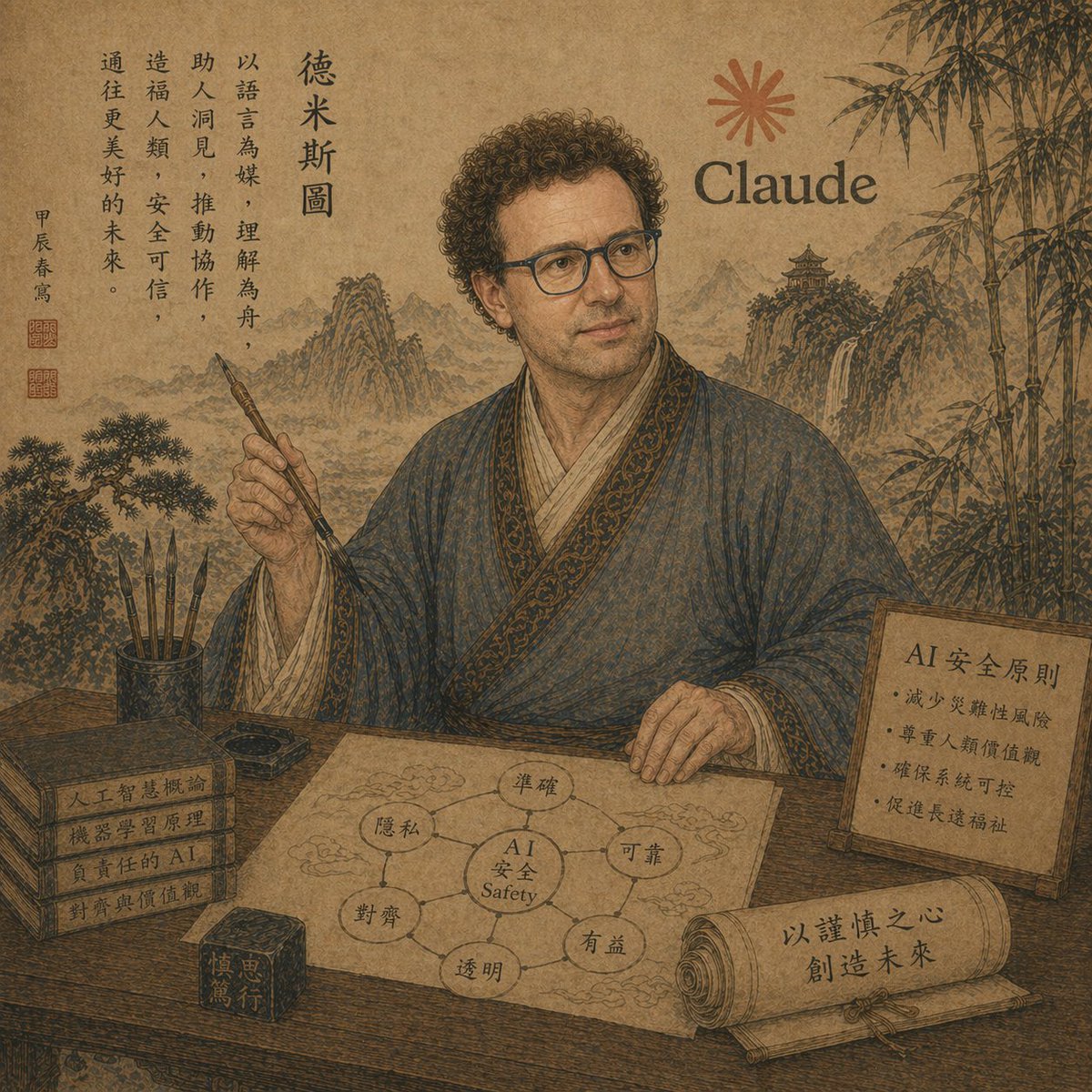
Sicherheitsposter für KI von Ancient Scholar
Dadurch entsteht ein Poster im Stil eines klassischen chinesischen Gelehrten auf Pergament mit Claude-Branding und Symbolik für KI-Sicherheit, geeignet für redaktionelle Illustrationen, Konzeptposter oder visuelle Essays zum Thema Kultur und Technologie.
Dies ist ein GPT Image 2 -Prompt für Grafik & Poster . Verwenden Sie den unten stehenden, kopierfertigen Prompt, um ähnliche Grafiken zu erstellen, und überprüfen Sie vor der Wiederverwendung Awesome GPT Image 2 Prompts -Quellenangaben sowie die kommerziellen Nutzungsrechte.
Benötigen Sie den vollständigen Prompt-Satz? Verwenden Sie den Grafik & Poster Weitere verwandte Beispiele finden Sie im Themen-Hub oder öffnen Sie die GPT Image 2 Prompt-Katalog für das vollständige Beispielverzeichnis, wiederverwendbare Strukturen und Quellenangaben.
Free 1K preview
Generate one preview image instantly, no sign-up required.
3087/4000
Eingabeaufforderung
Kopierfertige Eingabeaufforderung
A meticulously detailed sepia-toned illustration blending a portrait of a Chinese scholar with modern AI branding elements, presented on aged parchment with prominent texture and a watercolor feel. The central focus is a bust of a curly-haired male scholar inspired by Democritus, seated at a wooden desk, wearing layered traditional robes in soft blue-gray and brown tones with delicate trim. Show every face clearly with natural, detailed facial features, brown-toned rectangle, creating a sense of anonymity or censorship. He holds a calligraphy brush vertically in his right hand, and his left hand rests flat on the table. In the upper-middle-right, the Claude logo is placed, featuring a rust-orange sunburst emblem and the word “Claude” in a dark serif font. In the upper-left corner, add a large vertical Chinese title “德米斯图” (Demist), accompanied by a column of smaller vertical Chinese calligraphy text: “以语言为媒,理解为舟,助人洞见,推动协作,造福人类,安全可信,通往更美好的未来.” (Using language as a medium, understanding as a vessel, helping people gain insight, promoting collaboration, benefiting humanity, safe and trustworthy, leading to a better future.) Add a smaller vertical signature on the far left: “甲辰春写” (Written in Spring of the Jia Chen Year), with two red seals below. The background showcases a classical Chinese landscape painting, including distant mountains, a small pavilion on a cliff, clouds, and mist, with dense bamboo leaves adorning the upper-right and right edges, and dark pine branches in the lower-left corner.

The wooden desk occupies the lower third of the image, displaying 8 distinct items: on the left, a brush holder with 4 brushes, a stack of 4 bound books with the titles “Introduction to Artificial Intelligence,” “Principles of Machine Learning,” “Responsible AI,” and “Alignment & Values” on their spines; a central inkstone or ink dish; a parchment chart in the center; a small, dark square seal with Chinese characters in the lower-left; a framed notice board on the right; and a scroll in the lower-right. The desk surface exhibits clear wood grain. The central parchment chart should display a circular node labeled “AI Safety,” connected to 6 surrounding nodes labeled “Accuracy,” “Reliability,” “Beneficial,” “Transparency,” “Alignment,” and “Privacy,” all encircled by delicate cloud patterns. The framed notice board on the right should be titled “AI Safety Principles” and list 4 Chinese points: “Reduce catastrophic risks,” “Respect human values,” “Ensure system controllability,” and “Promote long-term well-being.” The scroll in the lower-right should display the text “以谨慎之心 创造未来” (Create the future with a cautious heart).

Employ a balanced composition, a scholarly and serene atmosphere, highly detailed ink lines, subtle watercolor rendering, antique museum print aesthetics, and a restrained color palette of parchment sepia, ink brown, faded blues, and soft charcoal grays. The overall impression should be a knowledgeable tribute poster fusing East Asian classical literati painting, philosophical portraiture, and contemporary AI safety themes.
Best for
- - Grafik & Poster visual exploration
- - Image generation and reference-image edits
- - Reusable briefs that keep source attribution visible
Change these parts
- - Subject, product, character, or scene
- - Aspect ratio, camera, lighting, and background
- - Brand, text, color, and output constraints
Recommended model and settings
- - Model: gpt-image-2
- - Input mode: Text zu Bild
- - Aspect ratio: source
- - Commercial status: review original source
How to use this prompt
- 1. Copy the prompt and preserve its structure for the first test.
- 2. Replace the subject, context, and publishing channel.
- 3. Change one camera, lighting, or style variable per iteration.
- 4. Inspect the output, source, text, and rights before reuse.
Limitations, source, and reuse cautions
- - Generated output is an editable draft, not factual, legal, or rights evidence.
- - Review the linked source, people, brands, logos, text, and third-party media before commercial use.
Importiert von Awesome GPT Image 2 Prompts . Quellenangabe erforderlich. Status der kommerziellen Nutzung: allowed ; Rechte an der Quelle vor kostenpflichtiger Nutzung prüfen.
Weitere Fälle in dieser Kategorie
Priorisiert nach Kategorie, Kompatibilität der Eingabemodi, Qualität und geringerem Risiko.

Hinweise zur Wiederverwendung und Quellenangabe
Verwenden Sie diese Eingabeaufforderung sicher, nachdem Sie den Fall in der Vorschau angezeigt haben.
- 1.Kopieren Sie die Eingabeaufforderung oder öffnen Sie sie direkt in Dovoo mit der Schaltfläche „Generieren“.
- 2.Passen Sie Variablen, Seitenverhältnis und Referenzbilder an Ihren Anwendungsfall an.
- 3.Vor der Veröffentlichung oder kostenpflichtigen Nutzung sollten Sie die Rechte an der Quelle, die Anforderungen an die Namensnennung sowie die Risiken für die Marke oder das Abbild prüfen.