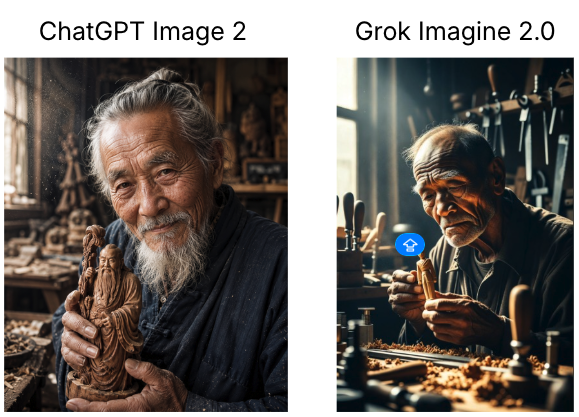
AI Image Realism Comparison
Generates a two-panel comparison graphic of realistic elderly woodcarver portraits labeled ChatGPT Image 2 and Grok Imagine 2.0.
Dies ist ein GPT Image 2 -Prompt für Grafik & Poster . Verwenden Sie den unten stehenden, kopierfertigen Prompt, um ähnliche Grafiken zu erstellen, und überprüfen Sie vor der Wiederverwendung Awesome GPT Image 2 Prompts -Quellenangaben sowie die kommerziellen Nutzungsrechte.
Benötigen Sie den vollständigen Prompt-Satz? Verwenden Sie den Grafik & Poster Weitere verwandte Beispiele finden Sie im Themen-Hub oder öffnen Sie die GPT Image 2 Prompt-Katalog für das vollständige Beispielverzeichnis, wiederverwendbare Strukturen und Quellenangaben.
Free 1K preview
Generate one preview image instantly, no sign-up required.
1734/4000
Eingabeaufforderung
Kopierfertige Eingabeaufforderung
Create a side-by-side comparison graphic on a white background showing two AI image results from the same prompt. Canvas: landscape aspect ratio, approximately 580×420 px, clean white margins. Layout: two equal vertical image panels aligned horizontally with a narrow white gutter between them; each panel has a black sans-serif heading centered above it. Use exactly 2 headings: left heading “ChatGPT Image 2”, right heading “Grok Imagine 2.0”. Left panel: a highly realistic warm-toned portrait photo of an elderly East Asian woodcarver in a cluttered traditional workshop, gray hair tied back, long white beard and mustache, weathered face with fine wrinkles, wearing dark work clothes, holding a detailed carved wooden statue close to his chest with both hands, soft window light from the left, shelves and tools blurred in the background, dusty particles in the air, documentary realism. Right panel: a more cinematic but less natural portrait of an elderly East Asian craftsman seated at a workbench in a woodworking studio, balding gray hair, deeply wrinkled face, dark shirt, carving a small wooden figure with hand tools, strong dramatic sunlight from a window, many chisels and woodworking tools standing upright behind him, wood shavings scattered across the table, high contrast shadows, slightly artificial glossy look. Include exactly 1 small blue circular overlay icon near the center-left of the right panel, with a simple white symbol inside, resembling an interface marker. Overall style: realistic photographic comparison, left image more natural and detailed, right image more stylized and dramatic. No extra captions, no watermarks beyond the single blue overlay icon, no borders except the white page background.
Best for
- - Grafik & Poster visual exploration
- - Image generation and reference-image edits
- - Reusable briefs that keep source attribution visible
Change these parts
- - Subject, product, character, or scene
- - Aspect ratio, camera, lighting, and background
- - Brand, text, color, and output constraints
Recommended model and settings
- - Model: gpt-image-2
- - Input mode: Text zu Bild
- - Aspect ratio: source
- - Commercial status: review original source
How to use this prompt
- 1. Copy the prompt and preserve its structure for the first test.
- 2. Replace the subject, context, and publishing channel.
- 3. Change one camera, lighting, or style variable per iteration.
- 4. Inspect the output, source, text, and rights before reuse.
Limitations, source, and reuse cautions
- - Generated output is an editable draft, not factual, legal, or rights evidence.
- - Review the linked source, people, brands, logos, text, and third-party media before commercial use.
Importiert von Awesome GPT Image 2 Prompts . Quellenangabe erforderlich. Status der kommerziellen Nutzung: allowed ; Rechte an der Quelle vor kostenpflichtiger Nutzung prüfen.
Weitere Fälle in dieser Kategorie
Priorisiert nach Kategorie, Kompatibilität der Eingabemodi, Qualität und geringerem Risiko.
Hinweise zur Wiederverwendung und Quellenangabe
Verwenden Sie diese Eingabeaufforderung sicher, nachdem Sie den Fall in der Vorschau angezeigt haben.
- 1.Kopieren Sie die Eingabeaufforderung oder öffnen Sie sie direkt in Dovoo mit der Schaltfläche „Generieren“.
- 2.Passen Sie Variablen, Seitenverhältnis und Referenzbilder an Ihren Anwendungsfall an.
- 3.Vor der Veröffentlichung oder kostenpflichtigen Nutzung sollten Sie die Rechte an der Quelle, die Anforderungen an die Namensnennung sowie die Risiken für die Marke oder das Abbild prüfen.