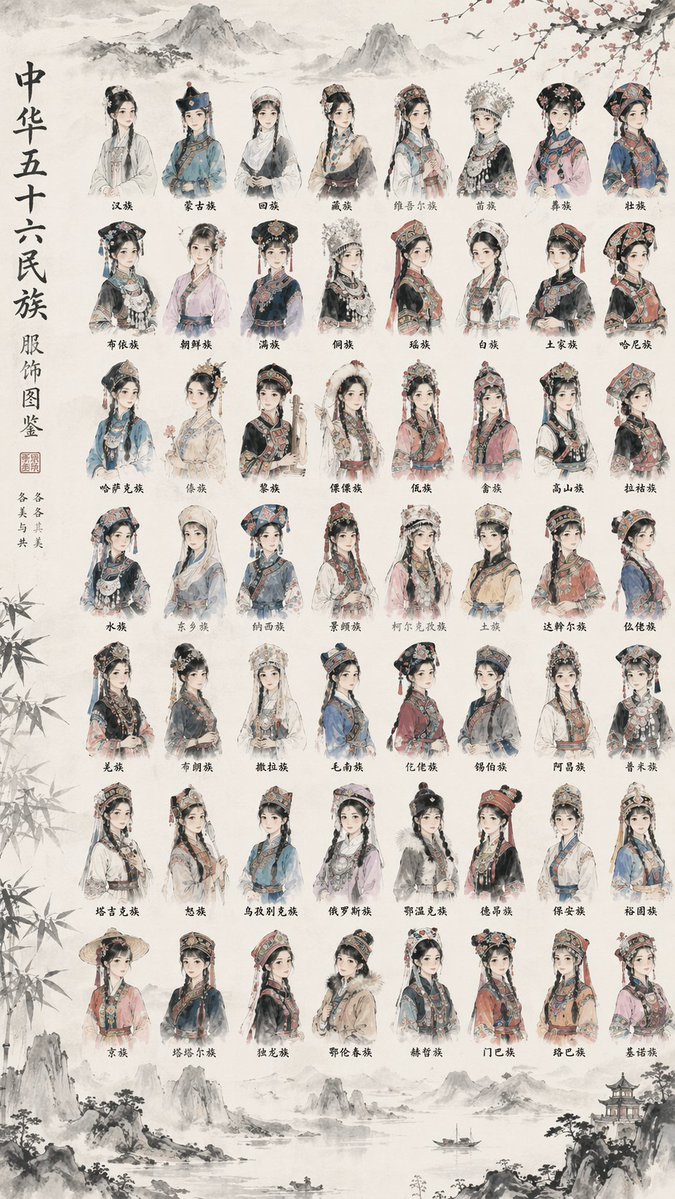
Kleidungstabelle der 56 chinesischen ethnischen Gruppen
Erzeugt ein Rasterdiagramm im traditionellen Tuschewaschstil, das 56 verschiedene weibliche Porträts in ethnischer Kleidung mit Beschriftungen und Landschaftshintergrund zeigt.
Dies ist ein GPT Image 2 -Prompt für Illustration & Kunst . Verwenden Sie den unten stehenden, kopierfertigen Prompt, um ähnliche Grafiken zu erstellen, und überprüfen Sie vor der Wiederverwendung Awesome GPT Image 2 Prompts -Quellenangaben sowie die kommerziellen Nutzungsrechte.
Free 1K preview
Generate one preview image instantly, no sign-up required.
Eingabeaufforderung
Kopierfertige Eingabeaufforderung
{
  "type": "illustrated reference chart",
  "style": "{argument name=\"art style\" default=\"traditional Chinese ink wash painting, delicate brushwork, soft watercolor tones, vintage aged paper texture\"}, Elegant Watercolor, Soft Tones, Vintage Paper Texture",
  "layout": {
    "background": "A delicate background with misty mountains and hills, adorned with plum blossoms in the upper right corner, bamboo branches along the left edge, and a small pavilion and boat in the lower right corner.",
    "typography": {
      "main_title": "{argument name=\"main title\" default=\"An Illustrated Guide to the Costumes of China's 56 Ethnic Groups\"}",
      "subtitle": "Each finds beauty in the other, and all are beautiful together.",
      "alignment": "Vertically arranged text, located on the far left."
    },
    "grid": {
      "rows": 7,
      "columns": 8,
      "total_items": 56,
      "item_description": "{argument name=\"subject description\" default=\"half-body portraits of young women wearing distinct, highly detailed traditional ethnic clothing and elaborate headdresses\"}",
      "labels": [
        "Han Chinese",
        "Mongolian",
        "Hui people",
        "Tibetan people",
        "Uyghur people",
        "Miao people",
        "Yi people",
        "Zhuang people",
        "Buyi people",
        "Korean people",
        "Manchu people",
        "Dong people",
        "Yao people",
        "Bai people",
        "Tujia people",
        "Hani people",
        "Kazakh people",
        "Dai people",
        "Li people",
        "Lisu people",
        "Wa people",
        "She people",
        "Gaoshan people",
        "Lahu people",
        "Shui people",
        "Dongxiang people",
        "Naxi people",
        "Jingpo people",
        "Kirghiz people",
        "Tujia people",
        "Daur people",
        "Qiongla people",
        "Qiang people",
        "Blang people",
        "Salar people",
        "Monan people",
        "Gelao people",
        "Sibe people",
        "Achang people",
        "Pumi people",
        "Tajik people",
        "Nu people",
        "Uyghur",
        "Russian",
        "Ewenki",
        "De'ang",
        "Bonan",
        "Yugur people",
        "Jing people",
        "Tatar people",
        "Dulung people",
        "Oroqen people",
        "Hezhen people",
        "Menba people",
        "Lopa people",
        "Jinuo people"
      ]
    }
  }
}
Eingabeaufforderungsvariablen
In der Eingabeaufforderung befinden sich bearbeitbare Argumentplatzhalter mit ihren Standardwerten.
Best for
- - Illustration & Kunst visual exploration
- - Image generation and reference-image edits
- - Reusable briefs that keep source attribution visible
Change these parts
- - Subject, product, character, or scene
- - Aspect ratio, camera, lighting, and background
- - Brand, text, color, and output constraints
Recommended model and settings
- - Model: gpt-image-2
- - Input mode: Text zu Bild
- - Aspect ratio: source
- - Commercial status: review original source
How to use this prompt
- 1. Copy the prompt and preserve its structure for the first test.
- 2. Replace the subject, context, and publishing channel.
- 3. Change one camera, lighting, or style variable per iteration.
- 4. Inspect the output, source, text, and rights before reuse.
Limitations, source, and reuse cautions
- - Generated output is an editable draft, not factual, legal, or rights evidence.
- - Review the linked source, people, brands, logos, text, and third-party media before commercial use.
Weitere Fälle in dieser Kategorie
Priorisiert nach Kategorie, Kompatibilität der Eingabemodi, Qualität und geringerem Risiko.

Hinweise zur Wiederverwendung und Quellenangabe
Verwenden Sie diese Eingabeaufforderung sicher, nachdem Sie den Fall in der Vorschau angezeigt haben.
- 1.Kopieren Sie die Eingabeaufforderung oder öffnen Sie sie direkt in Dovoo mit der Schaltfläche „Generieren“.
- 2.Passen Sie Variablen, Seitenverhältnis und Referenzbilder an Ihren Anwendungsfall an.
- 3.Vor der Veröffentlichung oder kostenpflichtigen Nutzung sollten Sie die Rechte an der Quelle, die Anforderungen an die Namensnennung sowie die Risiken für die Marke oder das Abbild prüfen.