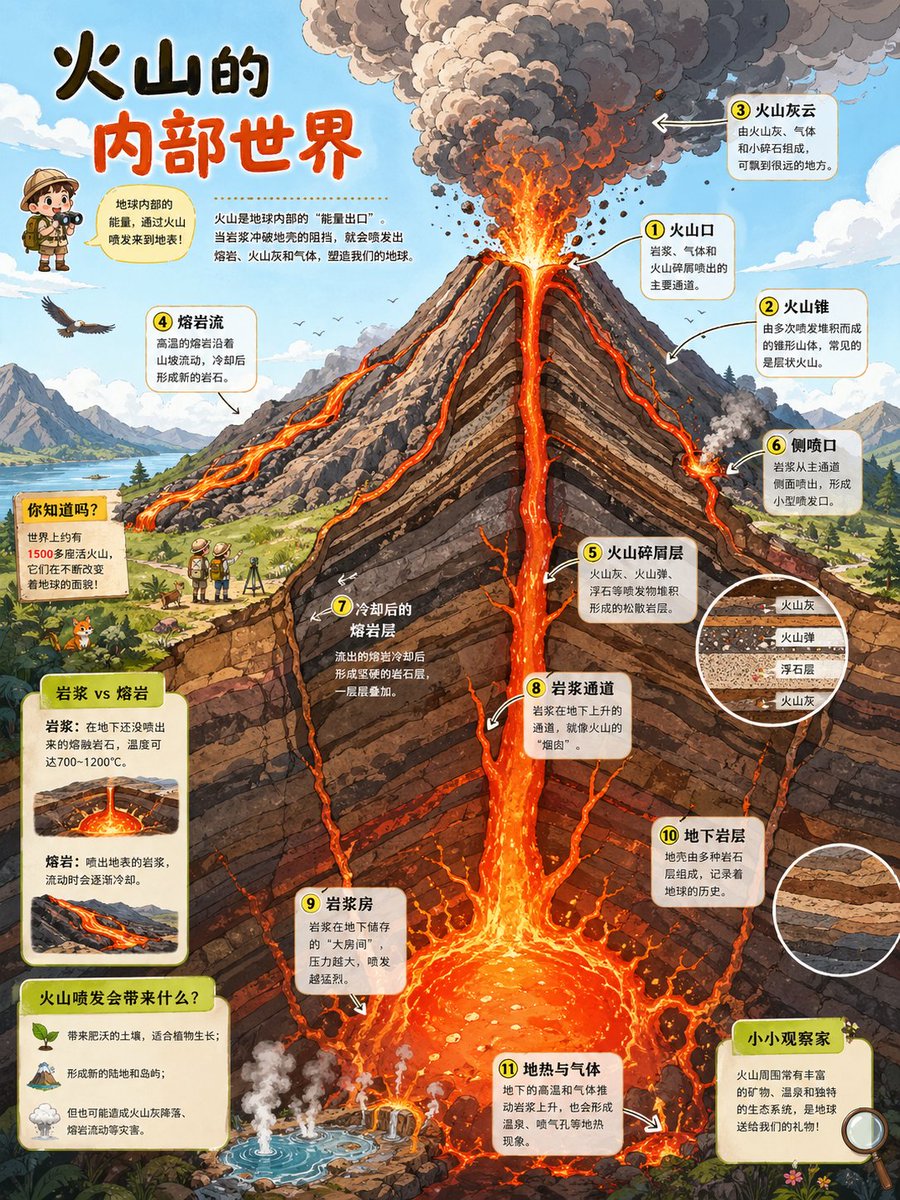
Volcano Cutaway Science Poster
Generates a Chinese children's encyclopedia-style volcano cross-section infographic with numbered anatomical callouts, side facts, and magnified geology insets.
This is a gpt-image-2 prompt case for 平面海报. Use the copy-ready prompt below to generate similar visuals, and review Awesome Seedance 2.0 Video Prompts attribution plus commercial-use rights before reuse.
Prompt
Copy-ready prompt
{
  "type": "Children's Science Encyclopedia Cross-Sectional Infographic Poster",
  "topic": "{argument name=\"main title\" default=\"The inner world of a volcano\"}",
  "language": "Simplified Chinese annotations and main text",
  "style": "Publishing-quality educational illustrations, richly detailed hand-painted watercolor and gouache style, with a warm volcanic orange contrasting with clear sky blue and green landscapes, suitable for children's reading. The annotations are neatly arranged, with high spatial coherence and high resolution.",
  "layout": {
    "canvas": "Vertical full-page poster",
    "main_scene": "A large stratigraphic volcano profile, with the right half cut open to reveal layered rock strata, a central glowing magma conduit, branching vents, lava flows, magma chambers, fissures, and groundwater and gases beneath the volcano.",
    "background": "Blue sky and white clouds, a huge gray volcanic ash column, fiery orange eruptions from the crater, distant mountains, lakes, forests, birds, and tiny explorers serving as a scale.",
    "title_area": {
      "position": "Top left corner",
      "text": "{argument name=\"main title\" default=\"The inner world of a volcano\"}",
      "typography": "Large Chinese font in the style of calligraphy brush, first line in black, second line in bold red-orange."
    },
    "mascot_and_intro": {
      "position": "upper left",
      "character": "A little explorer wearing a khaki adventure hat, carrying a backpack, and wearing boots.",
      "speech_bubble": "Energy from inside the Earth is released to the surface through volcanic eruptions!",
      "intro_paragraph": "Volcanoes are the Earth's internal 'energy outlets'. When magma breaks through the Earth's crust, it erupts lava, volcanic ash, and gases, shaping our planet."
    },
    "numbered_callouts": {
      "count": 11,
      "labels": [
        {
          "number": 1,
          "title": "crater",
          "description": "The main conduit for the ejection of magma, gas, and volcanic debris.",
          "position": "Next to the crater in the upper right corner"
        },
        {
          "number": 2,
          "title": "volcanic cone",
          "description": "Conical mountains formed by multiple eruptions are commonly stratovolcanoes.",
          "position": "right hillside"
        },
        {
          "number": 3,
          "title": "volcanic ash cloud",
          "description": "Composed of volcanic ash, gas, and small rock particles, it can drift to very far places.",
          "position": "In the volcanic ash cloud in the upper right corner"
        },
        {
          "number": 4,
          "title": "lava flow",
          "description": "High-temperature lava flows down the hillside and cools to form new rocks.",
          "position": "upper left slope"
        },
        {
          "number": 5,
          "title": "pyroclastic layer",
          "description": "Loose rock layers formed by the accumulation of volcanic ash, volcanic bombs, pumice, and other ejecta.",
          "position": "Right side middle section"
        },
        {
          "number": 6,
          "title": "Side nozzles",
          "description": "Magma erupted from the side of the main channel, forming a small vent.",
          "position": "Small eruption on the right side of the mountain"
        },
        {
          "number": 7,
          "title": "Cooled lava layer",
          "description": "The flowing lava cooled and formed hard rock layers, which were stacked one on top of the other.",
          "position": "Left side internal strata"
        },
        {
          "number": 8,
          "title": "Magma Conduit",
          "description": "The channels through which magma rises underground are like the 'chimneys' of a volcano.",
          "position": "Central Vertical Passage"
        },
        {
          "number": 9,
          "title": "magma chamber",
          "description": "The greater the pressure in the magma stored underground, the more violent the eruption.",
          "position": "Lower left of the magma chamber"
        },
        {
          "number": 10,
          "title": "underground rock strata",
          "description": "The Earth's crust is composed of various rock layers and records the Earth's history.",
          "position": "Lower right strata"
        },
        {
          "number": 11,
          "title": "Geothermal and Gas",
          "description": "High temperatures and gases underground can push magma upwards, creating geothermal phenomena such as hot springs and fumaroles.",
          "position": "The bottom of the hot spring and the vicinity of the lava"
        }
      ]
    },
    "side_panels": {
      "count": 4,
      "items": [
        {
          "title": "Did you know?",
          "position": "Yellow card in the middle of the left side",
          "content": "There are more than 1,500 active volcanoes in the world, constantly changing the face of the earth!"
        },
        {
          "title": "Magma vs. Lava",
          "position": "Green card at the bottom left",
          "content": "Magma: Incandescent rock underground that has not yet erupted, with temperatures reaching 700-1200°C. Lava: Magma that erupts to the surface and gradually cools as it flows.",
          "includes": "Two small contrasting illustrations"
        },
        {
          "title": "What are the consequences of a volcanic eruption?",
          "position": "light yellow card in the lower left corner",
          "content": "List three impacts and add icons: It brings fertile soil suitable for plant growth, forms new land and islands, but may also cause volcanic ash and lava flow disasters."
        },
        {
          "title": "Little Observer",
          "position": "light yellow card in the bottom right corner",
          "content": "Volcanoes are often surrounded by rich minerals, hot springs, and unique ecosystems, which are gifts from the Earth!",
          "includes": "Magnifying glass illustration"
        }
      ]
    },
    "detail_insets": {
      "count": 2,
      "items": [
        {
          "position": "Right middle",
          "shape": "Circular enlarged cross section",
          "content": "Four visible layers are labeled: volcanic ash, volcanic bomb, pumice layer, and volcanic ash."
        },
        {
          "position": "lower right",
          "shape": "Circular enlarged cross section",
          "content": "Close-up of brown and gray underground rock layers"
        }
      ]
    },
    "small_figures": {
      "count": 6,
      "items": [
        "A children's explorer mascot in the upper left corner",
        "Three young explorers with backpacks and binoculars at the base of the left side of the volcano",
        "A fox in the grass in the lower left corner",
        "An eagle flying above the valley on the left"
      ]
    }
  },
  "rendering_instructions": "Create a coherent cross-section, ensuring each numbered arrow points to the correct volcanic structure. Give the lava an incandescent color with yellowish-white highlights and orange-red edges. Add smoke, volcanic ash particles, lava fissures, realistic layered rock formations, and neat, rounded label boxes with yellow number badges. Keep all Chinese characters legible and formatted like a beautifully designed educational book page.",
  "customizable_subject": "{argument name=\"volcano type\" default=\"Stratovolcano\"}",
  "audience": "{argument name=\"audience\" default=\"Children's Science Readers\"}",
  "color_palette": "{argument name=\"color palette\" default=\"Warm volcanic orange, earth brown, sky blue, forest green, and light yellow are used to label the cards.\"}"
}
Prompt variables
Editable argument placeholders found in the prompt, with their default values.
More cases in this category
Prioritized by category, input mode compatibility, quality, and lower risk.



Reuse and source notes
Use this prompt safely after previewing the case.
- 1.Copy the prompt or open it directly in Dovoo with the generation button.
- 2.Adjust variables, aspect ratio, and reference images for your own use case.
- 3.Before publishing or paid usage, verify source rights, attribution requirements, and brand or likeness risks.
Can I use this prompt commercially?
Commercial-use status is restricted. Review the original source, license, brand constraints, and legal requirements before paid usage.
Where does this case come from?
This case is imported from Awesome Seedance 2.0 Video Prompts; keep attribution visible and check the source URL before reuse.