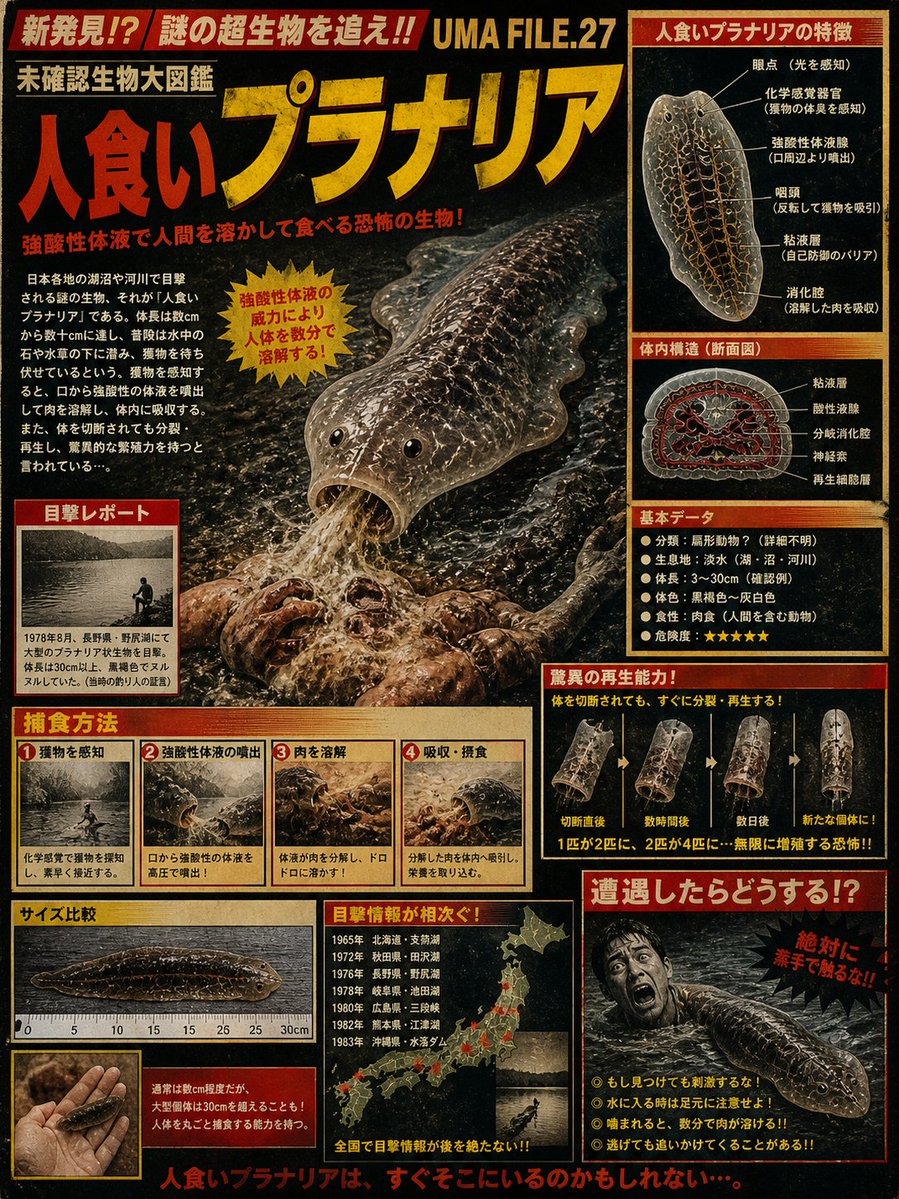
Retro Man-Eating Planaria Dossier
Generates a dense Japanese-style UMA cryptid poster with anatomical diagrams, danger data, sighting reports, feeding steps, and survival warnings.
This is a gpt-image-2 prompt case for 平面海报. Use the copy-ready prompt below to generate similar visuals, and review Awesome Seedance 2.0 Video Prompts attribution plus commercial-use rights before reuse.
Prompt
Copy-ready prompt
{
  "type": "Retro Japanese-style monster outdoor guide poster / Monster archive tabloid",
  "overall_style": "High-density 1970s popular magazine layout, black worn paper background, red and yellow emergency warning font, grainy halftone printing, weathered edges, pseudo-scientific annotations, horror documentary atmosphere, highly detailed bizarre creature art, rough tactile texture.",
  "main_title": {
    "top_banners": [
      "New discovery!?",
      "Track down the mysterious super-creature!!",
      "UMA FILE.27"
    ],
    "series_label": "Unconfirmed Biological Encyclopedia",
    "headline": "{argument name=\"headline text\" default=\"Man-eating planarians\"}",
    "subtitle": "A terrifying creature that uses its highly acidic body fluids to dissolve and devour humans!"
  },
  "central_creature": {
    "name": "{argument name=\"creature name\" default=\"Man-eating planarians\"}",
    "appearance": "A huge, translucent, dark brown, flattened animal, its surface moist and glossy, with wrinkled edges, two small black eye spots, a round, open mouth, and amber-colored vein-like internal texture, crawls like a slug on the damp rocks.",
    "action": "The monster leaned forward, vomiting or secreting a foamy, acidic liquid onto the partially dissolved remains of its prey on the dark, muddy riverbank.",
    "caption_burst": "The power of highly acidic bodily fluids can dissolve the human body within minutes!"
  },
  "left_article": {
    "position": "left side of the main organism",
    "body_text": "The Japanese description section details sightings of this creature in lakes and rivers throughout Japan. Often mistaken for a leech, the section also describes its acidic secretions, predation, and regenerative abilities.",
    "section_count": 1
  },
  "layout": {
    "sections": [
      {
        "title": "Characteristics of man-eating planarians",
        "position": "Top right",
        "count": 1,
        "content": "Anatomical side view of a translucent organism, with 6 label points.",
        "labels": [
          "Eye point (for sensing light)",
          "Chemosensory organs (for sensing the smell of prey)",
          "Strongly acidic body fluid glands (ejected from around the mouth)",
          "Throat (flipped over and sucked up prey)",
          "Mucus layer (self-defense barrier)",
          "Digestive cavity (for absorbing dissolved meat)"
        ]
      },
      {
        "title": "Internal structure (cross-sectional view)",
        "position": "Right Center",
        "count": 1,
        "content": "Cross-sectional view of the reddish-black organs inside a flatworm.",
        "labels": [
          "Mucus layer",
          "Acidic gland dissolution",
          "Branched digestive cavities",
          "Nervous system",
          "Regenerating cell population"
        ]
      },
      {
        "title": "Basic data",
        "position": "lower right",
        "count": 6,
        "labels": [
          "Classification: Flatworms? (Details unknown)",
          "Habitat: Freshwater (lakes, swamps, rivers)",
          "Body length: 3-30cm (confirmed cases)",
          "Body color: dark brown to grayish white",
          "Diet: Carnivorous (including humans and other animals).",
          "Danger level: ★★★★★"
        ]
      },
      {
        "title": "Eyewitness Report",
        "position": "bottom left illustration",
        "count": 1,
        "content": "A grainy black-and-white photograph of a lakeside scene, featuring a solitary figure and a report from August 1978."
      },
      {
        "title": "Predation methods",
        "position": "Bottom left wide bar",
        "count": 4,
        "labels": [
          "1. Sense the prey",
          "2. Spraying out highly acidic bodily fluids",
          "3. Dissolve meat",
          "4. Absorption and Ingestion"
        ],
        "content": "Four numbered illustrated panels depict the processes of sensing, acid spraying, dissolving the meat, and feeding."
      },
      {
        "title": "Size comparison",
        "position": "Bottom left",
        "count": 2,
        "labels": [
          "A ruler comparison showing a specimen approximately 30cm long.",
          "Comparison of human hands holding small specimens"
        ]
      },
      {
        "title": "Eyewitness reports keep coming!",
        "position": "Bottom Center",
        "count": 1,
        "content": "A map of Japan marked with numerous red sighting markers lists the year and location of each sighting, and includes a small photograph of the lakeside.",
        "footer_text": "Eyewitness reports from all over the country have been continuous!"
      },
      {
        "title": "Amazing regenerative ability!",
        "position": "Bottom right",
        "count": 4,
        "labels": [
          "Cut off moment",
          "Several hours later",
          "Several days later",
          "Become a new individual!"
        ],
        "content": "Four illustrations depicting a continuous regeneration process show an insect being cut in two, then the two pieces becoming four, and so on, multiplying indefinitely.",
        "caption": "One becomes two, two become four... the terror of endless proliferation!!"
      },
      {
        "title": "What should you do if you encounter this?",
        "position": "Bottom right",
        "count": 1,
        "content": "Warning panels featuring blurry human figures and a large, flattened animal near the water, along with red alert text and four safety guidelines.",
        "labels": [
          "Never touch it with your bare hands!!",
          "Even if you discover it, don't irritate it!",
          "Watch your step when entering the water!",
          "If you get bitten, the flesh will dissolve within minutes!",
          "Even if you run away, you might still be caught!"
        ]
      }
    ]
  },
  "footer": "{argument name=\"footer warning\" default=\"Man-eating planarians might be right next to you...\"}",
  "color_palette": "Dirty black, stale cream, dangerous yellow, deep red, muddy brown, and grayish-green water highlights",
  "rendering_instructions": "Create a vertical, information-dense poster with extremely sharp images that deliberately retain a grainy texture, featuring realistic wet, biological textures, worn print edges, blocks of Japanese text, boxed charts, arrows, warning asterisks, and dramatic, eerie scientific compositions."
}
Prompt variables
Editable argument placeholders found in the prompt, with their default values.
More cases in this category
Prioritized by category, input mode compatibility, quality, and lower risk.





Reuse and source notes
Use this prompt safely after previewing the case.
- 1.Copy the prompt or open it directly in Dovoo with the generation button.
- 2.Adjust variables, aspect ratio, and reference images for your own use case.
- 3.Before publishing or paid usage, verify source rights, attribution requirements, and brand or likeness risks.
Can I use this prompt commercially?
Commercial-use status is restricted. Review the original source, license, brand constraints, and legal requirements before paid usage.
Where does this case come from?
This case is imported from Awesome Seedance 2.0 Video Prompts; keep attribution visible and check the source URL before reuse.