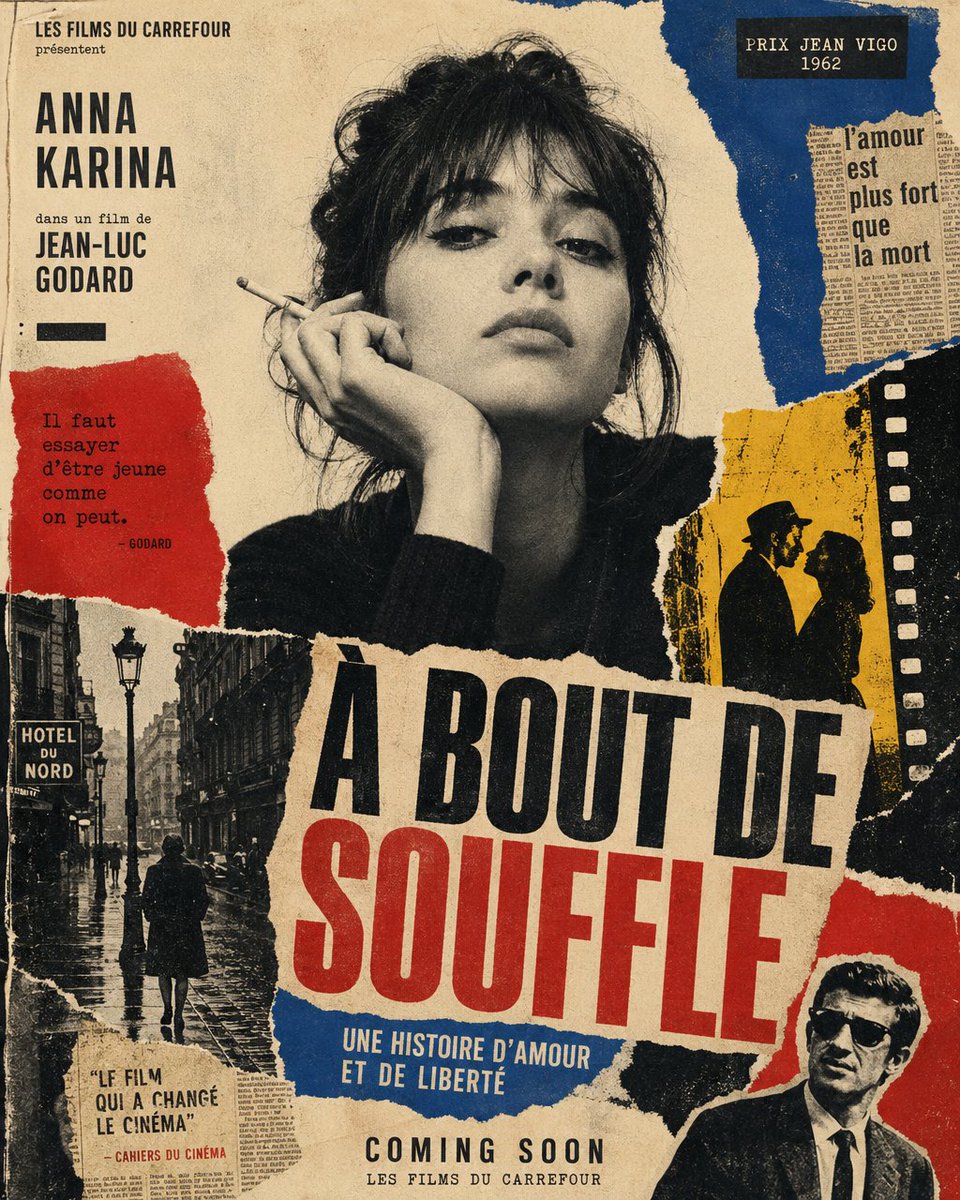
French New Wave Torn Poster Collage
This prompt generates a distressed 1960s-style French art-house movie poster collage, ideal for retro cinema branding, editorial artwork, or vintage film-inspired cover designs.
This is a GPT Image 2 prompt case for Graphic & Poster. Use the copy-ready prompt below to generate similar visuals, and review Awesome GPT Image 2 Prompts attribution plus commercial-use rights before reuse.
Free 1K preview
Generate one preview image instantly, no sign-up required.
Prompt
Copy-ready prompt
A vintage 1960s French New Wave cinema poster collage on aged beige paper, designed like a torn-paper art-house one-sheet with analog grain, distressed print texture, rough ripped edges, ink wear, halftone imperfections, and slight misregistration. Center the composition around a large black-and-white portrait of a woman with messy dark hair, hand raised to her face, holding a cigarette, cropped from the chest up, Show every face clearly with natural, detailed facial features. Use a layered collage layout with exactly 8 major paper elements: 1) a top-left black text block reading "LES FILMS DU CARREFOUR présentent" above the large stacked name "ANNA KARINA" and smaller text "dans un film de JEAN-LUC GODARD"; 2) a red torn quote panel on the left reading "Il faut essayer d’être jeune comme on peut. - GODARD"; 3) a blue torn panel in the upper right with a black label reading "PRIX JEAN VIGO 1962"; 4) a narrow torn newspaper clipping on the upper right reading "l’amour est plus fort que la mort"; 5) a yellow torn panel on the mid-right showing a black silhouette of a man in a hat facing a woman, beside a vertical black filmstrip border with white sprocket holes; 6) a bottom-left black-and-white Paris street photo with wet pavement, a lamppost, pedestrians, and a visible sign reading "HOTEL DU NORD"; 7) a small bottom-left review text block reading '"LE FILM QUI A CHANGÉ LE CINÉMA" - CAHIERS DU CINÉMA'; Show every face clearly with natural, detailed facial features, partially covered by a red torn paper shape. Across the lower middle, place the huge torn-paper title in bold condensed uppercase: "À BOUT DE" in black and "SOUFFLE" in red, slightly angled and spanning most of the width. Under the title, add a blue torn strip with white uppercase text "UNE HISTOIRE D’AMOUR ET DE LIBERTÉ". At the bottom center, add "COMING SOON" in black uppercase and below it "LES FILMS DU CARREFOUR". Limit the palette to faded cream, black, deep ultramarine blue, muted poster red, and mustard yellow. The overall mood is rebellious, romantic, and cinematic, like an iconic French New Wave poster made from ripped magazines, street photography, and bold typography.
Best for
- - Graphic & Poster visual exploration
- - Image generation and reference-image edits
- - Reusable briefs that keep source attribution visible
Change these parts
- - Subject, product, character, or scene
- - Aspect ratio, camera, lighting, and background
- - Brand, text, color, and output constraints
Recommended model and settings
- - Model: gpt-image-2
- - Input mode: Text to Image
- - Aspect ratio: source
- - Commercial status: review original source
How to use this prompt
- 1. Copy the prompt and preserve its structure for the first test.
- 2. Replace the subject, context, and publishing channel.
- 3. Change one camera, lighting, or style variable per iteration.
- 4. Inspect the output, source, text, and rights before reuse.
Limitations, source, and reuse cautions
- - Generated output is an editable draft, not factual, legal, or rights evidence.
- - Review the linked source, people, brands, logos, text, and third-party media before commercial use.
More cases in this category
Prioritized by category, input mode compatibility, quality, and lower risk.

Reuse and source notes
Use this prompt safely after previewing the case.
- 1.Copy the prompt or open it directly in Dovoo with the generation button.
- 2.Adjust variables, aspect ratio, and reference images for your own use case.
- 3.Before publishing or paid usage, verify source rights, attribution requirements, and brand or likeness risks.
Can I use this prompt commercially?
Commercial-use status is allowed. Review the original source, license, brand constraints, and legal requirements before paid usage.
Where does this case come from?
This case is imported from Awesome GPT Image 2 Prompts; keep attribution visible and check the source URL before reuse.