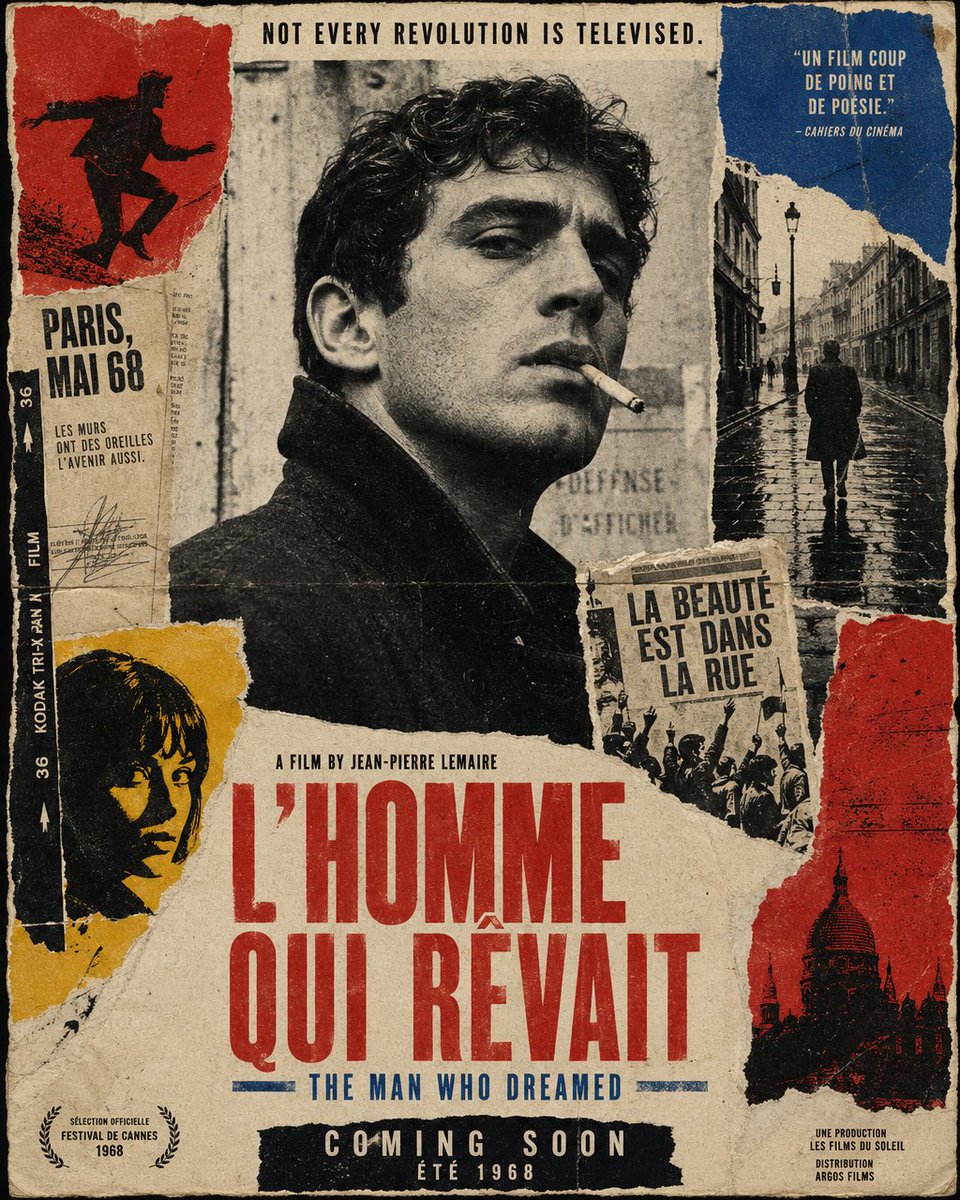
French New Wave Protest Film Poster
A distressed 1960s-style French art-house movie poster collage for creating rebellious vintage cinema graphics with torn paper, bold typography, and political street-poster energy.
This is a GPT Image 2 prompt case for Graphic & Poster. Use the copy-ready prompt below to generate similar visuals, and review Awesome GPT Image 2 Prompts attribution plus commercial-use rights before reuse.
Free 1K preview
Generate one preview image instantly, no sign-up required.
Prompt
Copy-ready prompt
Create a vintage French New Wave political cinema poster as a torn-paper collage, vertical one-sheet composition, aged and distressed like a weathered 1968 street poster pasted on a wall. Use a limited palette of cream paper, faded black, deep red, mustard yellow, and muted cobalt blue, with heavy analog film grain, halftone print texture, ink bleed, fold creases, scratches, rough paper fibers, ripped edges, glue stains, and slightly misregistered letterpress typography. In the center, place a large black-and-white portrait of a brooding young man in a dark coat, seen in three-quarter profile, cropped from chest up, Show every face clearly with natural, detailed facial features, giving the image a mysterious art-house feel. Surround the portrait with torn collage fragments: at upper left, a red paper panel with a black silhouette of a running protester; beneath it, a narrow off-white text strip reading “PARIS, MAI 68” and smaller French copy “LES MURS ONT DES OREILLES, L’AVENIR AUSSI.”; along the far left edge, a vertical black film-strip border with “36 KODAK TRI-X PAN FILM” in white; at lower left, a mustard-yellow torn panel with a cropped dark silhouette portrait; at upper right, a blue torn panel containing the quote “UN FILM COUP DE POING ET DE POÉSIE.” with “— CAHIERS DU CINÉMA” below; directly below that, a tall black-and-white photo fragment of a lone figure walking down a wet Paris street at night under lampposts; near the middle-right, a small torn newsprint block with the French slogan “LA BEAUTÉ EST DANS LA RUE” above a crowd scene; at lower right, a red torn panel with a black silhouette of a domed Paris landmark. Across the very top, centered in narrow black capitals, add the tagline “NOT EVERY REVOLUTION IS TELEVISED.” Near the lower middle, in small black condensed type, add “A FILM BY {argument name="director name" default="JEAN-PIERRE LEMAIRE"}”. Make the main title dominate the lower half in huge condensed red uppercase letters over torn cream paper: “{argument name="French title" default="L’HOMME QUI RÊVAIT"}”. Directly underneath, in smaller blue condensed capitals, add the English subtitle “{argument name="English subtitle" default="THE MAN WHO DREAMED"}”. At the bottom center, place a black strip with large white condensed capitals reading “COMING SOON”, and below it smaller text “ÉTÉ 1968”. In the bottom left corner, include a Cannes-style laurel mark with “SÉLECTION OFFICIELLE FESTIVAL DE CANNES 1968”. In the bottom right corner, add tiny production credits in French, including “UNE PRODUCTION LES FILMS DU SOLEIL DISTRIBUTION”. Keep the whole design asymmetrical, raw, rebellious, and elegant, evoking Godard, Truffaut, May 1968 protest graphics, and handmade French art-house poster collage.Prompt variables
Editable argument placeholders found in the prompt, with their default values.
Best for
- - Graphic & Poster visual exploration
- - Image generation and reference-image edits
- - Reusable briefs that keep source attribution visible
Change these parts
- - Subject, product, character, or scene
- - Aspect ratio, camera, lighting, and background
- - Brand, text, color, and output constraints
Recommended model and settings
- - Model: gpt-image-2
- - Input mode: Text to Image
- - Aspect ratio: source
- - Commercial status: review original source
How to use this prompt
- 1. Copy the prompt and preserve its structure for the first test.
- 2. Replace the subject, context, and publishing channel.
- 3. Change one camera, lighting, or style variable per iteration.
- 4. Inspect the output, source, text, and rights before reuse.
Limitations, source, and reuse cautions
- - Generated output is an editable draft, not factual, legal, or rights evidence.
- - Review the linked source, people, brands, logos, text, and third-party media before commercial use.
More cases in this category
Prioritized by category, input mode compatibility, quality, and lower risk.

Reuse and source notes
Use this prompt safely after previewing the case.
- 1.Copy the prompt or open it directly in Dovoo with the generation button.
- 2.Adjust variables, aspect ratio, and reference images for your own use case.
- 3.Before publishing or paid usage, verify source rights, attribution requirements, and brand or likeness risks.
Can I use this prompt commercially?
Commercial-use status is allowed. Review the original source, license, brand constraints, and legal requirements before paid usage.
Where does this case come from?
This case is imported from Awesome GPT Image 2 Prompts; keep attribution visible and check the source URL before reuse.