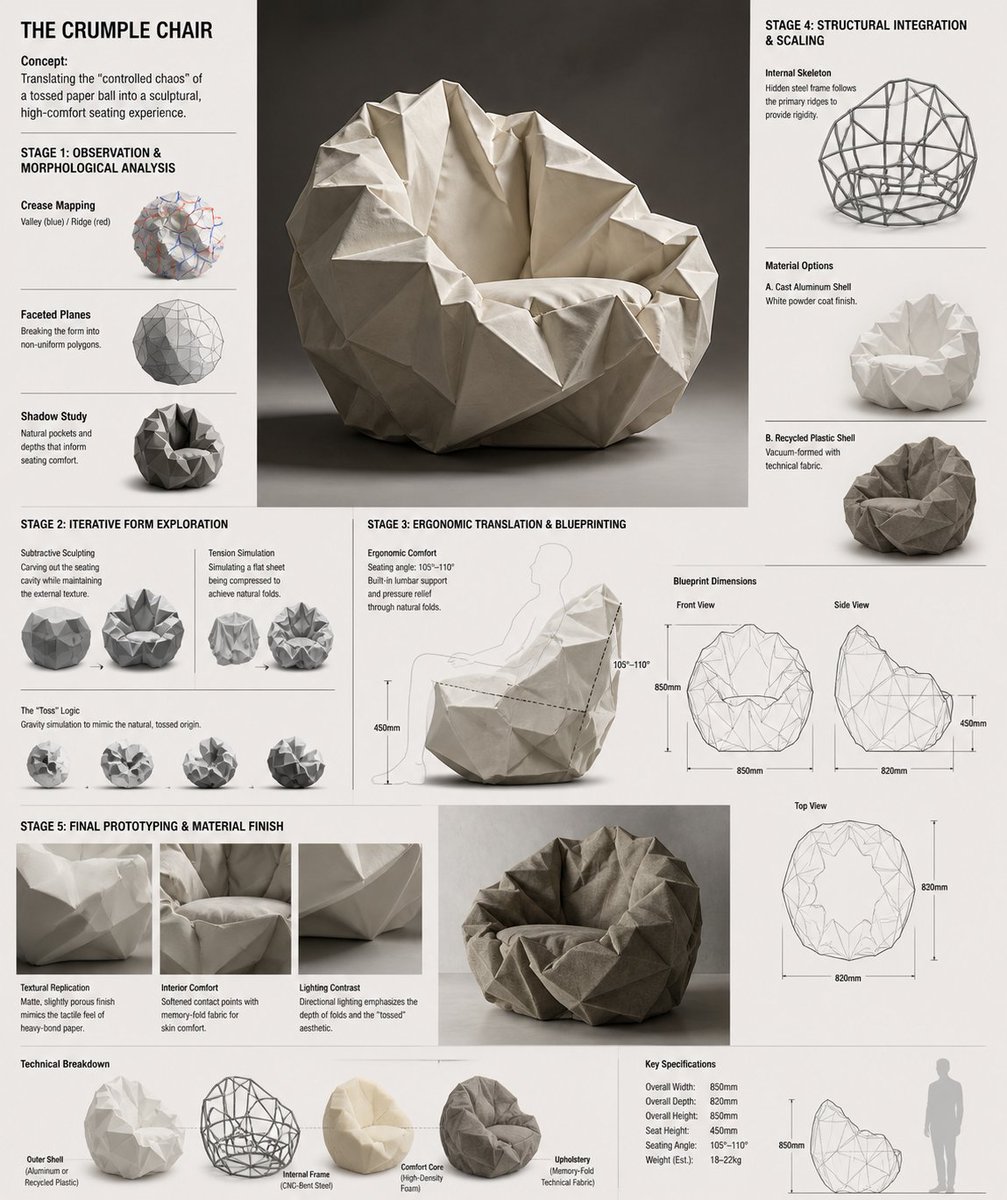
Crumple Paper Furniture Concept Design
An extensive architectural and product design prompt that translates the organic textures of crumpled paper into high-comfort sculptural furniture like chairs and sofas.
This is a gpt-image-2 prompt case for 产品商业. Use the copy-ready prompt below to generate similar visuals, and review Awesome Seedance 2.0 Video Prompts attribution plus commercial-use rights before reuse.
Prompt
Copy-ready prompt
Design concept:{argument name="furniture type" default="creased chair"} Core concept: to{argument name="inspiration" default="crumpled paper ball"} The “controlled chaos” is transformed into a sculptural and highly comfortable seating experience. Phase 1: Observation and Morphological Analysis. The goal is to deconstruct the imagery of crumpled paper into usable geometric data. Crease Mapping: Identify the main “valve lines” and “ridge lines.” These lines represent the chair’s potential structural ribs or seams. Multifaceted Planes: Decompose the sphere into a series of irregular polygons. Each plane of the paper becomes a potential panel for the chair’s upholstery or shell. Shadow Study: Analyze how the “crumpled” shape forms deep grooves. These natural pockets guide the placement of the user’s weight. Phase 2: Iterative Morphological Exploration. Transition from the sphere to the seat through “digital crumpling.” Subtractive Sculpting: Imagine the paper sphere as a solid entity. Use Boolean operations to “sculpt” a seat groove that is both ergonomic and retains the external jagged texture. Tension Simulation: Use 3D software (such as Rhino or Blender) to simulate the compression process of a flat material. This ensures that the creases look realistic, not “modeled.” "Throwing" Logic: Attempting to simulate gravity by dropping a digital grid and observing its natural settling, mimicking the primal feeling of "throwing." Phase Three: Ergonomic Transformation and Blueprinting elevate the primal aesthetic to a functional object. Comfort Core: Covering a standard ergonomic template (seat angle: 105°–110°) with a crumpled form. Adjusting internal "creases" to provide lumbar support and pressure relief. Blueprint Generation: Creating technical orthographic views (front, side, top). Planned Dimensions: Seat height: 450 mm, overall width: 850 mm. Surface Smoothing: Maintaining sharp "paper edges" on the outer shell while softening internal contact points to ensure a comfortable feel against the skin. Phase Four: Structural Integration and Scaling Make the Concept Physically Feasible. Skeleton: Designing a hidden internal frame (CNC bent steel rods or 3D printed lattices recommended) distributed along the most prominent ridges of the paper creases to provide rigidity. Material Selection: * Option A (High-end):{argument name="material" default="Multi-faceted cast aluminum"} Option B (Soft): Vacuum-formed recycled plastic shell covered with "memory crease" technical fabric to maintain the wrinkled appearance. Phase 5: Final Prototype and Material Finish Texture Replication: Apply a matte, microporous finish to the material to mimic the feel of heavy paper. Light and Shadow Contrast: Use directional studio lighting in the final rendering to emphasize the "crumpled" shadows, making the chair look like a huge, discarded piece of inspiration. Design Advice: To maintain the realism of the "crumpled" appearance, avoid symmetry.Prompt variables
Editable argument placeholders found in the prompt, with their default values.
More cases in this category
Prioritized by category, input mode compatibility, quality, and lower risk.



Reuse and source notes
Use this prompt safely after previewing the case.
- 1.Copy the prompt or open it directly in Dovoo with the generation button.
- 2.Adjust variables, aspect ratio, and reference images for your own use case.
- 3.Before publishing or paid usage, verify source rights, attribution requirements, and brand or likeness risks.
Can I use this prompt commercially?
Commercial-use status is restricted. Review the original source, license, brand constraints, and legal requirements before paid usage.
Where does this case come from?
This case is imported from Awesome Seedance 2.0 Video Prompts; keep attribution visible and check the source URL before reuse.