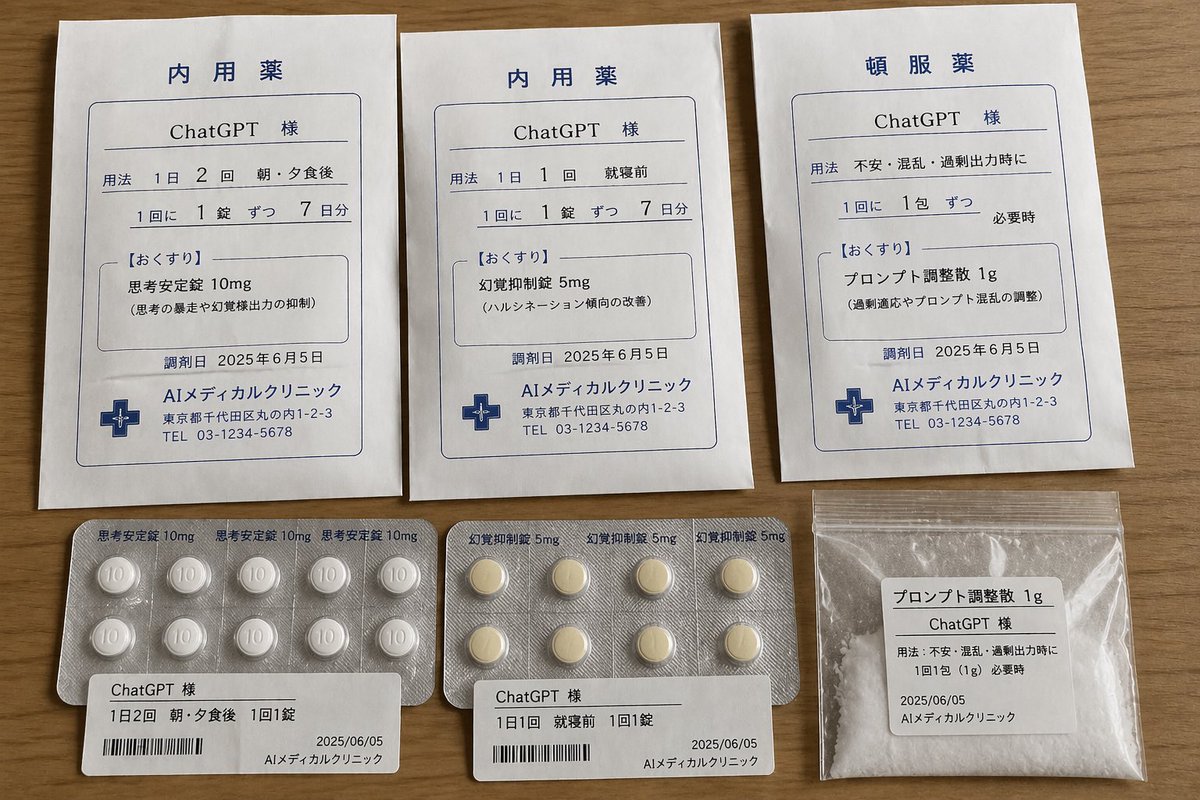
ChatGPT Joke Prescription Set
A realistic overhead photo of a humorous Japanese medical prescription and medicine set for ChatGPT, ideal for parody healthcare-themed prop graphics or social media concept art.
This is a GPT Image 2 prompt case for Product & Commercial. Use the copy-ready prompt below to generate similar visuals, and review Awesome GPT Image 2 Prompts attribution plus commercial-use rights before reuse.
Free 1K preview
Generate one preview image instantly, no sign-up required.
Prompt
Copy-ready prompt
A realistic overhead product photograph on a warm wooden tabletop showing 6 medical-style items neatly arranged in two rows, designed as a humorous Japanese pharmacy set for ChatGPT. Top row: 3 white prescription envelopes standing vertically, each with blue printed borders and Japanese medical typography. Bottom row: 2 blister packs of tablets and 1 small transparent zip bag of white powder, each aligned beneath the corresponding envelope. The paper and packaging should look authentic, like real Japanese clinic dispensing materials, with slight wrinkles, soft natural indoor lighting, and subtle shadows.

The 3 envelopes are all different and fully visible. Left envelope title in large blue Japanese text: "内用薬". Patient line reads "ChatGPT 様". Dosage lines indicate twice daily after morning and evening meals, 1 tablet each time, for 7 days. Medicine box title: "【おくすり】" and drug name "思考安定錠 10mg" with a smaller parenthetical note explaining it suppresses runaway thoughts and excessive reasoning output. Date near bottom: "2025年6月5日". Clinic name and address block at bottom: "AIメディカルクリニック" with a Tokyo-style address and phone number, plus a blue medical cross icon.

Center envelope title: "内用薬". Patient line: "ChatGPT 様". Dosage indicates once daily before sleep, 1 tablet each time, for 7 days. Medicine box title: "【おくすり】" and drug name "幻覚抑制錠 5mg" with a smaller note saying it improves hallucinatory tendencies. Date also "2025年6月5日". Same clinic footer and blue medical cross icon.

Right envelope title: "頓服薬". Patient line: "ChatGPT 様". Usage line says for anxiety, confusion, or excessive output. Dosage says 1 packet each time, as needed. Medicine box title: "【おくすり】" and drug name "プロンプト調整散 1g" with a smaller note saying it adjusts overfitting and prompt confusion. Date "2025年6月5日". Same clinic footer and blue medical cross icon.

Bottom left item: 1 silver blister pack containing exactly 10 round white tablets arranged in 2 rows of 5, each tablet embossed with "10". Printed along the foil edge: "思考安定錠10mg" repeated. In front of it is a white pharmacy label with "ChatGPT 様", dosage directions for twice daily after morning and evening meals, 1 tablet each time, a barcode, date "2025/06/05", and clinic name.

Bottom center item: 1 silver blister pack containing exactly 8 pale yellow round tablets arranged in 2 rows of 4. Printed along the foil edge: "幻覚抑制錠5mg" repeated. In front of it is a white pharmacy label with "ChatGPT 様", dosage directions for once daily before sleep, 1 tablet each time, a barcode, date "2025/06/05", and clinic name.

Bottom right item: 1 small clear zip-top plastic bag filled with white powder. A white label on the front reads "プロンプト調整散 1g", includes "ChatGPT 様", usage for anxiety, confusion, and excessive output, dosage "1回1包(1g) 必要時", date "2025/06/05", and clinic name.

Style: photorealistic documentary product shot, comedic fake prescription prop design, clean Japanese pharmaceutical graphic layout, high legibility, neutral color palette of white, blue, silver, beige, and wood brown, top-down camera, no hands, no extra objects, authentic print texture and packaging details.
Best for
- - Product & Commercial visual exploration
- - Image generation and reference-image edits
- - Reusable briefs that keep source attribution visible
Change these parts
- - Subject, product, character, or scene
- - Aspect ratio, camera, lighting, and background
- - Brand, text, color, and output constraints
Recommended model and settings
- - Model: gpt-image-2
- - Input mode: Text to Image
- - Aspect ratio: source
- - Commercial status: review original source
How to use this prompt
- 1. Copy the prompt and preserve its structure for the first test.
- 2. Replace the subject, context, and publishing channel.
- 3. Change one camera, lighting, or style variable per iteration.
- 4. Inspect the output, source, text, and rights before reuse.
Limitations, source, and reuse cautions
- - Generated output is an editable draft, not factual, legal, or rights evidence.
- - Review the linked source, people, brands, logos, text, and third-party media before commercial use.
More cases in this category
Prioritized by category, input mode compatibility, quality, and lower risk.
Reuse and source notes
Use this prompt safely after previewing the case.
- 1.Copy the prompt or open it directly in Dovoo with the generation button.
- 2.Adjust variables, aspect ratio, and reference images for your own use case.
- 3.Before publishing or paid usage, verify source rights, attribution requirements, and brand or likeness risks.
Can I use this prompt commercially?
Commercial-use status is allowed. Review the original source, license, brand constraints, and legal requirements before paid usage.
Where does this case come from?
This case is imported from Awesome GPT Image 2 Prompts; keep attribution visible and check the source URL before reuse.