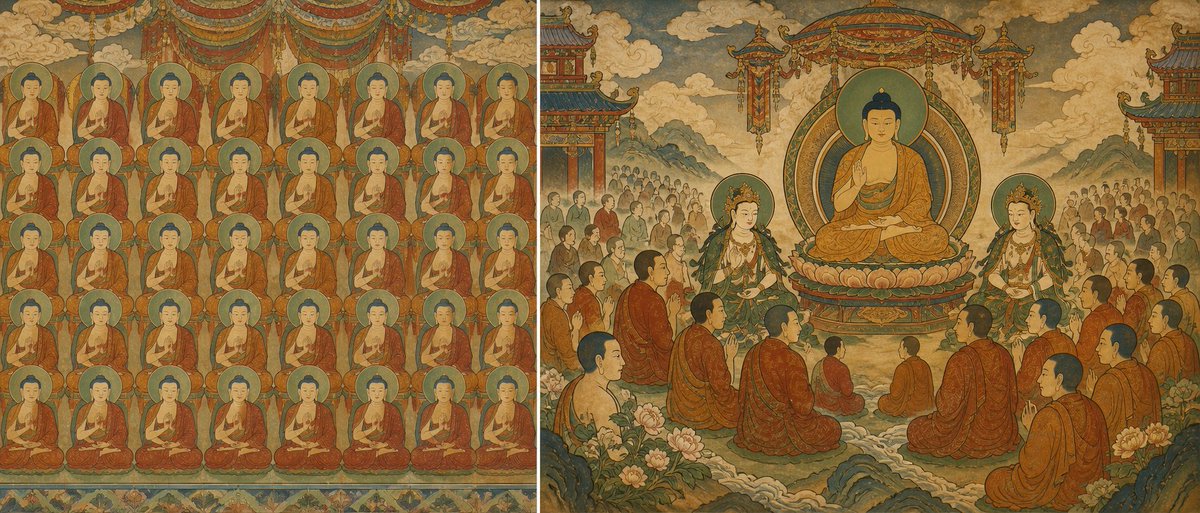
Buddhist Mural Composition Diptych
Generates a wide antique Buddhist fresco diptych contrasting a flat repeated Buddha grid with a layered sacred assembly for composition studies.
هذا GPT Image 2 لحالة الرسم والتوضيح الفني . استخدم النموذج الجاهز للنسخ أدناه لإنشاء صور مشابهة، وراجع حقوق الإسناد Awesome GPT Image 2 Prompts وحقوق الاستخدام التجاري قبل إعادة الاستخدام.
هل تحتاج إلى مجموعة كاملة من المطالبات؟ استخدم الرسم والتوضيح الفني للاطلاع على المزيد من الأمثلة ذات الصلة، أو افتح مركز المواضيع. GPT Image 2 كتالوج سريع للاطلاع على فهرس الأمثلة الكامل، والهياكل القابلة لإعادة الاستخدام، ونسب المصادر.
Free 1K preview
Generate one preview image instantly, no sign-up required.
3214/4000
المطالبة
نموذج جاهز للطباعة
Goal: Create a wide horizontal diptych comparing two Buddhist mural composition strategies in an aged Dunhuang / Chinese temple fresco style, showing the difference between a flat repetitive figure wall and a layered sacred assembly scene.

Canvas: Extra-wide panoramic image, about 2:1 aspect ratio, split vertically into two equal panels with no modern border, both panels painted on weathered tan plaster with faded mineral pigments, cracks, patina, and antique hand-painted texture.

Left panel: Depict a flat frontal mural filled with exactly 48 nearly identical seated Buddha figures arranged in a strict grid of 6 rows and 8 columns. Each Buddha has a round green-blue halo, dark blue hair, calm face, orange-red robe, and seated meditation pose. Keep the figures similar in size and spacing so the panel feels visually crowded and wall-like. Add decorative hanging canopy fabric at the top and a narrow floral border along the bottom. The background should be shallow, with almost no spatial depth.

Right panel: Depict a layered Pure Land / Buddhist court assembly with clear hierarchy, depth, and breathing space. Place exactly 1 large central Buddha seated on a lotus pedestal beneath an ornate circular mandorla and hanging canopy, making this the first visual focus. Flank the central Buddha with exactly 2 standing bodhisattvas, one on each side, wearing jeweled crowns, green and gold garments, and halos. Add exactly 14 larger foreground and midground monks seated or kneeling in orange-brown robes, arranged in curved rows that lead the eye toward the central Buddha. Behind them, include two distant crowd groups of many smaller worshippers on the left and right, intentionally reduced in scale and detail to create depth. Include layered mountains, cloud banks, temple pavilions at the far left and far right edges, lotus flowers, rocks, and soft misty pathways receding into the background.

Visual style: Ancient Chinese Buddhist mural, inspired by Dunhuang Pure Land paintings, Chaoyuan Tu-style hierarchical crowd composition, and Song/Yuan temple fresco aesthetics. Use muted mineral colors: ochre, sienna, cinnabar red, malachite green, teal blue, faded gold, ivory, and smoky gray. Lines should be delicate but aged, with hand-brushed outlines, flattened perspective, decorative symmetry, and subtle atmospheric depth on the right panel.

Composition intent: The left side must feel repetitive, dense, and spatially flat; the right side must feel organized, ceremonial, and deep, with hierarchy, foreground-middle-background separation, and intentional empty space around the central deity.

Text: No captions, no labels, no watermark, no modern typography.

Customizable subject: The central figure may be {argument name="central deity" default="Buddha"}; the mural tradition may be {argument name="mural tradition" default="Dunhuang Pure Land Buddhist fresco"}; the left grid count must remain {argument name="left panel figure count" default="48"}; the right main assembly should keep {argument name="foreground monk count" default="14"}; use an antique palette dominated by {argument name="primary color palette" default="ochre, cinnabar red, malachite green, teal blue, faded gold"}.
متغيرات المطالبة
عناصر نائبة قابلة للتعديل موجودة في موجه الأوامر، مع قيمها الافتراضية.
عامل
central deity
تقصير
Buddha
عامل
mural tradition
تقصير
Dunhuang Pure Land Buddhist fresco
عامل
left panel figure count
تقصير
48
عامل
foreground monk count
تقصير
14
عامل
primary color palette
تقصير
ochre, cinnabar red, malachite green, teal blue, faded gold
Best for
- - الرسم والتوضيح الفني visual exploration
- - Image generation and reference-image edits
- - Reusable briefs that keep source attribution visible
Change these parts
- - Subject, product, character, or scene
- - Aspect ratio, camera, lighting, and background
- - Brand, text, color, and output constraints
Recommended model and settings
- - Model: gpt-image-2
- - Input mode: تحويل النص إلى صورة
- - Aspect ratio: source
- - Commercial status: review original source
How to use this prompt
- 1. Copy the prompt and preserve its structure for the first test.
- 2. Replace the subject, context, and publishing channel.
- 3. Change one camera, lighting, or style variable per iteration.
- 4. Inspect the output, source, text, and rights before reuse.
Limitations, source, and reuse cautions
- - Generated output is an editable draft, not factual, legal, or rights evidence.
- - Review the linked source, people, brands, logos, text, and third-party media before commercial use.
مستورد من Awesome GPT Image 2 Prompts . يلزم ذكر المصدر. حالة الاستخدام التجاري هي allowed ؛ يرجى مراجعة حقوق المصدر قبل الاستخدام المدفوع.
المزيد من الحالات في هذه الفئة
يتم تحديد الأولويات حسب الفئة، وتوافق وضع الإدخال، والجودة، وانخفاض المخاطر.

إعادة استخدام الملاحظات ومصادرها
استخدم هذا التنبيه بأمان بعد معاينة الحالة.
- 1.انسخ الرسالة أو افتحها مباشرة في Dovoo باستخدام زر الإنشاء.
- 2.قم بتعديل المتغيرات ونسبة العرض إلى الارتفاع والصور المرجعية لتناسب حالة استخدامك الخاصة.
- 3.قبل النشر أو الاستخدام المدفوع، تحقق من حقوق المصدر، ومتطلبات الإسناد، ومخاطر العلامة التجارية أو التشابه.